
Clarify ownership
Define decision rights, accountable leaders, and practical reporting expectations.
Find exposure, strengthen essential controls, and build practical resilience around the systems your organization depends on.
Explore cybersecurity services →Evaluate controls independently, document defensible findings, and focus remediation on the risks with the greatest operational impact.
Explore security audits →Translate security obligations into clear evidence, accountable remediation, and a practical path toward audit or customer readiness.
Explore compliance services →Bring security governance, risk decisions, leadership communication, and improvement planning into one accountable executive program.
Explore vCISO services →Orange County Executive security leadership
Use vCISO security governance to connect business risk, technical reality, compliance evidence, accountable ownership, and a prioritized security decision.
CISO-led guidance from Ali Hassani, backed by 25+ years of IT, cybersecurity, compliance, and infrastructure experience.

A focused video briefing for leaders and IT teams working through this page.
Virtual CISO Leadership Series · Episode 01
Use this concise briefing alongside the guidance on this page to connect virtual ciso guidance with clear evidence, accountable ownership, and a practical next action.
Executive Cybersecurity Governance
Governance turns technical security work into a managed business process: who owns cyber risk, who approves decisions, what gets fixed first, what evidence is tracked, and how progress is reported to leadership.
The Problem Governance Solves
Firewalls, antivirus, backups, Microsoft 365, Azure, cloud services, VPNs, and endpoint tools are important. But tools alone do not create a security program. Governance creates structure for decisions, ownership, documentation, remediation, budget, and executive visibility.
Security work stalls when executives, IT teams, MSPs, vendors, and department leaders are not aligned on responsibility, authority, or priority.
Businesses may know they have risks, but lack a formal register, severity ratings, remediation owners, timelines, budget needs, and leadership visibility.
Policies, procedures, incident plans, vendor processes, and evidence records are often incomplete until a customer, insurer, auditor, or incident requires them.
What We Deliver
OC Security Audit helps your organization turn cybersecurity into a managed business process with clear priorities, assigned ownership, documented controls, and executive-ready reporting.
Roles, responsibilities, decision rights, meeting cadence, escalation paths, and risk acceptance process.
Risk ratings, business impact, remediation plans, ownership, due dates, accepted risks, and reporting status.
Prioritized improvements across identity, cloud, network, endpoints, backups, policies, and compliance readiness.
Access control, MFA, remote access, incident response, vendor security, backup, data protection, acceptable use, and change management.
KPI/KRI summaries, remediation tracking, blocked items, budget needs, and board-ready security updates.
Documentation organization, control review, evidence tracking, and preparation support for customer, insurance, and audit expectations.
Who We Work With
Our security governance service is designed to work with your existing people and partners. We do not replace your IT team. We help create direction, accountability, risk visibility, and executive alignment.
Our Governance Process
The engagement helps leadership understand risk, set priorities, assign owners, track progress, and report cybersecurity status clearly.
Understand goals, technology, compliance needs, IT support model, risks, and business concerns.
Review ownership, policies, reporting, risk decisions, documentation, and accountability.
Document risks with priority, ownership, remediation path, due dates, and status.
Develop a practical security roadmap based on risk, cost, urgency, and business impact.
Provide executive reporting on risk, progress, budget needs, and decisions required.
Update risks, track remediation, refresh policies, improve maturity, and validate progress.
Governance Deliverables
The exact deliverables depend on your environment, but a CISO governance engagement commonly includes these business-ready outputs.
| Deliverable | Purpose | Business Value |
|---|---|---|
| Governance Charter | Defines security roles, responsibilities, decision-making, and reporting cadence. | Clarifies who owns cybersecurity and how decisions are made. |
| Cyber Risk Register | Documents risks, ratings, business impact, owners, remediation, and status. | Gives executives visibility into what matters most. |
| Security Roadmap | Prioritizes improvements across identity, cloud, network, endpoints, backup, policies, and compliance readiness. | Turns cybersecurity into a practical plan instead of scattered tasks. |
| Policy and Procedure Set | Creates or improves security policies and procedures needed for operations and readiness. | Supports consistency, accountability, training, and compliance preparation. |
| Executive Security Report | Summarizes risk, progress, blocked items, budget needs, and leadership decisions required. | Helps executives and boards understand security in business terms. |
| Remediation Tracker | Tracks assigned security tasks, owners, deadlines, evidence, and completion status. | Improves accountability across IT, MSPs, vendors, and leadership. |
| Compliance Readiness Gap Review | Assesses control gaps, documentation needs, and evidence readiness for relevant frameworks. | Helps prepare for customer, insurance, audit, and compliance expectations. |
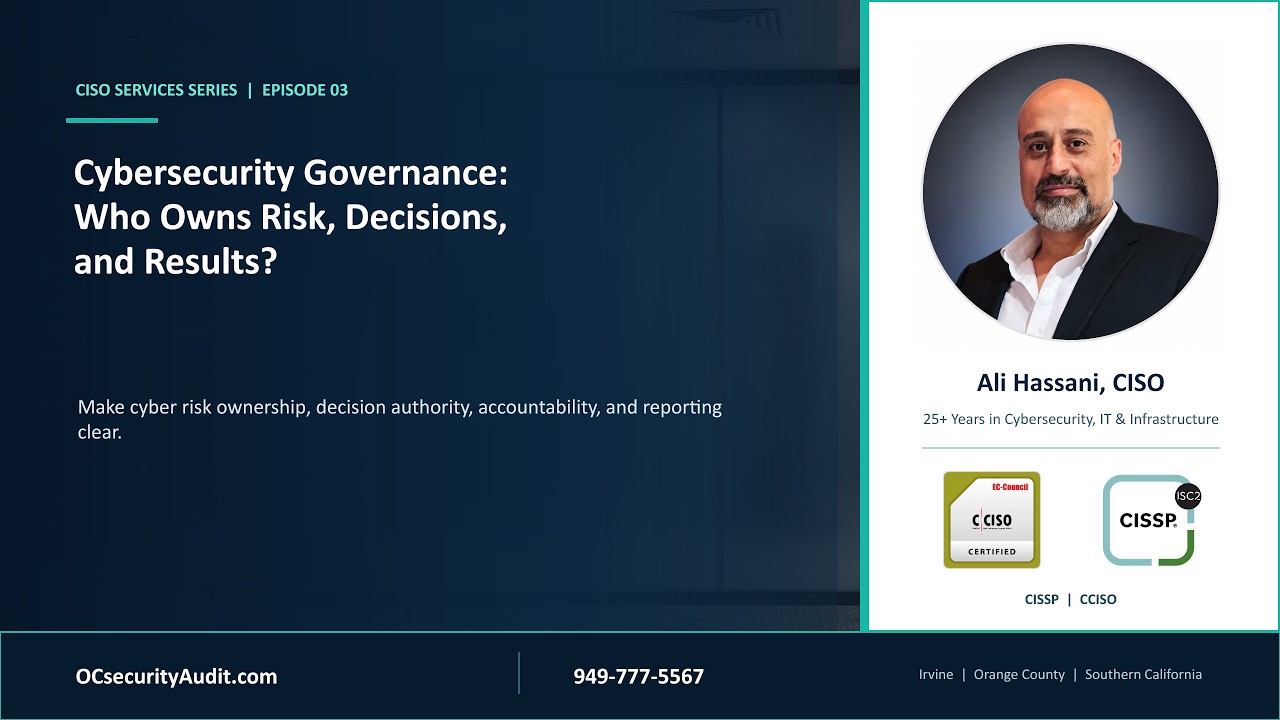
A focused video briefing for leaders and IT teams working through this page.
Virtual CISO Leadership Series · Episode 03
Use this concise briefing alongside the guidance on this page to connect cyber risk ownership with clear evidence, accountable ownership, and a practical next action.

Executive Leadership Profile
Ali Hassani brings hands-on experience across cybersecurity, compliance auditing, Microsoft infrastructure, Cisco networking, cloud security, firewalls, vulnerability management, and IT operations. His vCISO guidance helps leaders make defensible decisions, assign accountability, and turn security priorities into measurable business progress.
Define decision rights, accountable leaders, and practical reporting expectations.
Connect infrastructure and control weaknesses to business impact and priorities.
Organize evidence, remediation, and executive metrics around measurable outcomes.

Related Services and Next Steps
After executive decisions and risk direction are set, organizations usually need practical delivery support across infrastructure, endpoint security, cloud reliability, and managed operations.
Local Southern California Focus
Local businesses need cybersecurity governance that understands modern threats and the realities of operating a growing organization in Southern California. We help leadership make practical security decisions that protect operations, reputation, customer trust, and compliance readiness.
Support for business owners, IT managers, healthcare practices, professional services, and growing companies that need cybersecurity leadership.
Governance, risk, and compliance guidance for organizations that need better oversight across complex technology and vendor environments.
Practical vCISO leadership for companies that need accountability, documentation, and a clear path from risk findings to remediation.
Frequently Asked Questions
CISO security governance is the leadership structure that helps an organization make cybersecurity decisions, assign accountability, manage risk, approve policies, track remediation, and report security priorities to executives and business owners.
Security governance helps leadership understand risk, prioritize cybersecurity investments, assign owners to remediation tasks, improve compliance readiness, strengthen policies, and make sure IT security work supports business goals.
Yes. OC Security Audit works with executives, owners, IT managers, MSPs, vendors, and department leaders to guide cybersecurity strategy, risk management, policy development, executive reporting, and accountability without replacing your existing IT team.
Yes. Security governance supports compliance readiness by organizing policies, controls, risk decisions, documentation, remediation tracking, and executive oversight for frameworks such as HIPAA, PCI DSS, SOC 2, NIST, ISO 27001, and CMMC readiness.
Most organizations benefit from monthly or quarterly governance meetings, with annual policy reviews, recurring risk register updates, and additional reviews during audits, incidents, major technology changes, cyber insurance renewals, or customer security reviews.

A focused video briefing for leaders and IT teams working through this page.
Virtual CISO Leadership Series · Episode 08
Use this concise briefing alongside the guidance on this page to connect executive cybersecurity reporting with clear evidence, accountable ownership, and a practical next action.
From authority to operating proof
If leaders disagree about priorities, a CISO-led risk assessment can connect scenarios, business impact, owners, and treatment. If approved expectations are not consistently followed, security policies and procedures translate authority into standards, operating steps, evidence, and managed exceptions.
When executives need to see whether governance is working, use executive and board cybersecurity reporting to track material risk, decisions, trends, and residual exposure. Start with the free Executive Cyber Risk Scorecard or review Ali Hassani’s CISO leadership experience.
The Business Technology Risk Navigator helps business owners, CISOs, CIOs, IT managers, MSPs, and technical teams review cybersecurity, compliance, Microsoft 365, Azure, network, backup, endpoint, vulnerability, vendor, and incident-response readiness in one guided workflow.
For security governance and risk ownership, the navigator is useful when leadership needs a faster way to see what is verified, what is uncertain, which areas create business exposure, and what should become a prioritized remediation plan.
This website uses essential cookies for security and operation. Optional analytics and advertising cookies help measure site use and outreach. Choose Allow or Deny. You can change your choice at any time.