Ransomware recovery
Review immutable backup options, separation of duties, clean restore paths, identity protection, and recovery from encrypted or deleted systems.
Find exposure, strengthen essential controls, and build practical resilience around the systems your organization depends on.
Explore cybersecurity services →Evaluate controls independently, document defensible findings, and focus remediation on the risks with the greatest operational impact.
Explore security audits →Translate security obligations into clear evidence, accountable remediation, and a practical path toward audit or customer readiness.
Explore compliance services →Bring security governance, risk decisions, leadership communication, and improvement planning into one accountable executive program.
Explore vCISO services →
Orange County Technical security implementation
CISO-led business continuity and disaster recovery guidance, focused on business risk, the affected environment, available evidence, and practical next steps.
CISO-led guidance from Ali Hassani, backed by 25+ years of IT, cybersecurity, compliance, and infrastructure experience.
Business continuity and disaster recovery planning helps your organization keep critical operations running, restore systems cleanly, and explain recovery readiness to leadership, auditors, customers, insurance reviewers, and legal or compliance teams.
A professional BCDR program connects backup technology, cybersecurity controls, people, communication plans, recovery priorities, restore testing, and evidence. It should answer practical questions: what must come back first, how quickly it must recover, how much data can be lost, who approves the recovery path, and how recovery will be proven.
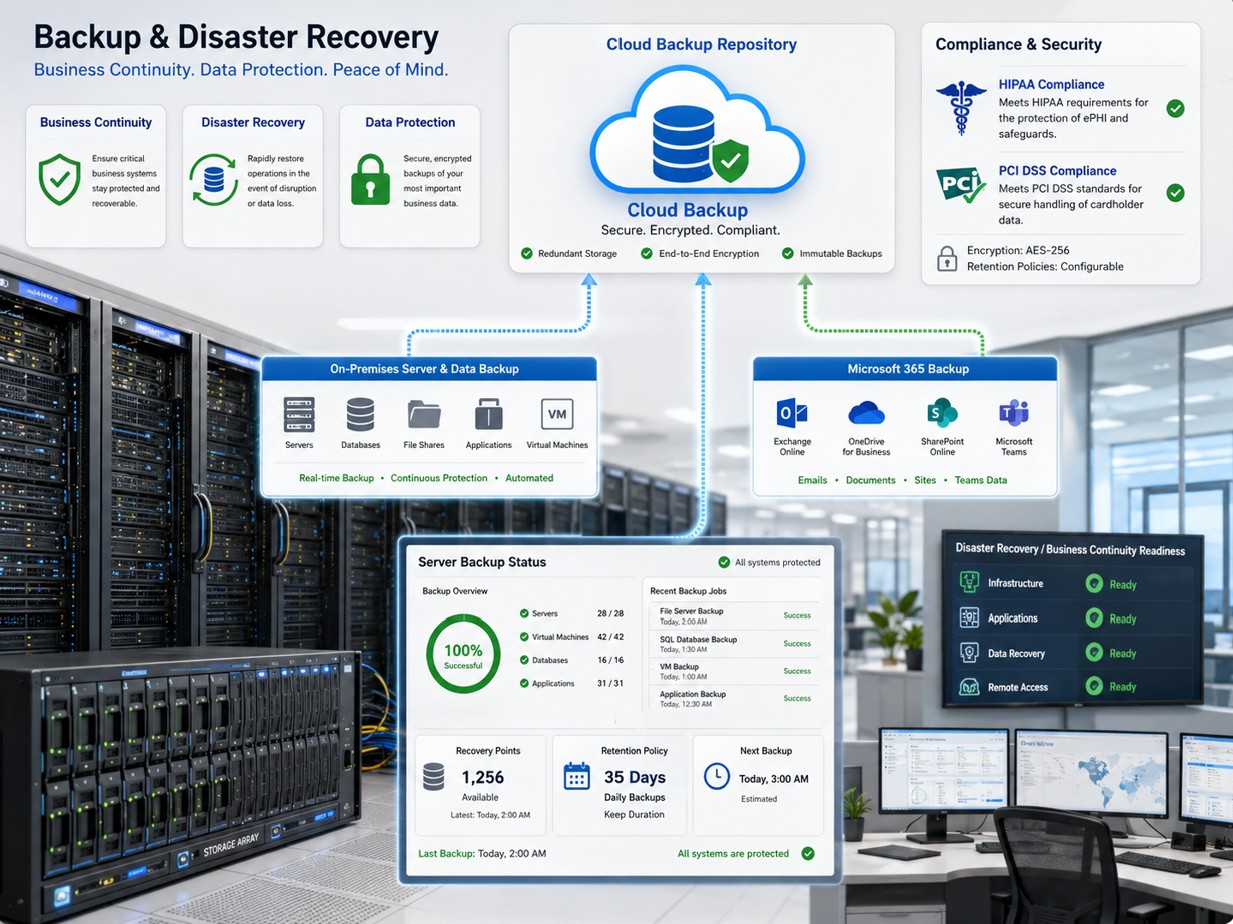
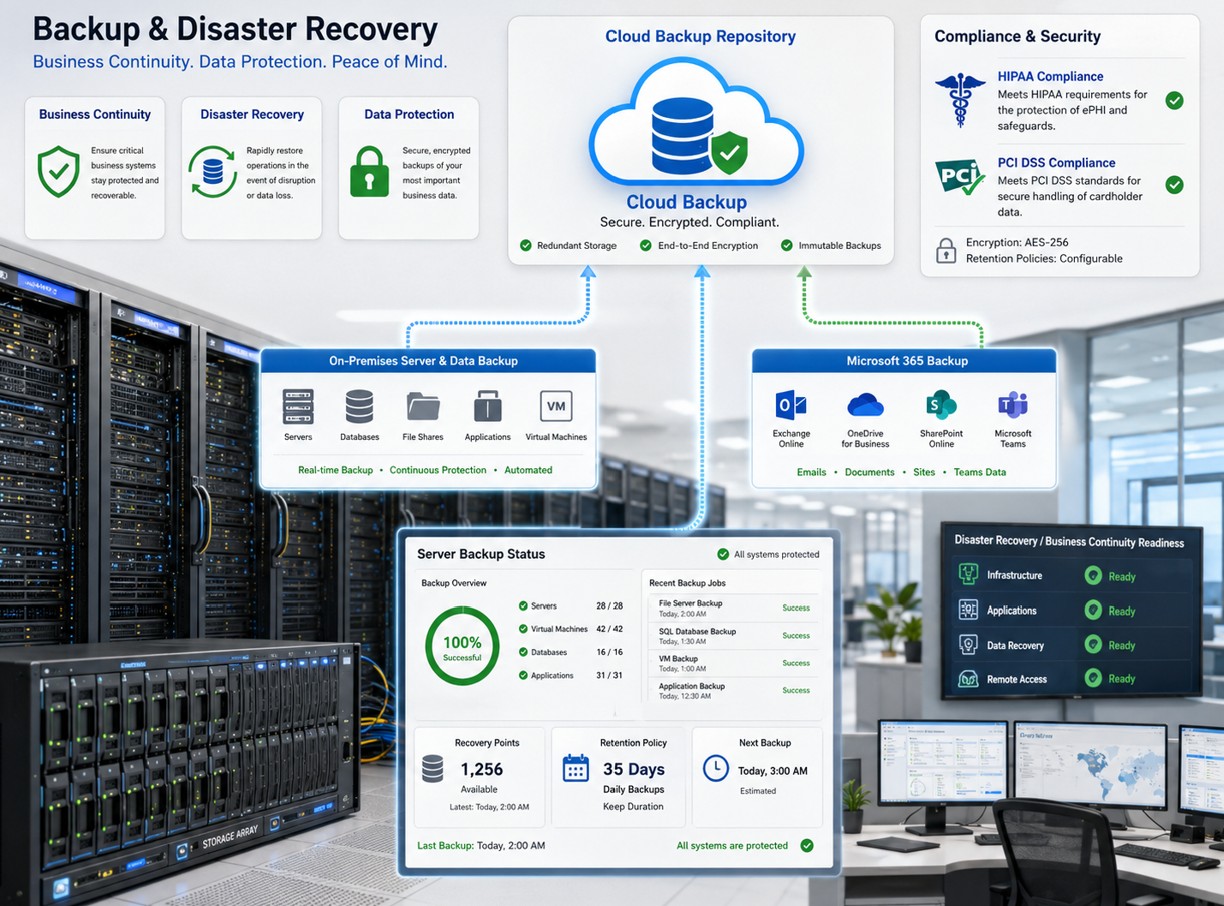
Backups are valuable only when they are protected, monitored, restorable, and documented. OC Security Audit reviews your recovery posture from a cybersecurity and business risk perspective.
Review immutable backup options, separation of duties, clean restore paths, identity protection, and recovery from encrypted or deleted systems.
Evaluate backup access, retention, MFA, administrative roles, network segmentation, logging, alerting, and vendor configuration.
Document restore tests, recovery screenshots, success criteria, exceptions, ownership, remediation, and business approval.
Review Microsoft 365, Azure, server, endpoint, SaaS, email, SharePoint, OneDrive, and Teams recovery assumptions.
Align BCDR evidence with HIPAA, PCI DSS, SOC 2, NIST CSF, ISO 27001, CMMC, customer reviews, and insurance requirements.
Translate technical recovery gaps into business impact, decision points, budgets, timelines, and practical next steps.

BCDR planning should account for cyber events and ordinary operational failures. Your recovery strategy should not depend on a single backup job, one administrator, one vendor, or undocumented assumptions.
OC Security Audit helps identify gaps, prioritize recovery risks, document requirements, and create a realistic plan your team can use before an outage turns into a crisis.
Review backup coverage, dependencies, restore history, ownership, recovery priorities, and gaps.
Define critical systems, acceptable downtime, data loss tolerance, business owners, and recovery order.
Assess server, cloud, Microsoft 365, endpoint, database, and SaaS backup protection.
Create actionable recovery procedures, escalation paths, communication plans, and test criteria.
Validate recovery through sample restores, documented evidence, lessons learned, and remediation actions.
Review immutable backup options, clean restore workflows, privileged access, and incident decision points.
Prepare documentation for HIPAA, PCI DSS, SOC 2, NIST, ISO 27001, CMMC, and insurance reviews.
Prioritize improvements by business impact, risk reduction, timeline, and practical implementation effort.
Every BCDR engagement should produce useful findings, plain-English explanations, and next steps your business can act on.
Confirm systems, data, business processes, backup tools, vendors, compliance drivers, and recovery goals.
Map RTO, RPO, dependencies, business impact, and the systems that must recover first.
Review configurations, backup schedules, restore history, access controls, alerts, and ransomware resilience.
Document findings, evidence, remediation priorities, testing cadence, and an executive-ready roadmap.
Free self-assessment tools help business owners, IT managers, and executives quickly review common gaps before a customer review, insurance renewal, ransomware concern, compliance project, or leadership discussion. These tools are for initial guidance only and do not replace a professional cybersecurity audit, compliance assessment, penetration test, or legal/compliance review.
Different industries recover from different risks. OC Security Audit links BCDR planning to the systems, data, vendors, compliance requirements, and business processes that matter most in your environment.
Healthcare clinics and dental offices need continuity plans that protect patient scheduling, PHI, EHR access, Microsoft 365, imaging systems, billing, and vendor-supported platforms. Start with HIPAA compliance readiness, cybersecurity risk assessment, or a BCDR review focused on patient care disruption.
CPA firms and tax preparers need backup resilience for tax files, client portals, email, workstation access, scanned documents, and IRS WISP expectations. Pair BCDR planning with IRS WISP readiness, Microsoft 365 email security, and secure client data retention.
Law firms, real estate companies, and nonprofit organizations often need recovery plans for case files, escrow and transaction records, donor databases, email evidence, wire fraud exposure, and vendor platforms. BCDR planning helps leadership understand operational downtime before a real incident.
Manufacturers, construction companies, and engineering firms need recovery planning for production files, drawings, project systems, accounting, endpoints, remote access, and network equipment. OC Security Audit can connect recovery readiness with network vulnerability assessment, firewall security audits, and vCISO guidance.

OC Security Audit is led by Ali Hassani, CISO, with hands-on experience across IT operations, network security, Microsoft infrastructure, compliance readiness, backup planning, cloud security, firewall security, and executive cybersecurity guidance.
Certifications include CISSP, CCISO, CCNP, CCNA, MCSE, MCSA Security, MCITP, MCP, and MCTS. The goal is practical guidance that helps owners, IT managers, CISOs, CIOs, and compliance leaders make better recovery decisions.
OC Security Audit can assess, validate, document, and prioritize BCDR risk. When a business needs managed IT execution, backup configuration, endpoint work, Microsoft 365 support, Azure support, server projects, or network improvements, Ali’s IT Perfection team can help with implementation and ongoing support.
This keeps the roles clear: OC Security Audit provides cybersecurity, audit, compliance, and vCISO guidance; IT Perfection provides managed IT, co-managed IT, Microsoft 365, Azure, endpoint, backup, server, help desk, and infrastructure support when that is the right path.
Answers about BCDR scope, backup validation, restore testing, ransomware recovery, compliance evidence, and local support.
Business continuity and disaster recovery is the planning, technology, documentation, and testing used to keep critical operations running and recover systems, data, and services after a disruption.
No. Backup is one part of disaster recovery. A complete BCDR program also includes recovery objectives, documented procedures, restore testing, communication plans, access controls, business priorities, and evidence.
Most businesses should perform restore tests at least annually and after major infrastructure, cloud, vendor, or compliance changes. Higher-risk systems may need more frequent validation.
Yes. Cyber insurance applications and renewals often ask about backups, MFA, EDR, incident response, privileged access, vulnerability management, ransomware recovery, and restore testing. A BCDR review can help organize that evidence.
Yes. OC Security Audit supports Irvine, Orange County, Los Angeles County, and Southern California businesses with onsite and remote cybersecurity, BCDR, compliance, and vCISO services.
Start with a focused consultation or a free self-assessment to identify backup, recovery, ransomware, compliance, and cyber insurance readiness gaps.
This website uses essential cookies for security and operation. Optional analytics and advertising cookies help measure site use and outreach. Choose Allow or Deny. You can change your choice at any time.