Governance
Leadership creates the structure, accountability, and oversight needed for cybersecurity and HIPAA compliance to operate effectively.
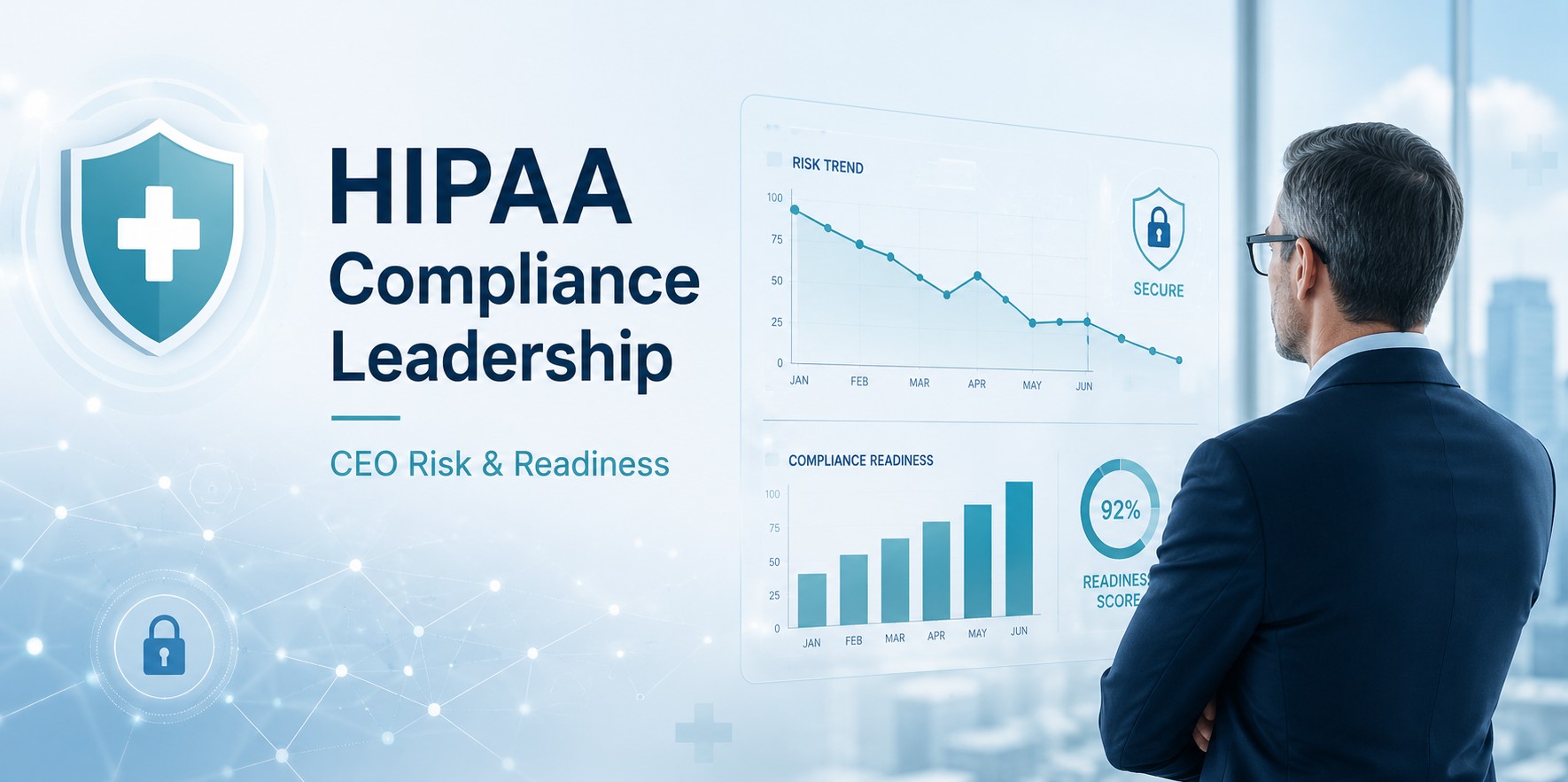
HIPAA compliance and cybersecurity are not only IT responsibilities. CEOs and business owners must approve, fund, monitor, assign, and enforce the security and compliance programs that protect sensitive information, patient data, business operations, and organizational trust.
In today’s digital business environment, cybersecurity is no longer only a technical concern. It is a leadership responsibility, a compliance requirement, and a core part of protecting business operations, customer trust, patient privacy, and sensitive data.
For healthcare organizations, medical practices, business associates, and companies handling protected health information, HIPAA compliance must be taken seriously at the executive level. Many CEOs and business owners mistakenly believe HIPAA is only an IT problem. While IT plays an important role, leadership is responsible for making sure the compliance program is funded, approved, assigned, reviewed, documented, and enforced.
Leadership creates the structure, accountability, and oversight needed for cybersecurity and HIPAA compliance to operate effectively.
Executives must ensure the organization protects sensitive data, electronic protected health information, systems, networks, users, and vendors.
Security failures can create business interruption, regulatory exposure, legal concerns, loss of trust, and financial damage.
OC Security Audit helps organizations strengthen cybersecurity, reduce compliance risk, and build practical security programs that leadership can understand and manage.
Cybersecurity threats continue to increase across every industry. Ransomware, phishing, data breaches, cloud misconfigurations, weak passwords, insider misuse, vendor risk, and regulatory pressure all create serious exposure for businesses.
Organizations need more than basic IT support. They need a structured cybersecurity and compliance approach that identifies risk, prioritizes remediation, protects sensitive data, and supports long-term business resilience.
OC Security Audit is led by Ali Hassani, a cybersecurity and IT professional with more than 25 years of experience in network engineering, system administration, IT leadership, cybersecurity engineering, compliance, and security audits.
This background allows OC Security Audit to approach cybersecurity from both the technical and executive sides. Strong cybersecurity is not only about tools. It requires understanding business risk, network architecture, user behavior, compliance requirements, vendor exposure, data protection, incident response, and leadership accountability.
OC Security Audit provides cybersecurity audits, HIPAA compliance consulting, vulnerability assessments, compliance gap analysis, risk assessments, PCI-DSS readiness, NIST assessments, ISO 27001 support, SOC 2 readiness, vCISO services, and executive cybersecurity guidance.
The goal is simple: help organizations understand their risk, improve their defenses, meet compliance obligations, and make better security decisions.
HIPAA compliance is not only the responsibility of IT, the compliance officer, or frontline staff. CEOs, business owners, and executive leaders play a critical role in making sure the organization protects patient information properly.
A firewall cannot approve policies. A server cannot assign accountability. An IT manager cannot always approve budget, vendor decisions, or organizational priorities without executive support. That is why HIPAA compliance and cybersecurity excellence must start at the top.
| HIPAA Area | Leadership Connection |
|---|---|
| Policies and procedures | Leadership must approve and enforce them. |
| Workforce training | Leadership must require participation and accountability. |
| Security risk assessments | Leadership must review risk and approve remediation. |
| Vendor management | Leadership must make sure business associates are properly reviewed. |
| Incident response | Leadership must know what happens after a breach. |
| Budgeting | Leadership must fund needed safeguards. |
| Documentation | Leadership must ensure compliance activity is recorded. |
Leadership does not need to personally complete every HIPAA task. However, leadership must make sure the work is assigned, funded, reviewed, and enforced.
HIPAA policies define how the organization protects patient information, controls access, responds to incidents, trains employees, manages vendors, and handles sensitive data.
Policies are not just paperwork. They are the official rules of the organization.
HIPAA compliance requires resources. Leadership must fund the tools, people, training, and services needed to protect PHI and ePHI.
Underfunding cybersecurity creates compliance risk, operational risk, and reputational risk.
Someone must own HIPAA compliance inside the organization. If everyone assumes someone else is responsible, then no one truly owns the program.
Responsibility should be clearly assigned and documented.
A HIPAA security risk assessment should not be completed and then ignored. Leadership must review risk assessment findings and understand what they mean for the business.
Vendors can create serious HIPAA exposure. Leadership should make sure the organization has a vendor oversight process before PHI is shared with outside companies.
Leadership must know what happens after a suspected breach, ransomware event, lost device, unauthorized access issue, or vendor incident.
| Leadership Responsibility | Why It Matters |
|---|---|
| Approving policies | Creates accountability and makes HIPAA requirements official across the organization. |
| Funding cybersecurity | Compliance requires tools, training, staffing, monitoring, and remediation budget. |
| Assigning responsibility | Someone must clearly own HIPAA privacy, security, and compliance activities. |
| Reviewing risk reports | Leadership must understand business risk, not just technical details. |
| Vendor oversight | Business associates and outside vendors can create HIPAA exposure. |
| Incident response | Leadership must know what happens after a breach or suspected security incident. |
A strong HIPAA program requires shared responsibility. The CEO, IT manager, compliance officer, and employees all have different roles.
| HIPAA Area | CEO / Business Owner | IT Manager | Compliance Officer | Employees |
|---|---|---|---|---|
| Policy Approval | Approves and enforces policies | Provides technical input | Drafts and maintains policies | Follows policies |
| Cybersecurity Budget | Funds required safeguards | Recommends tools and controls | Identifies compliance needs | Uses systems responsibly |
| Risk Assessment | Reviews business-level risk | Provides system and technical details | Coordinates assessment and documentation | Reports workflow risks |
| Access Control | Approves accountability standards | Manages accounts, permissions, and authentication | Reviews access policies | Uses only authorized access |
| Vendor Management | Requires vendor oversight | Reviews technical vendor risks | Tracks BAAs and vendor compliance | Uses approved vendors only |
| Incident Response | Makes executive decisions | Investigates technical issues | Coordinates documentation and notifications | Reports suspected incidents quickly |
Use this checklist as a leadership tool to track HIPAA compliance responsibilities at the executive level. CEOs and business owners can use it to confirm that key compliance tasks are assigned, funded, reviewed, documented, and followed up on.
| # | Checklist Item | Description | Personnel Assigned | Leadership Responsibility | Next Step | Status | Review Frequency | Notes / Evidence |
|---|---|---|---|---|---|---|---|---|
| 1 | Assign a HIPAA Security Officer | Identify the person responsible for overseeing HIPAA security requirements, safeguards, and risk management. | CEO / Owner, Security Officer, IT Manager | Formally assign responsibility and document the role. | Name the responsible person and update internal documentation. | Needs Review | Annually or when roles change | Appointment letter, job description, org chart |
| 2 | Assign a Privacy Officer or Compliance Lead | Designate someone to manage HIPAA privacy policies, patient information practices, documentation, and workforce compliance. | CEO / Owner, Privacy Officer, Compliance Officer | Ensure privacy responsibilities are clearly owned. | Confirm who owns privacy and compliance duties. | Needs Review | Annually | Role assignment, compliance records |
| 3 | Approve HIPAA Privacy and Security Policies | Review and approve written policies that explain how PHI and ePHI are protected across the organization. | CEO / Owner, Compliance Officer, IT Manager | Approve policies and require organization-wide enforcement. | Schedule policy review and leadership approval. | In Progress | Annually or after major changes | Signed policy approval, policy manual |
| 4 | Complete a HIPAA Security Risk Assessment | Identify risks to electronic protected health information, including systems, users, vendors, and workflows. | Security Officer, IT Manager, Compliance Officer, External Consultant | Require the assessment and review the results. | Schedule or update the risk assessment. | High Priority | At least annually | Risk assessment report |
| 5 | Review Risk Assessment Findings with Leadership | Make sure executives understand the organization’s highest HIPAA, cybersecurity, and business risks. | CEO / Owner, Executive Team, Security Officer, Compliance Officer | Review risk at the business level and set priorities. | Hold a leadership risk review meeting. | In Progress | Quarterly or annually | Meeting minutes, risk summary |
| 6 | Approve a Remediation Plan | Create a written plan to fix risks found during the assessment, including owners, deadlines, and priorities. | CEO / Owner, IT Manager, Compliance Officer | Approve priorities, timelines, and accountability. | Create a remediation tracker with due dates. | High Priority | Monthly until resolved | Remediation plan, task tracker |
| 7 | Fund Required Cybersecurity Improvements | Allocate budget for tools, services, training, monitoring, backups, access controls, and other safeguards. | CEO / Owner, CFO, IT Manager, Security Officer | Provide budget needed to reduce risk. | Review risk items that require funding. | Needs Review | Budget cycle / quarterly | Approved budget, invoices, project plans |
| 8 | Maintain Signed Business Associate Agreements | Confirm that required vendors handling PHI or ePHI have signed Business Associate Agreements. | Compliance Officer, Vendor Manager, Legal Counsel, CEO / Owner | Require vendor accountability before PHI is shared. | Build or update the vendor BAA list. | In Progress | Quarterly or when vendors change | Signed BAAs, vendor inventory |
| 9 | Train Employees on HIPAA and Security Responsibilities | Make sure workforce members understand HIPAA rules, phishing risks, incident reporting, passwords, and PHI handling. | Compliance Officer, HR, IT Manager, Department Managers | Require training and enforce completion. | Assign training and track completion. | In Progress | New hire and annually | Training logs, certificates |
| 10 | Implement Access Controls and Authentication Standards | Ensure users only access the PHI or ePHI needed for their role and that accounts are properly protected. | IT Manager, Security Officer, Department Managers | Require access accountability and approve standards. | Review user access and authentication controls. | High Priority | Quarterly | Access review reports, MFA records |
| 11 | Require Secure Backup and Disaster Recovery Processes | Confirm that critical systems and data are backed up, recoverable, and protected from ransomware or system failure. | IT Manager, Security Officer, Managed IT Provider | Ensure business continuity and recovery planning are funded and tested. | Review backup status and recovery testing results. | Needs Review | Quarterly or semiannually | Backup reports, recovery test results |
| 12 | Document Incident Response Procedures | Create a written plan for responding to suspected breaches, security incidents, ransomware, lost devices, or unauthorized access. | CEO / Owner, Security Officer, IT Manager, Compliance Officer, Legal Counsel | Approve the response structure and decision-making process. | Review or create the incident response plan. | High Priority | Annually | Incident response plan |
| 13 | Test the Incident Response Plan | Practice the incident response process so leadership and staff know what to do during a real event. | CEO / Owner, IT Manager, Compliance Officer, Department Leads | Participate in or review tabletop exercise results. | Schedule a tabletop exercise. | Needs Review | Annually | Test results, after-action report |
| 14 | Review Compliance Status Periodically | Establish regular leadership reviews of HIPAA risk, open remediation items, training, vendor issues, and incidents. | CEO / Owner, Compliance Officer, Security Officer, IT Manager | Keep HIPAA visible as an ongoing business priority. | Add HIPAA compliance to leadership meeting agenda. | In Progress | Quarterly | Meeting notes, compliance dashboard |
| 15 | Keep Documentation Organized and Available | Maintain records showing policies, training, risk assessments, BAAs, incident reports, access reviews, and remediation efforts. | Compliance Officer, Security Officer, HR, IT Manager | Require documentation that proves compliance activity. | Create a centralized HIPAA documentation folder or system. | Complete | Quarterly | Document repository, audit folder |

Needs immediate attention due to risk, deadline, or exposure.
The item exists or is planned but needs leadership or compliance review.
Work has started but is not complete.
The item has been completed and documented.
These questions help turn HIPAA from a vague concern into a managed business process.
| Question | Why It Matters |
|---|---|
| When was our last HIPAA security risk assessment completed? | Confirms whether risk review is current. |
| What were the highest risks identified? | Helps leadership focus on priority issues. |
| Do we have a written remediation plan? | Shows whether findings are being addressed. |
| Who is responsible for HIPAA privacy and security? | Confirms accountability. |
| Are our policies current and approved? | Supports governance and enforcement. |
| Do all workforce members complete HIPAA training? | Reduces employee-related risk. |
| Do we have signed BAAs with required vendors? | Reduces business associate exposure. |
| Are we using multi-factor authentication? | Strengthens account security. |
| Are backups tested and recoverable? | Supports ransomware recovery and continuity. |
| Do we have an incident response plan? | Prepares the organization for breach response. |
| Has the incident response plan been tested? | Confirms the plan is practical. |
| How often does leadership receive compliance updates? | Keeps HIPAA visible at the executive level. |
Avoiding these mistakes can significantly improve HIPAA readiness and cybersecurity maturity.
HIPAA includes technical safeguards, but it also requires administrative policies, workforce training, risk management, vendor oversight, documentation, and leadership enforcement.
Policies must reflect real workflows. If employees do not know the policies exist, or if management never enforces them, the policies provide limited protection.
A vendor can expose PHI through poor security, weak access controls, missing BAAs, or unclear responsibilities. Vendor oversight must be part of HIPAA governance.
A risk assessment is only the beginning. Leadership must review findings, approve remediation, assign owners, and track progress.
Incident response should be planned before an incident happens. The organization should know who investigates, who decides, who documents, and who communicates.
If compliance work is not documented, it is difficult to prove what was done, when it was completed, who approved it, and what evidence exists.
OC Security Audit provides a comprehensive suite of cybersecurity and compliance services designed to address the unique needs of each organization.
| Service | Purpose |
|---|---|
| Cybersecurity Audits | Review current security posture and identify weaknesses. |
| Risk Assessments | Identify threats, vulnerabilities, and business impact. |
| Vulnerability Scanning | Detect technical weaknesses before attackers exploit them. |
| Penetration Testing Support | Test security controls and identify exploitable risks. |
| HIPAA Compliance Consulting | Support healthcare organizations and business associates. |
| PCI-DSS Readiness | Help businesses protect payment card environments. |
| NIST Assessments | Align cybersecurity practices with structured frameworks. |
| ISO 27001 Support | Support information security management system readiness. |
| SOC 2 Readiness | Help service organizations prepare for trust and security reviews. |
| vCISO Services | Provide executive cybersecurity leadership without a full-time CISO. |
| Incident Response Planning | Prepare businesses for breaches, ransomware, and security events. |
| Vendor Risk Management | Review business associates and third-party providers. |
Many businesses must meet cybersecurity and privacy requirements from regulators, customers, vendors, insurance providers, and industry frameworks.
| Compliance Area | Who It Helps | Common Focus |
|---|---|---|
| HIPAA | Healthcare providers, clinics, business associates, healthcare vendors | ePHI protection, risk assessments, safeguards, policies, training, audit readiness |
| PCI-DSS | Retailers, merchants, payment environments | Cardholder data protection, network controls, access security, compliance readiness |
| NIST Cybersecurity Framework | Businesses wanting structured security improvement | Identify, Protect, Detect, Respond, Recover |
| ISO 27001 | Organizations building an information security management system | Security governance, risk management, documentation, control maturity |
| SOC 2 | SaaS and service organizations | Security controls, vendor trust, audit readiness |
| CMMC | Defense contractors and subcontractors | Cybersecurity maturity and controlled unclassified information protection |
| CCPA / CPRA | California businesses handling personal information | Privacy and security readiness |
| HIPAA Service | Purpose |
|---|---|
| HIPAA Security Risk Assessment | Identifies risks to electronic protected health information. |
| HIPAA Gap Analysis | Compares current practices against HIPAA expectations. |
| Policies and Procedures Development | Helps document privacy and security responsibilities. |
| Technical Safeguards Review | Reviews access controls, authentication, encryption, logging, and system protections. |
| Workforce Training | Helps employees understand HIPAA responsibilities. |
| Business Associate Review | Helps identify vendors that may require BAAs. |
| OCR Readiness Support | Helps organizations organize documentation and prepare for possible review. |
| Incident Response Planning | Helps prepare for suspected breaches or security incidents. |
| Remediation Roadmap | Provides leadership with prioritized next steps. |
Cybersecurity excellence is not achieved by installing one tool or passing one audit. It requires an ongoing program that combines people, process, technology, leadership, and accountability.
Keep customer, patient, employee, and business data secure.
Identify and remediate weaknesses before they become incidents.
Prepare for ransomware, outages, breaches, and system failures.
Align controls with HIPAA, PCI-DSS, NIST, ISO 27001, SOC 2, and other requirements.
Give executives clear visibility into cybersecurity risk.
Show clients, patients, and partners that security is taken seriously.
Businesses choose OC Security Audit because they need practical cybersecurity guidance, experienced technical review, and compliance support that leadership can understand.
OC Security Audit supports healthcare providers, medical practices, dental offices, clinics, business associates, retail businesses, professional services firms, SaaS companies, small and mid-size businesses, regulated organizations, and companies concerned about ransomware, data breaches, compliance readiness, or cybersecurity maturity.
OC Security Audit serves businesses across Irvine, Anaheim, Santa Ana, Costa Mesa, Newport Beach, Huntington Beach, Fullerton, Orange, Garden Grove, Mission Viejo, Tustin, Lake Forest, Aliso Viejo, and other Southern California communities.
Cybersecurity excellence starts with understanding your current risk. OC Security Audit can help your organization identify vulnerabilities, improve HIPAA compliance readiness, reduce cyber risk, review vendor exposure, strengthen policies, and create a practical roadmap for better protection.
Common questions CEOs and business owners ask about HIPAA compliance, cybersecurity, and OC Security Audit.
No. IT plays an important role, but HIPAA compliance also requires leadership approval, policies, training, risk management, vendor oversight, documentation, and incident response planning.
The CEO or business owner is responsible for ensuring the organization has an effective compliance program. Daily tasks may be delegated, but leadership must make sure HIPAA is assigned, funded, reviewed, and enforced.
HIPAA responsibility should be clearly assigned. Many organizations designate a HIPAA Security Officer, Privacy Officer, Compliance Officer, IT Manager, or outside compliance consultant.
Leadership must understand the business impact of HIPAA risks. Risk assessments often identify issues that require budget, staffing, vendor changes, policy updates, or operational decisions.
Any vendor that creates, receives, maintains, or transmits PHI or ePHI may create HIPAA risk. Examples include IT providers, EHR vendors, cloud platforms, billing companies, consultants, answering services, and software providers.
The CEO should make sure the incident response plan is followed, the issue is investigated, legal or compliance guidance is involved, documentation is preserved, and notification obligations are evaluated.
OC Security Audit provides cybersecurity audits, compliance consulting, HIPAA compliance support, vulnerability assessments, PCI-DSS readiness, NIST assessments, ISO 27001 support, SOC 2 readiness, vCISO services, and cybersecurity consulting.
OC Security Audit is led by Ali Hassani, an experienced cybersecurity and IT professional with more than 25 years of experience in networking, systems administration, IT leadership, cybersecurity engineering, compliance, and security audits.
Yes. OC Security Audit helps healthcare organizations and business associates with HIPAA security risk assessments, gap analysis, remediation planning, policies and procedures, technical safeguards review, workforce training, and audit readiness.
A business can start by requesting a cybersecurity consultation, security audit, HIPAA assessment, or compliance readiness review through the OC Security Audit contact page.
This article is intended for general cybersecurity and compliance education. Organizations should consult appropriate legal, compliance, and cybersecurity professionals for advice specific to their environment.
25+ Years of Experience
Local Orange County Experts
Certified Cybersecurity Professionals