Asset discovery
Review critical systems, workstations, servers, cloud platforms, applications, sensitive data, administrative accounts, vendors, and business-critical processes.
Find exposure, strengthen essential controls, and build practical resilience around the systems your organization depends on.
Explore cybersecurity services →Evaluate controls independently, document defensible findings, and focus remediation on the risks with the greatest operational impact.
Explore security audits →Translate security obligations into clear evidence, accountable remediation, and a practical path toward audit or customer readiness.
Explore compliance services →Bring security governance, risk decisions, leadership communication, and improvement planning into one accountable executive program.
Explore vCISO services →
Orange County Cybersecurity audit
Use this cybersecurity risk to identify gaps across scope and criteria, control design and operation, and evidence quality. Treat the result as initial guidance and validate material findings through a professional review.
CISO-led guidance from Ali Hassani, backed by 25+ years of IT, cybersecurity, compliance, and infrastructure experience.

A focused video briefing for leaders and IT teams working through this page.
Virtual CISO Leadership Series · Episode 04
Use this concise briefing alongside the guidance on this page to connect cyber risk assessment with clear evidence, accountable ownership, and a practical next action.
Yes. OC Security Audit evaluates your current security posture, identifies threats and vulnerabilities, reviews control gaps, scores risk, and provides a practical report your team can use for remediation planning, management reporting, cyber insurance, vendor reviews, and compliance preparation.
A cybersecurity risk assessment is a structured audit deliverable. It identifies current risks, control gaps, severity, evidence needs, and remediation priorities. Cybersecurity risk management is the ongoing program that tracks ownership, remediation, monitoring, governance, and long-term security improvement.

The assessment can be tailored to your organization’s size, systems, compliance needs, data exposure, and business priorities.
Resource-constrained teams can adapt the evidence and interview burden with the Practical Small-Business Cybersecurity Risk Assessment workflow.
Review critical systems, workstations, servers, cloud platforms, applications, sensitive data, administrative accounts, vendors, and business-critical processes.
Evaluate ransomware, phishing, malware, exposed services, missing patches, insecure remote access, cloud weaknesses, and configuration issues.
Review access management, MFA, endpoint protection, logging, monitoring, patch management, backup, incident response, policies, and vendor risk.
Prioritize findings by likelihood, business impact, exposure, sensitivity of affected data, compensating controls, and compliance relevance. For a transparent approach to likelihood, impact, inherent risk, residual risk, and confidence, use Cybersecurity Risk Scoring Without Hidden Uncertainty.
Receive an executive-friendly report with scope, methodology, findings, severity, business impact, supporting notes, and recommended next steps. Before approving a deliverable, review Build a Cybersecurity Risk Assessment Report That Drives Decisions for the executive summary, limitations, evidence, finding, and roadmap elements leaders need.
Get practical guidance for immediate risk reduction, short-term improvements, policy updates, technical controls, and long-term roadmap planning.
The engagement defines assessment boundaries, reviews evidence, validates control gaps, and delivers clear decisions for leadership and technical owners.
Understand business operations, current security concerns, compliance needs, critical systems, sensitive data, and reporting goals.
Define which networks, cloud systems, endpoints, users, applications, vendors, policies, and compliance areas should be included.
Review diagrams, inventories, policies, access information, security configurations, backup procedures, vendor details, and prior findings.
Evaluate controls for identity, endpoint, email, network, cloud, monitoring, vulnerability management, incident response, and data protection.
Analyze each finding based on likelihood, impact, exposure, urgency, compliance relevance, and business importance.
Deliver a professional assessment report and review key findings, high-priority risks, remediation options, and next steps with your team.
Your report becomes the foundation for remediation, leadership discussion, audit preparation, vendor security responses, and ongoing risk management.
Organizations commonly request a cybersecurity risk assessment annually, before or after an audit, after major technology changes, before cyber insurance renewal, after a security incident, before cloud migrations, or when customers and vendors request security documentation.
The assessment can support audit readiness and documentation for frameworks and requirements such as HIPAA risk assessment, PCI DSS, SOC 2, NIST CSF, ISO 27001, and CMMC 2.0.
Use this audit-oriented worksheet to identify assets, document threat scenarios, evaluate likelihood and impact, collect evidence, and assign remediation ownership.
Use the workbook to identify assets, document threats, rate likelihood and impact, evaluate affected data, and recommend practical remediation steps.
Verify whether controls are documented, implemented, monitored, tested, assigned to an owner, and aligned with business and compliance expectations.
Assign owners, confirm operational importance, review remediation difficulty, and use the table as a roadmap for reducing cybersecurity risk.
| Assessment Area | Checklist Item | Audit Objective / What To Verify | Evidence To Collect | Risk Level | Likelihood | Business Impact | Compliance Relevance | Owner | Status / Remediation Action |
|---|---|---|---|---|---|---|---|---|---|
| Asset Discovery | Servers | Confirm physical and virtual servers are inventoried, classified, patched, monitored, backed up, and assigned to an owner. | Asset inventory, patch reports, EDR status, ownership records, backup coverage. | High | Medium | High | NIST / HIPAA / PCI / SOC 2 | IT Infrastructure Owner | Validate inventory accuracy and remediate unmanaged servers. |
| Asset Discovery | Workstations | Verify endpoint inventory, encryption, endpoint protection, patch status, local admin rights, and user assignment. | Endpoint inventory, EDR report, encryption report, patch compliance, local admin report. | Medium / High | High | Medium | NIST / HIPAA / SOC 2 | Endpoint Lead | Review unmanaged devices and remove unnecessary admin rights. |
| Asset Discovery | Cloud systems | Review cloud tenant, subscriptions, identity controls, storage exposure, logging, and administrative access. | Cloud inventory, IAM reports, conditional access, logging configuration, posture reports. | High | High | High | NIST / HIPAA / SOC 2 / ISO | Cloud Administrator | Review privileged accounts, exposed storage, and log coverage. |
| Asset Discovery | Administrative accounts | Verify privileged accounts are minimized, protected with MFA, monitored, and separated from daily-use accounts. | Privileged access report, role assignments, MFA logs, admin activity logs. | Critical | Medium / High | Critical | NIST / SOC 2 / HIPAA | Security / IT Manager | Reduce excessive privilege and enable alerting for admin activity. |
| Asset Discovery | Sensitive data | Identify sensitive data locations, owners, access permissions, encryption, retention, and sharing controls. | Data map, classification report, access permissions, DLP alerts, retention policies. | Critical | Medium | Critical | HIPAA / PCI / SOC 2 / ISO | Data Owner | Create data inventory and remediate over-permissioned repositories. |
| Threat Review | Missing patches | Review patch compliance for operating systems, applications, network devices, firmware, and security tools. | Patch reports, vulnerability scan, exception list, maintenance schedule. | High | High | Medium / High | NIST / PCI / SOC 2 | Patch Management Owner | Prioritize critical vulnerabilities and document patch exceptions. |
| Threat Review | Insecure remote access | Evaluate VPN, direct RDP exposure, MFA, vendor access, administrative access, and logging. | Remote access logs, VPN policy, firewall exposure report, vendor access list. | Critical | High | Critical | NIST / HIPAA / SOC 2 | Network / Security Owner | Eliminate direct RDP exposure and require MFA for remote access. |
| Threat Review | Malware and ransomware risk | Assess malware prevention, EDR deployment, backup isolation, and incident response readiness. | EDR coverage, backup test records, incident response plan, ransomware protection settings. | Critical | High | Critical | NIST / HIPAA / SOC 2 | Security / BCDR Owner | Validate restore testing and isolate backups from domain compromise. |
| Control Gap | MFA coverage | Verify MFA coverage for users, administrators, cloud services, remote access, email, and high-risk applications. | MFA registration report, conditional access policies, exception list, sign-in logs. | Critical | High | High | NIST / HIPAA / SOC 2 / PCI | Security Administrator | Close MFA gaps and document approved exceptions. |
| Control Gap | Firewall configuration | Review inbound rules, outbound controls, NAT, VPN, admin access, rule cleanup, logging, and change approval. | Firewall rule export, change tickets, VPN settings, log samples, rule review evidence. | Critical | Medium / High | Critical | PCI / NIST / SOC 2 | Firewall Administrator | Remove stale rules and validate business justification for open services. |
| Control Gap | Logging and monitoring | Confirm logs are collected, retained, correlated, reviewed, and escalated for security events. | Log source inventory, retention settings, alert examples, incident response tickets. | High | Medium | High | NIST / SOC 2 / HIPAA | Security Operations Owner | Document log coverage and align retention with business needs. |
| Control Gap | Vendor risk management | Verify vendors are inventoried, risk-ranked, reviewed, contractually controlled, and periodically reassessed. | Vendor assessments, contracts, SOC reports, risk ranking, access review schedule. | High | Medium | High | SOC 2 / HIPAA / ISO / PCI | Vendor Risk Owner | Risk-rank vendors and collect updated security documentation. |
| Reporting | Risk register and findings report | Ensure findings are documented with severity, evidence, business impact, owner, due date, and remediation status. | Final report, risk register, screenshots, tickets, management review notes. | High | TBD | TBD | All Applicable | Risk Assessment Lead | Use assessment results to build a prioritized remediation roadmap. |
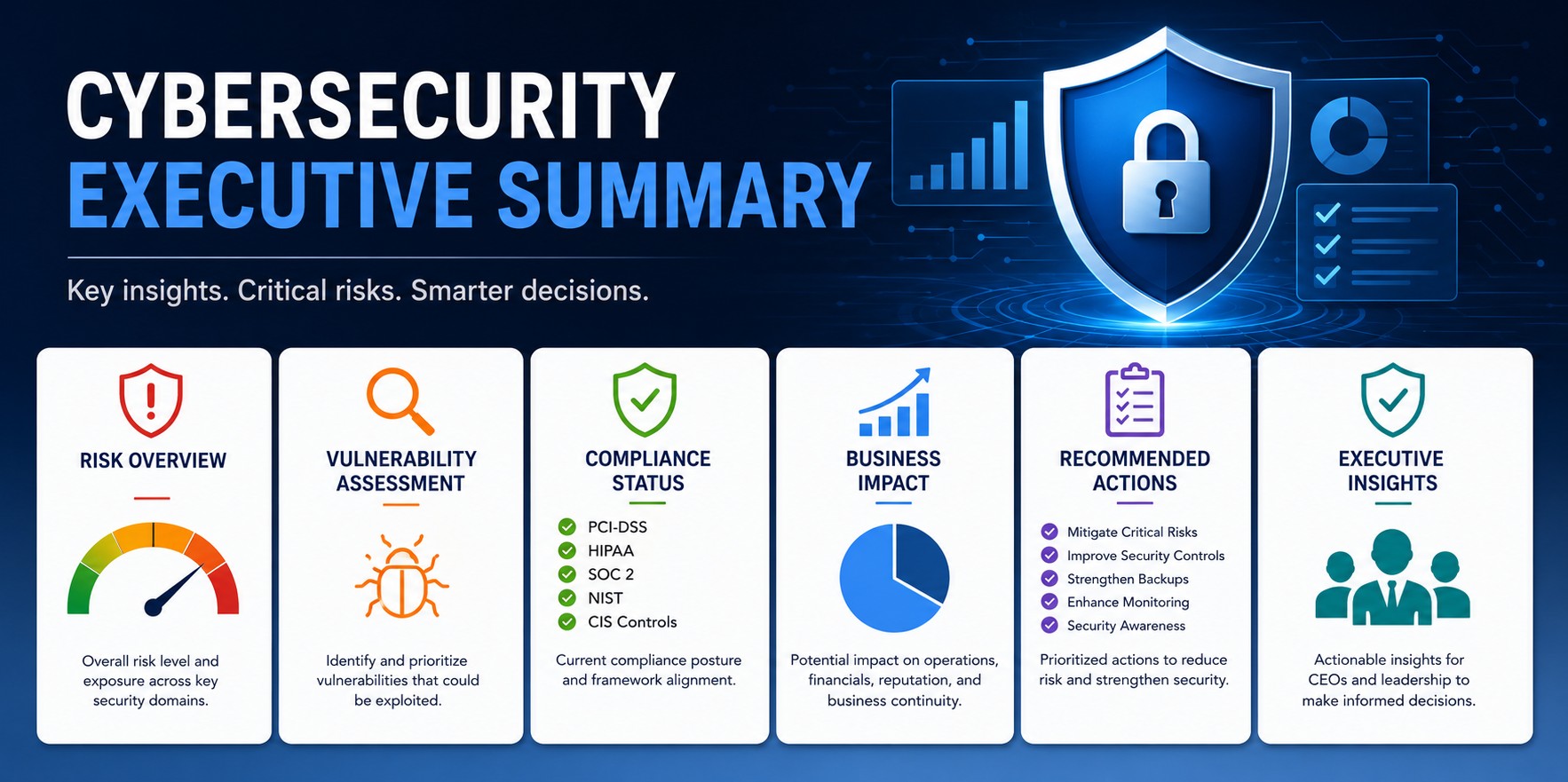
This example shows how scope, methodology, risk ratings, business impact, ownership, and recommended actions can be summarized for executive review.
Network infrastructure, firewalls, switches, routers, VPN, remote access, endpoints, cloud workloads, critical applications, identities, backups, logging, monitoring, incident response, and compliance evidence.
Findings are prioritized based on likelihood, business impact, data sensitivity, external exposure, severity of weakness, operational importance, and remediation difficulty.
The report connects high-priority findings to owners, timelines, business impact, remediation steps, risk acceptance, and management review.
These tools help owners, IT managers, and executives identify common gaps before a customer review, insurance renewal, audit request, ransomware concern, or leadership discussion.
Each organization has different pressure points: protected health information, taxpayer records, legal files, wire transfers, donor data, project files, vendor access, Microsoft 365 exposure, cloud workloads, and operational downtime.
Healthcare clinics and dental offices need practical risk assessment support for PHI, HIPAA security safeguards, Microsoft 365, endpoint controls, backups, vendor access, and incident readiness. Review related pages for healthcare clinics and dental offices.
CPA firms, tax preparers, law firms, and professional services companies often need risk documentation for client confidentiality, IRS WISP planning, access control, email security, and vendor reviews. See CPA firms and tax preparers and law firms.
Operational businesses need risk visibility around downtime, remote access, project data, wire fraud, endpoint security, vendors, and backup recovery. Explore manufacturing, construction, and real estate.

OC Security Audit is led by Ali Hassani, CISO, with hands-on experience across IT operations, network security, Microsoft infrastructure, compliance readiness, cloud security, firewall security, vulnerability management, and executive cybersecurity guidance.
Certifications include CISSP, CCISO, CCNP, CCNA, MCSE, MCSA Security, MCITP, MCP, and MCTS. The goal is practical reporting that helps owners, IT managers, CISOs, CIOs, and compliance leaders make better risk decisions.
OC Security Audit can assess, validate, document, and prioritize cybersecurity risk. When a business needs managed IT execution, Microsoft 365 support, Azure support, endpoint work, backup configuration, server projects, network improvements, or ongoing operations, IT Perfection can help with implementation and support.
This keeps the roles clear: OC Security Audit provides cybersecurity audit, compliance, risk, and vCISO guidance; IT Perfection provides managed IT, co-managed IT, Microsoft 365, Azure, endpoint, backup, server, help desk, and infrastructure support when that is the right path.
Risk assessment, security audits, compliance readiness, cyber insurance readiness, vulnerability management, and vCISO guidance.
Managed IT, Microsoft 365 support, Azure support, backup and disaster recovery, server management, endpoint support, and help desk operations.
Answers for business owners, IT managers, executives, and compliance teams considering a formal cybersecurity risk assessment.
The purpose is to identify security weaknesses, evaluate threats, analyze business impact, prioritize risks, and provide recommendations to reduce cybersecurity exposure.
No. A vulnerability scan identifies known technical weaknesses. A cybersecurity risk assessment is broader and may include controls, business impact, policies, access, compliance documentation, and remediation priorities. If the organization is still choosing a review, compare security review types by scope and evidence before defining the engagement.
The report may include an executive summary, scope, methodology, findings, risk ratings, control gaps, business impact, remediation recommendations, and audit-readiness notes.
Yes. A risk assessment can support audit preparation, compliance planning, cyber insurance reviews, vendor security questionnaires, and management reporting.
Yes. OC Security Audit can help prioritize remediation, improve controls, update documentation, support compliance readiness, and connect findings to an ongoing cybersecurity risk management program.
OC Security Audit can help identify security gaps, evaluate current controls, prioritize risks, and provide a professional report with practical remediation recommendations.
The Business Technology Risk Navigator helps business owners, CISOs, CIOs, IT managers, MSPs, and technical teams review cybersecurity, compliance, Microsoft 365, Azure, network, backup, endpoint, vulnerability, vendor, and incident-response readiness in one guided workflow.
For cybersecurity risk assessment, the navigator is useful when leadership needs a faster way to see what is verified, what is uncertain, which areas create business exposure, and what should become a prioritized remediation plan.
This website uses essential cookies for security and operation. Optional analytics and advertising cookies help measure site use and outreach. Choose Allow or Deny. You can change your choice at any time.