| Inventory & Ownership | Device inventory accuracy | Document all routers, switches, stacks, serial numbers, models, OS versions, locations, owners, and support status. | Medium | Medium | Unknown network assets create blind spots during incidents and upgrades. | Maintain an approved inventory and reconcile it during every audit cycle. | Open / Review / Complete |
| Inventory & Ownership | Lifecycle and support status | Confirm whether Cisco, HPE Aruba, and HP devices are under vendor support and not end-of-life. | High | High | Unsupported devices may not receive critical firmware or security updates. | Replace unsupported devices or document compensating controls and upgrade timelines. | Open / Review / Complete |
| Firmware & OS | Firmware version review | Compare firmware and network OS versions against vendor advisories and approved baselines. | High | High | Outdated firmware can expose routers and switches to known vulnerabilities. | Upgrade through a controlled change window after backup and compatibility review. | Open / Review / Complete |
| Firmware & OS | Boot image integrity | Verify approved boot images, startup configuration integrity, and unauthorized image changes. | Medium | High | Unapproved images may introduce instability, backdoors, or misconfiguration. | Restrict image changes and validate hashes where supported. | Open / Review / Complete |
| Firmware & OS | Patch management process | Review how firmware updates are tested, approved, scheduled, and documented. | Medium | High | Unstructured updates increase outage risk or leave devices unpatched. | Create a repeatable patch process with maintenance windows and rollback steps. | Open / Review / Complete |
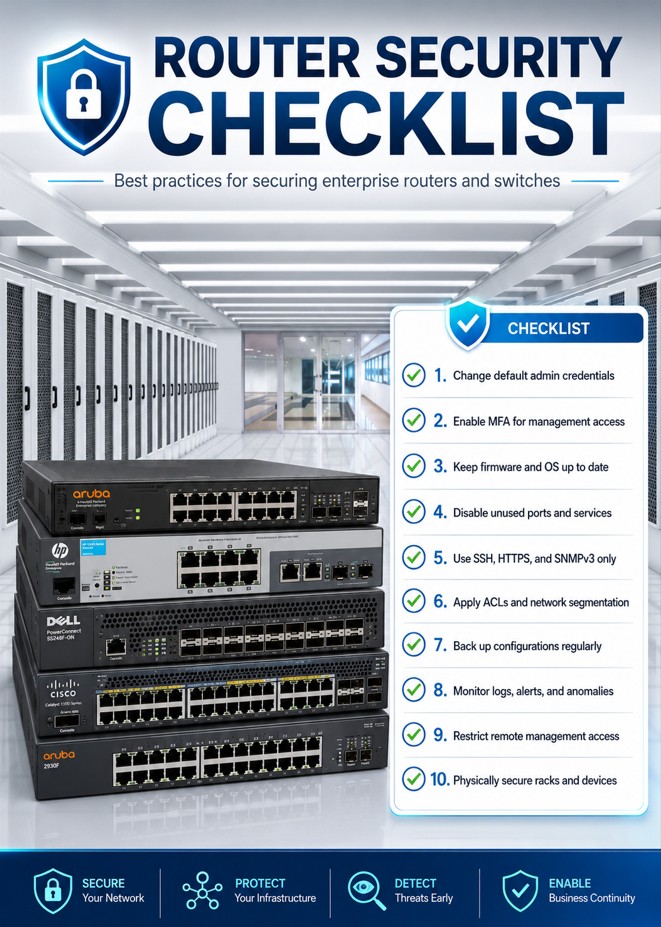
| Management Plane | SSH-only administration | Confirm Telnet is disabled and SSH is configured using secure versions and approved ciphers where supported. | High | High | Clear-text management protocols expose credentials and configuration data. | Disable Telnet and require SSH from trusted management networks. | Open / Review / Complete |
| Management Plane | HTTPS management review | Confirm HTTP is disabled and HTTPS uses trusted certificates where web management is required. | Medium | High | Insecure web management can leak credentials or expose admin portals. | Use HTTPS only, restrict access, and disable web management if not needed. | Open / Review / Complete |
| Management Plane | Management VLAN isolation | Verify router and switch management interfaces are isolated from user VLANs and guest networks. | High | High | Flat access to management interfaces increases takeover risk. | Place management access in a dedicated VLAN or subnet with ACL restrictions. | Open / Review / Complete |
| Management Plane | Allowed management sources | Review ACLs that limit device administration to approved jump boxes, VPNs, or admin workstations. | High | High | Broad administrative access expands the attack surface. | Permit management only from approved source IP ranges. | Open / Review / Complete |
| Authentication | Default credentials removed | Confirm vendor default usernames, passwords, and setup accounts are removed or disabled. | High | High | Default credentials are commonly abused during internal compromise. | Remove defaults and use unique named accounts or centralized authentication. | Open / Review / Complete |
| Authentication | AAA / RADIUS / TACACS+ | Review centralized authentication, authorization, and accounting for administrators. | Medium | High | Local-only accounts reduce accountability and delay offboarding. | Use AAA with least privilege, fallback controls, and admin logging. | Open / Review / Complete |
| Authentication | Privileged account review | Validate admin roles, named accounts, emergency accounts, and privilege levels. | Medium | High | Excessive admin rights can lead to unauthorized network changes. | Limit privileges and review access regularly. | Open / Review / Complete |
| Authentication | Password policy | Review password complexity, rotation expectations, encrypted secrets, and local account storage. | Medium | High | Weak or reusable passwords can lead to device compromise. | Use long unique credentials, encrypted secrets, and vault-based access. | Open / Review / Complete |
| SNMP & Monitoring | SNMP version | Confirm SNMPv1 and SNMPv2c are disabled unless there is an approved exception. | High | High | Weak SNMP versions can expose device data and community strings. | Use SNMPv3 with authentication and encryption. | Open / Review / Complete |
| SNMP & Monitoring | Community string exposure | Review SNMP community strings, ACLs, and read/write permissions. | High | High | Exposed or writable community strings can reveal or change device configuration. | Remove public/private strings and restrict SNMP to monitoring servers only. | Open / Review / Complete |
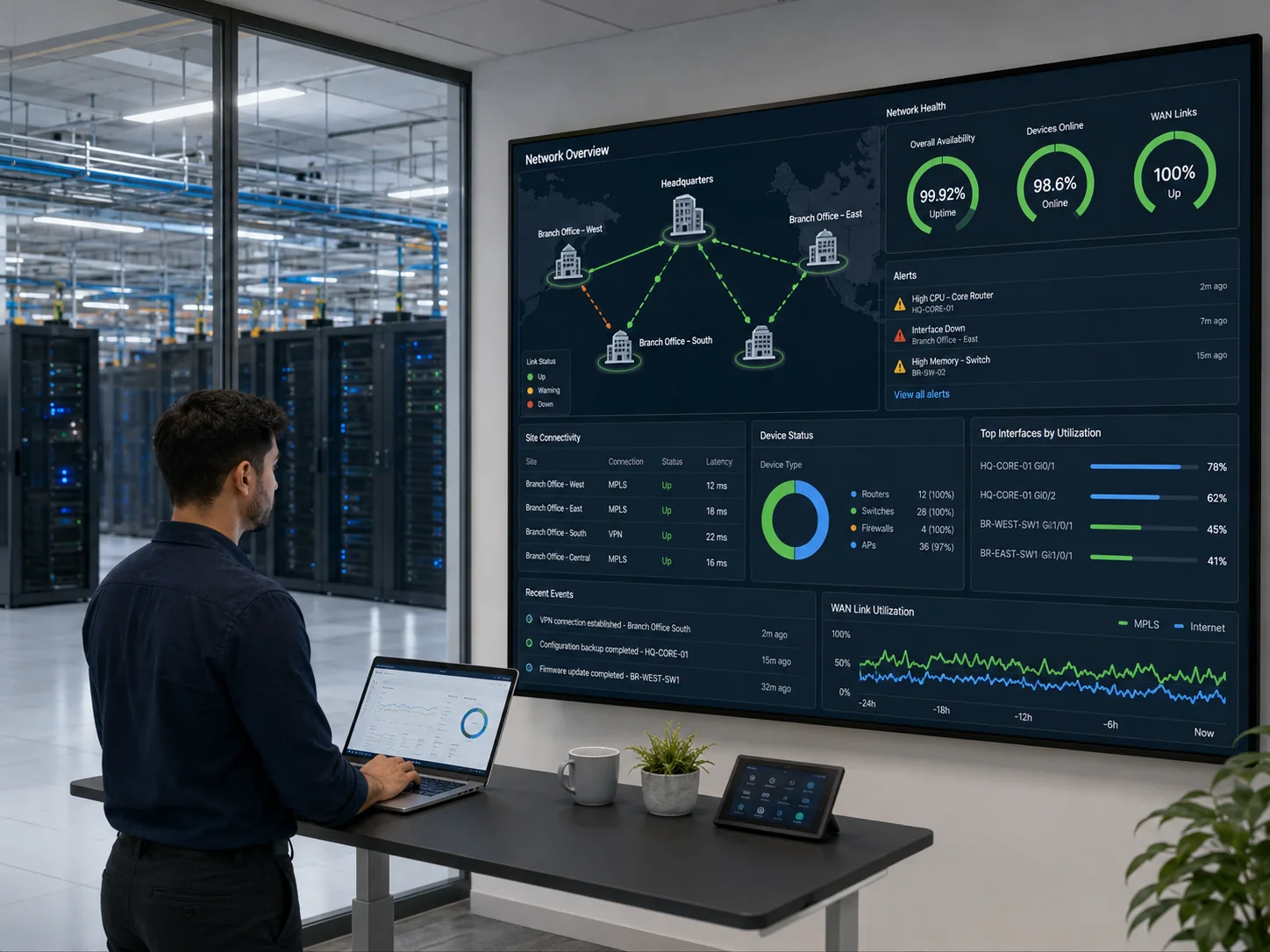
| SNMP & Monitoring | Syslog forwarding | Confirm logs are forwarded to centralized syslog/SIEM systems. | Medium | High | Local-only logs may be lost after reboot or compromise. | Forward logs to a protected logging platform with retention. | Open / Review / Complete |
| SNMP & Monitoring | NTP configuration | Verify devices use trusted NTP sources and consistent time zones. | Medium | Medium | Incorrect time breaks incident timelines and log correlation. | Configure reliable NTP and document time settings. | Open / Review / Complete |
| Segmentation | VLAN design review | Review VLANs for users, servers, voice, printers, guest, IoT, cameras, and management. | High | High | Poor segmentation allows unnecessary lateral movement. | Separate sensitive zones and document VLAN purpose and ownership. | Open / Review / Complete |
| Segmentation | Inter-VLAN routing control | Review routing between VLANs and confirm only required flows are permitted. | High | High | Overly permissive inter-VLAN routing exposes critical systems. | Use ACLs, firewall policy, or routed segmentation for controlled access. | Open / Review / Complete |
| Segmentation | Guest network isolation | Confirm guest and visitor networks cannot reach internal resources. | High | High | Guest access can become an entry point into the corporate network. | Isolate guest VLANs and route them directly to internet-only access. | Open / Review / Complete |
| Segmentation | Voice VLAN security | Review voice VLAN separation and whether phones can bridge into data networks. | Medium | Medium | Voice networks can become a lateral movement path. | Apply voice VLAN controls, DHCP options, and port-level restrictions. | Open / Review / Complete |
| Switch Port Security | Unused ports disabled | Confirm unused switch ports are administratively disabled and assigned to an unused VLAN. | High | Medium | Open ports allow unauthorized internal access. | Disable unused ports and monitor link-up events. | Open / Review / Complete |
| Switch Port Security | Port security / MAC limits | Review MAC address limits, sticky MAC policies, and violation actions where appropriate. | Medium | High | Unauthorized devices can be connected to active ports. | Enable port security for access ports based on operational needs. | Open / Review / Complete |
| Switch Port Security | 802.1X / NAC readiness | Evaluate support for 802.1X, MAC authentication bypass, or NAC integration. | Medium | High | Uncontrolled network access increases insider and rogue-device risk. | Implement phased NAC for sensitive or high-risk areas. | Open / Review / Complete |
| Switch Port Security | Trunk port review | Confirm trunk ports are approved, documented, and restricted to required VLANs. | High | High | Misconfigured trunks can expose multiple VLANs to one connection. | Limit allowed VLANs and disable trunk negotiation where appropriate. | Open / Review / Complete |
| Layer 2 Protection | BPDU Guard | Review BPDU Guard on access ports to reduce rogue switch risk. | Medium | High | Rogue switches can disrupt spanning tree and network availability. | Enable BPDU Guard on access ports. | Open / Review / Complete |
| Layer 2 Protection | Root Guard | Review root bridge placement and Root Guard on appropriate ports. | Medium | High | Unexpected root bridge changes can destabilize switching paths. | Define root bridge strategy and enforce it with guard features. | Open / Review / Complete |
| Layer 2 Protection | DHCP Snooping | Review DHCP Snooping for user VLANs and trust boundaries. | Medium | High | Rogue DHCP servers can redirect or disrupt user traffic. | Enable DHCP Snooping and trust only legitimate uplink/server ports. | Open / Review / Complete |
| Layer 2 Protection | Dynamic ARP Inspection | Review ARP protection where DHCP Snooping bindings are available. | Medium | High | ARP spoofing can enable traffic interception or disruption. | Enable Dynamic ARP Inspection on supported access VLANs. | Open / Review / Complete |
| Layer 2 Protection | Storm control | Review broadcast, multicast, and unknown unicast storm-control thresholds. | Medium | Medium | Layer 2 storms can create outages. | Configure storm control on access ports with tested thresholds. | Open / Review / Complete |
| Access Control Lists | Router ACL review | Review inbound and outbound ACLs on routed interfaces. | High | High | Overly broad ACLs may expose sensitive networks or management services. | Apply least privilege and document business justification. | Open / Review / Complete |
| Access Control Lists | Management ACLs | Confirm management services are protected by explicit ACLs. | High | High | Attackers on internal networks may attempt direct device access. | Restrict SSH/HTTPS/SNMP to approved management hosts. | Open / Review / Complete |
| Access Control Lists | Any-any rules | Identify permissive allow-all rules and undocumented exceptions. | High | High | Broad rules undermine segmentation and increase blast radius. | Replace with specific source, destination, and service rules. | Open / Review / Complete |
| Routing Security | Static route review | Validate static routes, default routes, and route ownership. | Medium | High | Incorrect routes can expose traffic or create black holes. | Document route purpose and remove stale routes. | Open / Review / Complete |
| Routing Security | Dynamic routing authentication | Review OSPF, EIGRP, BGP, or other protocol authentication where used. | Medium | High | Unauthenticated routing can allow route injection or disruption. | Enable protocol authentication and route filtering where supported. | Open / Review / Complete |
| Routing Security | Route filtering | Review route redistribution and filtering between sites, WAN, VPN, and internal zones. | Medium | High | Uncontrolled redistribution can leak routes between environments. | Filter routes and document accepted prefixes. | Open / Review / Complete |
| Site Connectivity | WAN and branch links | Review routers/switches supporting branch, data center, and cloud connectivity. | Medium | High | Weak inter-site controls can allow compromise to spread across locations. | Validate routing, ACLs, monitoring, and redundancy for site links. | Open / Review / Complete |
| Site Connectivity | Site-to-site VPN interfaces | Review router interfaces, routes, ACLs, and monitoring tied to VPN connectivity. | Medium | High | VPN-connected networks often have excessive trust. | Limit reachable subnets and monitor tunnel health. | Open / Review / Complete |
| Resilience | Configuration backups | Confirm scheduled configuration backups are captured and protected. | High | Medium | No backup increases downtime after failure or misconfiguration. | Automate backups and test restoration. | Open / Review / Complete |
| Resilience | Change control | Review change tickets, approval workflow, and post-change validation. | Medium | High | Untracked changes make incidents harder to diagnose. | Require documented changes for routing, VLAN, ACL, and firmware updates. | Open / Review / Complete |
| Resilience | High availability links | Review stack members, uplinks, LACP, redundant power, and failover paths. | Medium | High | Single points of failure can interrupt business operations. | Document redundancy and test failover scenarios. | Open / Review / Complete |
| Physical Security | Rack and closet access | Review physical access to network closets, MDFs, IDFs, and data center racks. | Medium | High | Physical access can bypass logical controls. | Restrict access, lock cabinets, and log entry where feasible. | Open / Review / Complete |
| Physical Security | Console port control | Review console access procedures, adapters, and local recovery controls. | Medium | Medium | Uncontrolled console access can allow device reconfiguration. | Control physical console access and protect emergency credentials. | Open / Review / Complete |
| Documentation | Network diagrams | Validate current logical and physical diagrams. | Medium | Medium | Outdated diagrams slow troubleshooting and audits. | Update diagrams with VLANs, uplinks, trunks, and routing paths. | Open / Review / Complete |
| Documentation | Standards and baseline configs | Review standard templates for Cisco, HPE Aruba, and HP devices. | Medium | High | Inconsistent configs create security gaps and support issues. | Create approved baseline configurations by device role. | Open / Review / Complete |