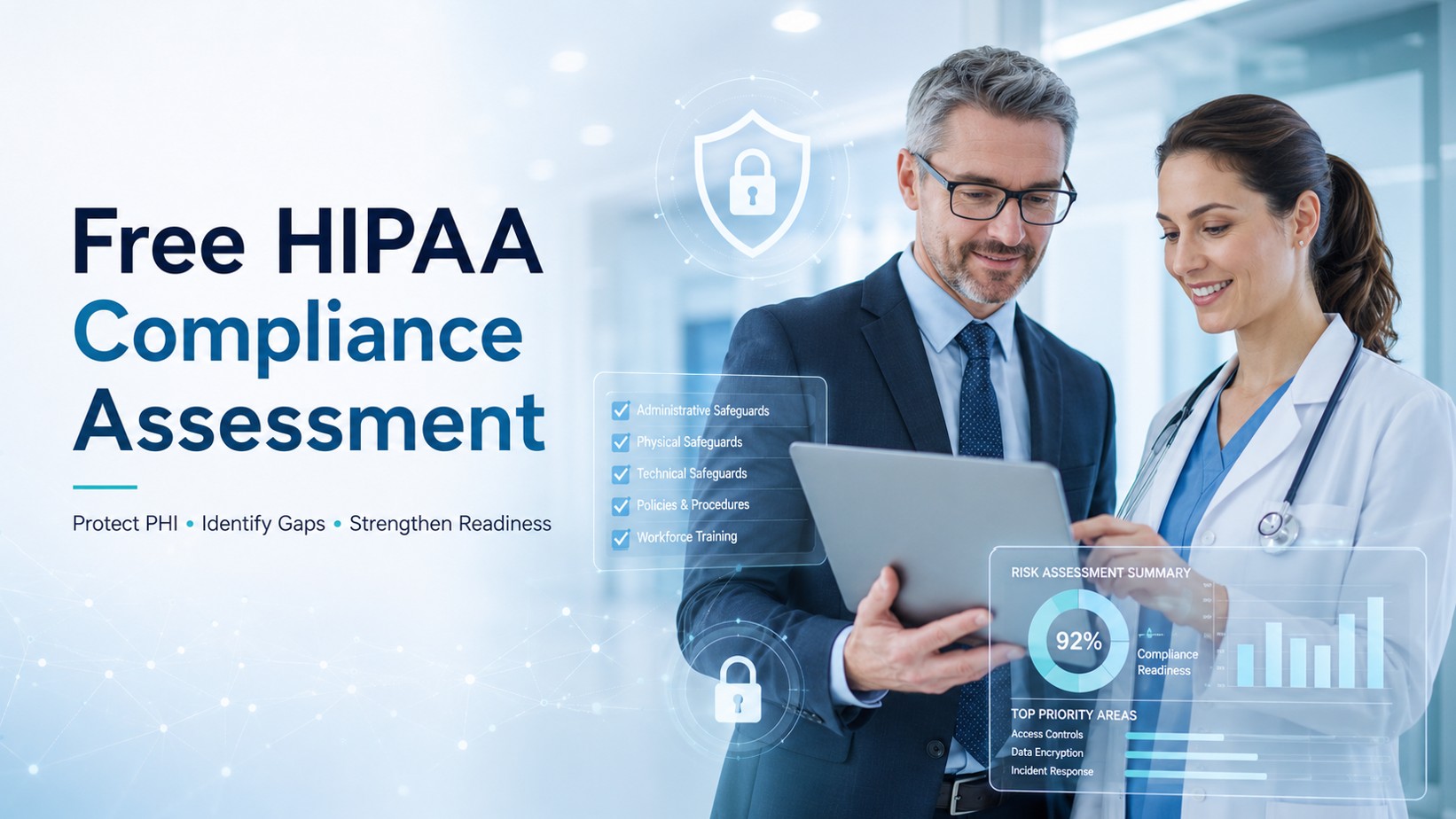
Free security assessment tool

HIPAA Security Readiness Assessment

Review common HIPAA Security Rule readiness gaps across ePHI scope, risk analysis, administrative safeguards, workforce access, technical safeguards, physical safeguards, vendors, incident response, backups, and recovery in about 5–10 minutes.

50 easy HIPAA security-readiness questions No names, phone numbers, emails, or company information Instant on-page readiness report with charts and priorities No data submission, API calls, or external scripts
Dental clinic using secure digital systems and HIPAA ePHI safeguards
Ali Hassani, CISO, in a data center

Start with a practical HIPAA security-readiness review

OC Security Audit, led by Ali Hassani, CISO, helps healthcare organizations, dental practices, medical offices, behavioral-health providers, business associates, IT teams, and leadership groups across Irvine, Orange County, Los Angeles County, and Southern California evaluate HIPAA safeguards and improve protection around electronic protected health information (ePHI). Ali Hassani brings more than 25 years of hands-on experience in cybersecurity, network engineering, network administration, IT management, security audits, compliance readiness, and security implementation across dozens of business networks.

Relevant certifications include CISSP, CCISO, MCSE, MCSA Security, MCITP, CCNA, and CCNP.

CISSP certification badgeCCISO certification badge25+ years of experienceSouthern CaliforniaRisk-based guidance
5–10 minutesTypical completion time
50 questionsControlled selections only
7 categoriesHIPAA Security Rule readiness
On-page reportCharts and next steps
HIPAA and healthcare data security illustration with protected medical records
Protect ePHI and patient-care operations

HIPAA readiness requires policies, technical safeguards, physical safeguards, and operational discipline

A useful HIPAA security-readiness review should identify where ePHI exists, who can access it, how it is protected, which vendors are involved, how incidents are handled, and whether backups and recovery procedures are reliable.

  • Identify ePHI locations, systems, users, vendors, and data flows.
  • Review administrative, physical, and technical safeguards.
  • Strengthen identity, endpoint, email, cloud, and remote-access controls.
  • Validate logging, incident response, breach escalation, backups, and recovery.
  • Use professional review to confirm scope, evidence, and remediation priorities.
Important disclaimer. This free HIPAA Security Readiness Assessment is an introductory informational tool provided by OC Security Audit. It is not a formal HIPAA Security Rule risk analysis, compliance determination, legal opinion, certification, attestation, penetration test, vulnerability scan, guarantee, or substitute for qualified professional advice. HIPAA applicability, scope, risk-analysis sufficiency, Privacy Rule issues, Breach Notification Rule issues, contracts, and regulatory obligations must be reviewed with appropriate legal and compliance advisors. Results depend entirely on the selected answers. Do not make network, cloud, account, medical-system, backup, or workflow changes solely because of this tool. Consult a qualified cybersecurity consultant, appropriate vendors, and legal or compliance advisors before taking action. HHS has also published a proposed Security Rule update; this tool does not determine the impact or status of proposed requirements. To the maximum extent permitted by applicable law, OC Security Audit and its representatives disclaim liability for decisions, changes, outages, losses, or outcomes arising from use of this tool.

HIPAA Security Readiness Assessment

Choose the closest answer. Use the expandable guidance under each question when needed.

Assessment progress

Optional environment context

You may skip this section. It uses controlled dropdowns only and does not request personal or company information.

Review and confirm before generating the report

OC Security Audit free assessment tools

HIPAA Security Readiness Assessment Report

This introductory report is generated locally in your browser from controlled selections. No information is submitted to OC Security Audit.

0%
Preliminary risk level

Executive summary

Optional context selected

No optional context was selected.

Assessment analytics

0Critical priorities
0High priorities
0Medium priorities
0Questions answered

Risk level by assessment category

Highest-priority areas to validate

Recommended next steps

1. Confirm HIPAA applicability and ePHI scope with appropriate legal and compliance advisors.

2. Validate the ePHI inventory, data flows, system owners, vendors, business associates, and subcontractors.

3. Review critical and high-priority findings through evidence review, interviews, and technical testing.

4. Create a remediation roadmap with owners, deadlines, maintenance windows, rollback plans, and documented decisions.

5. Reassess periodically and after major technology, vendor, facility, workflow, or regulatory changes.

Ali Hassani, CISO, cybersecurity consultant

Discuss the report with OC Security Audit

Ali Hassani, CISO, brings 25+ years of hands-on IT and cybersecurity experience. For a professional HIPAA security-readiness consultation, call 949-777-5567 or visit ocsecurityaudit.com.

Final disclaimer and limitation of liability. This report is a free, preliminary HIPAA security-readiness summary provided by OC Security Audit. It is not a formal HIPAA Security Rule risk analysis, compliance determination, legal opinion, Privacy Rule review, Breach Notification Rule determination, certification, attestation, penetration test, vulnerability scan, forensic investigation, guarantee, or professional-services engagement. It may be incomplete or inaccurate because it is based only on self-reported selections and does not review systems, configurations, ePHI inventories, evidence, logs, policies, contracts, business associate agreements, legal obligations, or regulatory developments. Do not implement changes solely because of this report. Always consult qualified cybersecurity, legal, compliance, insurance, and vendor advisors. To the maximum extent permitted by applicable law, OC Security Audit, its representatives, and related parties disclaim liability for any action, inaction, decision, outage, loss, cost, damage, or outcome arising from or related to this tool or report.