

Find exposure, strengthen essential controls, and build practical resilience around the systems your organization depends on.
Explore cybersecurity services →Evaluate controls independently, document defensible findings, and focus remediation on the risks with the greatest operational impact.
Explore security audits →Translate security obligations into clear evidence, accountable remediation, and a practical path toward audit or customer readiness.
Explore compliance services →Bring security governance, risk decisions, leadership communication, and improvement planning into one accountable executive program.
Explore vCISO services → OC Security Audit
Get professional cybersecurity guidance from local Orange County experts. We help businesses with security audits, compliance, risk assessments, and practical protection strategies.
Cybersecurity Leadership
Give executives a clear view of exposure, control maturity, priority gaps, ownership, and the decisions required to reduce business risk.
CISO-led analysis by Ali Hassani, backed by 25+ years of IT, cybersecurity, compliance, and infrastructure experience.
Today’s organizations face increasing risks from ransomware, data breaches, cloud vulnerabilities, insider threats, compliance violations, and operational disruptions. Business owners, CEOs, executives, and IT managers need clear visibility into these risks before they become costly incidents.
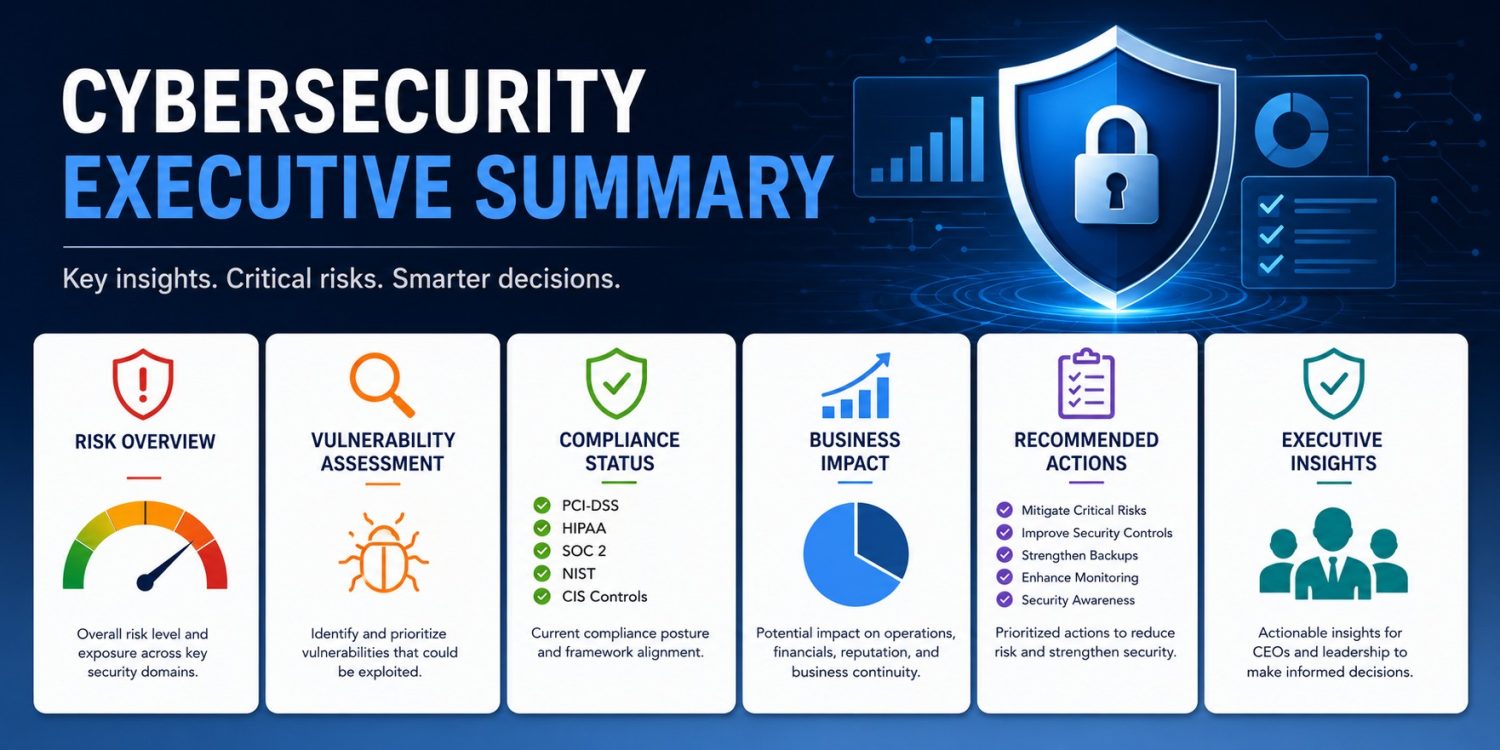
A cybersecurity executive summary gives leadership teams a high-level understanding of the organization’s cybersecurity posture, risk exposure, compliance readiness, business impact, remediation priorities, and financial or operational risk.
Many organizations invest heavily in technology but still lack executive-level visibility into their true cybersecurity condition. Technical reports often fail to clearly communicate business impact, operational exposure, financial consequences, compliance liabilities, and strategic cybersecurity priorities.
An effective cybersecurity executive summary translates technical risks into business language executives can understand, prioritize, and act upon.
Executives should receive a clear overview of the organization’s current cybersecurity posture, including security maturity, threat exposure, posture trends, current risk level, and areas requiring immediate attention.
The organization currently maintains a high cybersecurity risk profile due to identified vulnerabilities, incomplete security controls, elevated ransomware exposure, and compliance gaps.
A cybersecurity risk score helps executives quickly understand organizational exposure to cyber threats. It should evaluate areas such as ransomware readiness, endpoint security, cloud security, identity management, backup recovery, compliance posture, vendor exposure, and incident response capabilities.
| Risk Score | Risk Level | Business Meaning |
|---|---|---|
| 0–25 | Low | Acceptable risk |
| 26–50 | Moderate | Improvements recommended |
| 51–75 | High | Significant exposure |
| 76–100 | Critical | Immediate executive attention required |
The executive summary should clearly identify the most important risks affecting the business, including weak identity and access controls, unpatched infrastructure, cloud security exposure, weak backup and disaster recovery processes, and lack of security monitoring.
Cybersecurity risks should be presented in terms executives understand: operational downtime, financial loss, reputation damage, legal exposure, compliance penalties, customer trust issues, and revenue interruption.
Compliance is a critical part of executive cybersecurity reporting. Common frameworks include HIPAA, PCI-DSS, SOC 2, ISO 27001, NIST Cybersecurity Framework, CIS Controls, GDPR, and CCPA.
Reporting should include current compliance status, compliance gaps, remediation needs, and regulatory risk exposure. Failure to maintain compliance can lead to financial penalties, lawsuits, insurance complications, and loss of customer trust.
Executives should understand when the organization was last evaluated for cybersecurity weaknesses. Important assessment categories include vulnerability assessments, penetration testing, cloud security audits, compliance reviews, backup recovery testing, and phishing simulations.
A strong executive summary should include clear recommendations for reducing risk, such as enforcing multi-factor authentication, deploying endpoint detection and response, improving backup strategies, conducting cloud security audits, implementing SIEM monitoring, and strengthening employee security awareness.
Cyber insurance providers increasingly require organizations to maintain minimum cybersecurity controls, including multi-factor authentication, endpoint protection, security awareness training, backup validation, and incident response planning.
Organizations with weak cybersecurity controls may face higher premiums, coverage limitations, or claim denials.
Independent cybersecurity assessments provide objective visibility into security gaps, compliance posture, infrastructure vulnerabilities, cloud security risks, and operational resilience.
Regular cybersecurity audits help businesses improve compliance, reduce ransomware exposure, strengthen executive decision-making, improve cyber insurance readiness, and protect business continuity.
OC Security Audit, led by Ali Hassani, provides professional cybersecurity audit, compliance, vulnerability assessment, and risk management services for businesses of all sizes.
With more than 25 years of experience and numerous industry-standard cybersecurity certifications, OC Security Audit specializes in cybersecurity assessments, compliance evaluations, cloud security audits, vulnerability analysis, executive cybersecurity reporting, and risk management consulting.
The organization helps businesses gain visibility into their cybersecurity posture and reduce operational, financial, and reputational cybersecurity risks.
Cybersecurity is no longer optional for modern businesses. Executives and IT managers need visibility into organizational risks, compliance exposure, operational vulnerabilities, and cyber resilience.
A strong cybersecurity executive summary helps leadership understand business risk, improve operational resilience, reduce compliance exposure, prioritize cybersecurity investments, and protect revenue and reputation.
Organizations that proactively assess and improve their cybersecurity posture are significantly better positioned to defend against modern cyber threats and business disruption.
OC Security Audit
Get professional cybersecurity guidance from local Orange County experts. We help businesses with security audits, compliance, risk assessments, and practical protection strategies.
This website uses essential cookies for security and operation. Optional analytics and advertising cookies help measure site use and outreach. Choose Allow or Deny. You can change your choice at any time.