

LIBRARY 3.26Microsoft 365 Security Library
How to Review Mailbox Permissions in Microsoft 365
Full Access, Send As and Send on Behalf let one account open or send from someone else’s mailbox. They’re useful for assistants and shared mailboxes, and a quiet way for an attacker to keep reading mail. Here is how to find and clean them up.
Reviewed by Ali Hassani, C|CISO, CISSP · Last verified November 20, 2026
Mailbox permissions are managed in the Exchange admin center or with Exchange Online PowerShell on every plan (Microsoft Learn).
In one minute
- Export every Full Access, Send As and Send on Behalf permission.
- Ask each mailbox owner to confirm who should have access.
- Remove anything nobody can explain.
- Repeat every quarter and after any account compromise.
Mailbox delegation is part of the email security checks in our Microsoft 365 Security Audit.
What it is
The three mailbox permissions
| Permission | What it allows | Typical legitimate use |
|---|---|---|
| Full Access | Open the mailbox and read everything in it | Shared mailboxes, executive assistants |
| Send As | Send mail that appears to come from the mailbox | Shared addresses such as info@ or billing@ |
| Send on Behalf | Send mail “on behalf of” the owner | Assistants scheduling for a manager |
Microsoft describes Full Access as the right to open the mailbox and access its contents, but not to send mail; sending needs Send As or Send on Behalf (Microsoft Learn).
That’s why permissions matter after an incident: resetting the victim’s password doesn’t remove a delegate the attacker added.
Why it matters
Delegation is a persistence trick
- Account taken overAttacker has one mailbox.
- Adds Full AccessTo finance or the CEO.
- Permissions reviewedUnknown delegate removed.
- Reads mail quietlyWithout it: invoices and payment dates.
- Payment divertedBusiness email compromise.
Drawing: where a permissions review breaks the path.
lost to business email compromise in 2024, the FBI reports.
Source: CyberScoop on FBI IC3business email compromise complaints to the FBI in 2024.
Source: Nacha on FBI IC3permissions to check on every mailbox: Full Access, Send As, Send on Behalf.
Source: Microsoft Learndays is a sensible review cycle for mailbox permissions.
Source: Our recommendationDocumented research
Report · FBI IC3, 2024
BEC remains a multi-billion-dollar crime
The FBI received 21,442 business email compromise complaints in 2024 with close to $2.8 billion in losses.
Source: Nacha · CyberScoop
What we find in audits
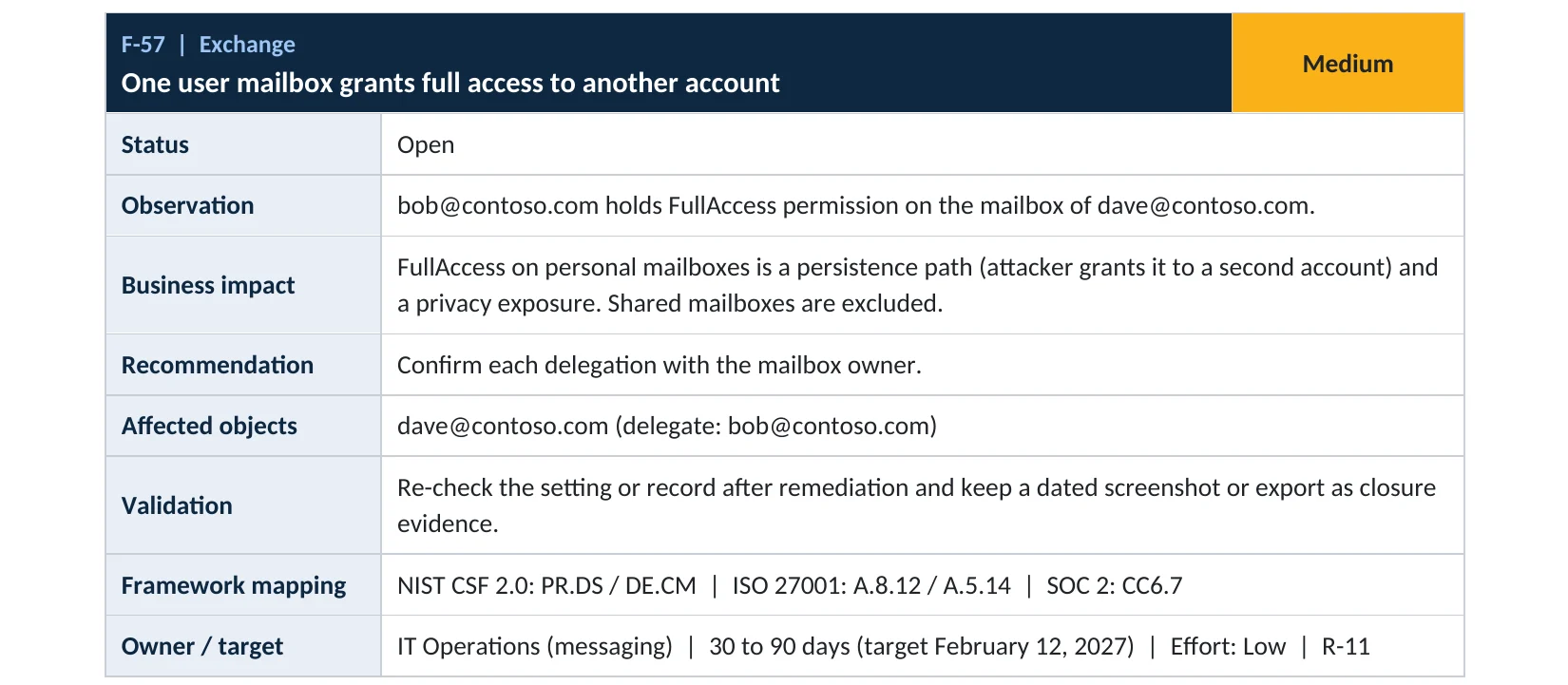
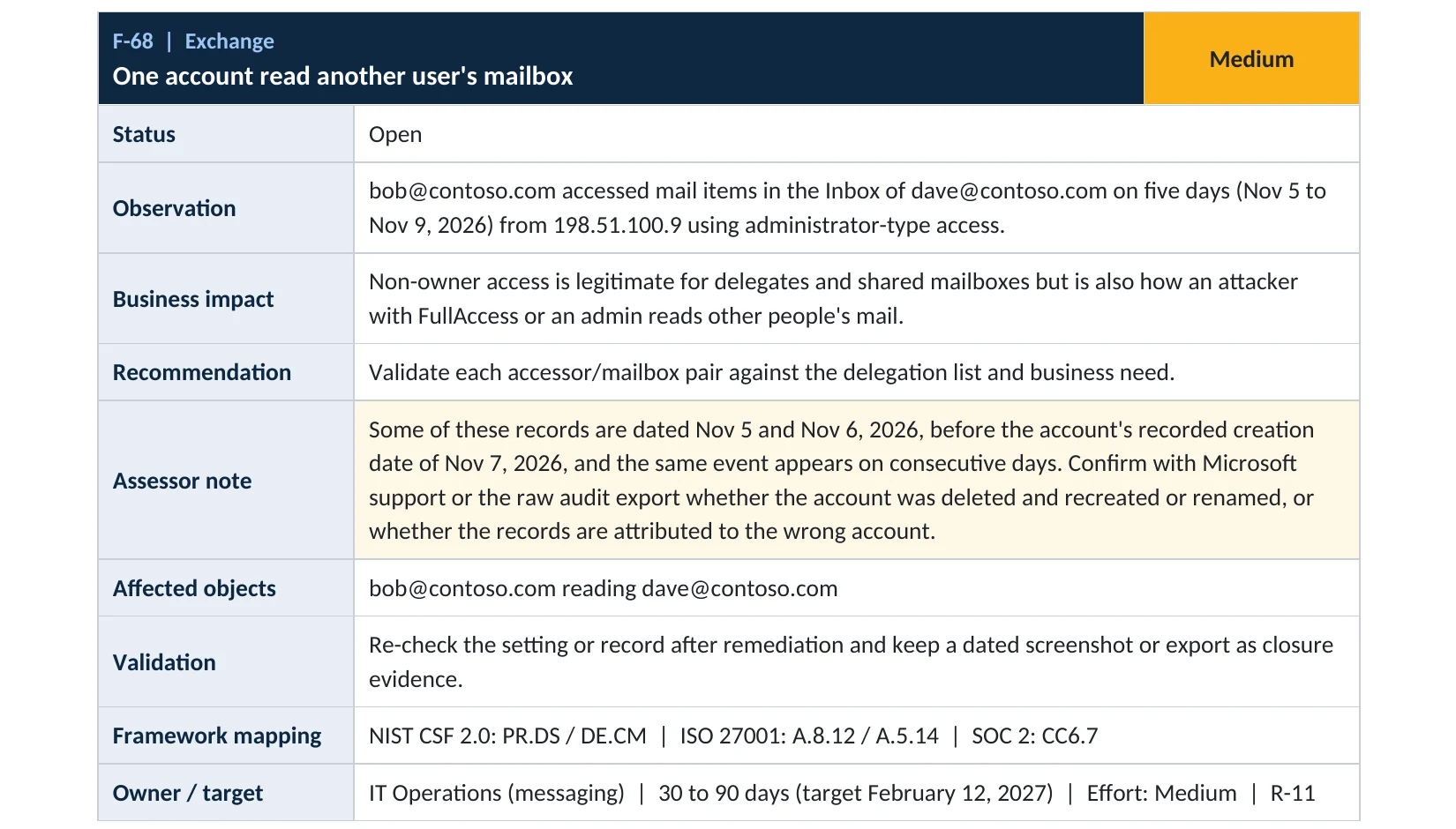
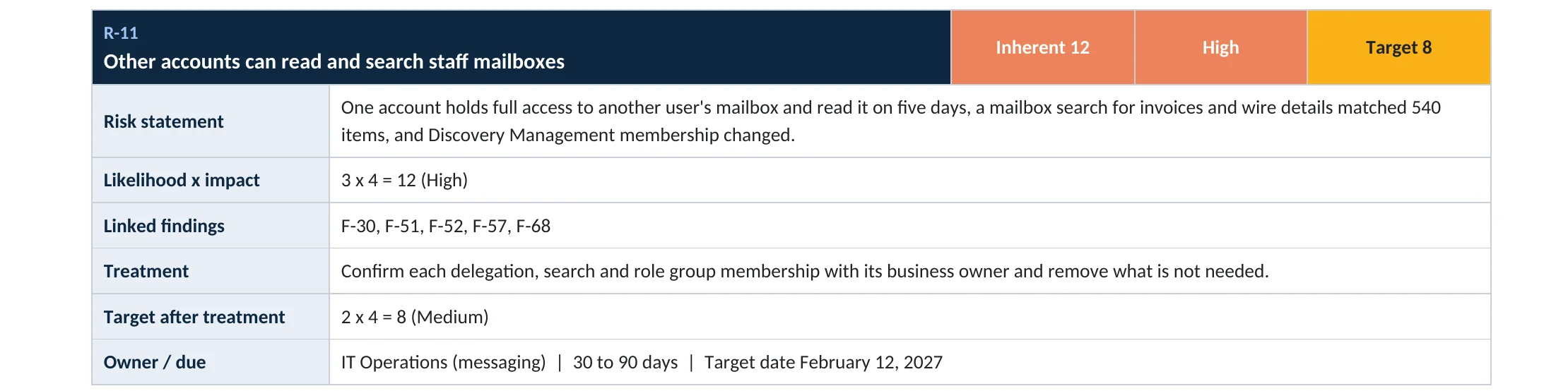
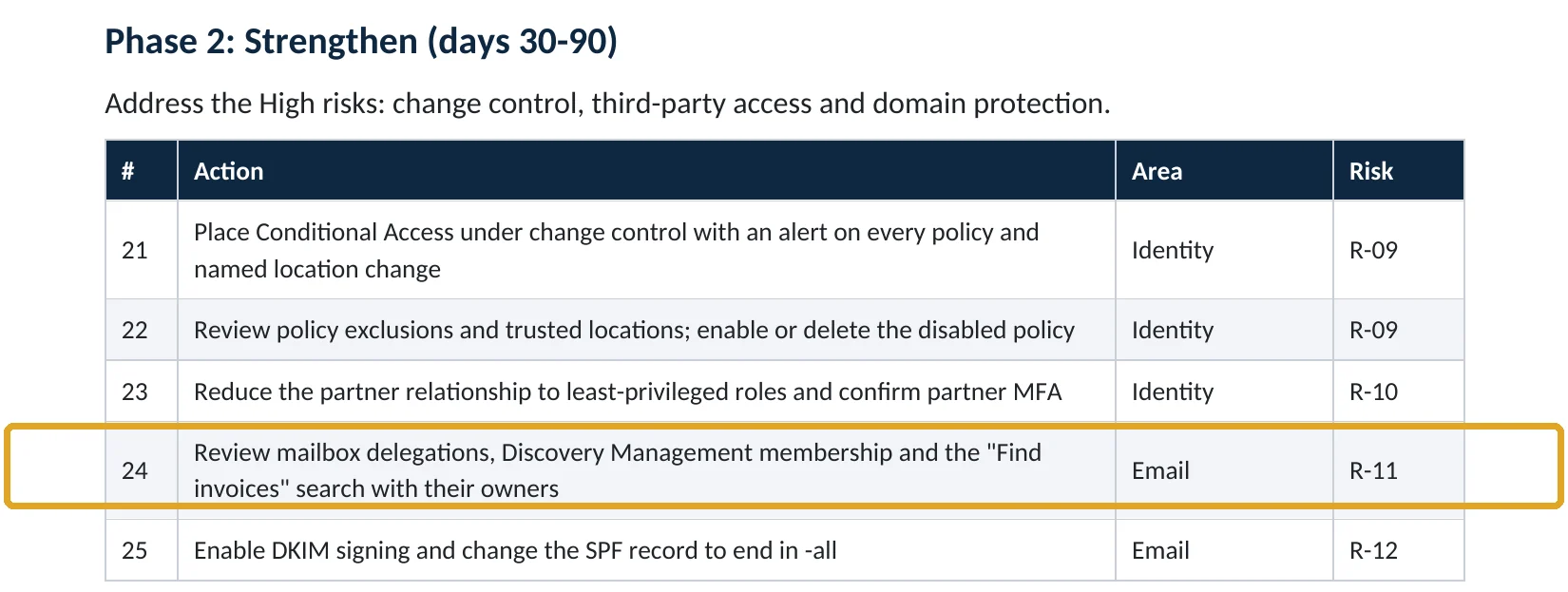
What this finding looks like in our audit reports
These are real pages from our published compromise assessment sample, written for a fictional company. Click any page to open it full size.
Your options
What each plan gives you
| Capability | All plans with Exchange Online | E5 or Purview Audit Premium |
|---|---|---|
| View and remove mailbox permissions | Yes | Yes |
| Audit log of permission changes (Add-MailboxPermission) | Yes | Yes |
| Record of which items a delegate opened (MailItemsAccessed) | Limited | Yes |
Mailbox auditing records actions by owners, delegates and admins (Microsoft Learn). See our audit log retention guide for how long those records are kept.
How to check it yourself
List every mailbox delegation, without changing anything
Read-only PowerShell: all Full Access and Send As permissions
Connect-ExchangeOnline
Get-EXOMailbox -ResultSize Unlimited | Get-EXOMailboxPermission |
  Where-Object { $_.User -notlike "NT AUTHORITY\*" -and $_.IsInherited -eq $false } |
  Select-Object Identity, User, AccessRights
Get-EXORecipientPermission -ResultSize Unlimited |
  Where-Object { $_.Trustee -notlike "NT AUTHORITY\*" } | Select-Object Identity, Trustee, AccessRights
The commands only read permissions. Everything listed is a person or group that can open or send as someone else’s mailbox.
How to configure
How to clean up mailbox permissions, step by step
All plans
Review and remove
- Export the lists above to a spreadsheet.
- Send each mailbox owner the list of who can access their mailbox.
- Remove permissions nobody confirms, in Recipients › Mailboxes › Delegation.
- Use shared mailboxes with group-based access instead of Full Access on personal mailboxes.
- Write down the approved delegations so the next review is quick.
After an account compromise
Check before you close the incident
- Search the audit log for Add-MailboxPermission and Add-RecipientPermission during the incident window.
- Remove any delegation the attacker added.
- Check the delegate’s own account for compromise.
- Keep the audit records before changing anything else.
What your users will notice
Only people whose access is removed notice. If a removal was wrong, the mailbox owner can ask for it back.
How to undo it
Re-add the permission on the mailbox’s Delegation tab. Full Access can take a short while to appear in Outlook.
Proof and questions
How to prove it is fixed, and what to ask your IT provider
Evidence it is fixed
- A current export of all mailbox delegations exists.
- Every delegation has an owner who approved it.
- No personal mailbox grants Full Access without a documented reason.
- Permission changes are reviewed after every incident.
Questions for your IT provider
- Who can open the CEO’s and finance mailboxes?
- When did we last review mailbox permissions?
- Would we notice a new Full Access permission?
- Do we use shared mailboxes or Full Access on personal ones?
- Who is in the eDiscovery and Discovery Management roles?
Signs it was already abused
If a mailbox permission may already have been misused, look for these signs
Red flags
- Full Access granted to an account the owner doesn’t know.
- Permissions added outside business hours or by an unfamiliar admin.
- MailItemsAccessed events from a delegate on many messages.
- Send As used to email payment instructions.
- Delegations that reappear after being removed.
If you see these, remove the delegation, secure both accounts and keep the logs. Our business email compromise investigation establishes what was read and sent, and the Microsoft 365 Evidence Clock shows how long the records are kept.
Framework mapping
Where mailbox permissions fit
| Framework | Where it fits |
|---|---|
| NIST CSF 2.0 | PR.AA-05: access permissions managed and reviewed; DE.CM-03: personnel activity monitored |
| ISO/IEC 27001:2022 | Annex A 5.15 Access control; 5.18 Access rights; 8.3 Information access restriction |
| SOC 2 | CC6.2 access provisioning and removal; CC6.3 least privilege |
Reviewed by
Written and reviewed by a practicing CISO

Ali Hassani, C|CISO, CISSP
Ali has more than 25 years of IT and cybersecurity experience and holds the Certified CISO and CISSP certifications along with Microsoft and Cisco credentials. He leads every OC Security Audit engagement from Irvine, on-site across Southern California and remotely nationwide. Every Microsoft 365 audit is read-only.
FAQ
Frequently asked questions about mailbox permissions
What is Full Access on a mailbox?
Permission to open another person's mailbox and read everything in it. It doesn't allow sending; that needs Send As or Send on Behalf.
Do admins automatically have access to everyone's mailbox?
No. Even Global Administrators need to be granted Full Access, which is logged. But admins can grant it, which is why changes should be reviewed.
How often should we review mailbox permissions?
Every quarter, and always after an account compromise.
Does resetting a password remove a delegate?
No. A delegate keeps access through their own account until the permission is removed.
Should we use Full Access for shared addresses?
Use a shared mailbox and grant access to a group. It's easier to review than Full Access on personal mailboxes.
Can we see what a delegate read?
With Purview Audit Premium (E5), MailItemsAccessed records which items were opened. Standard audit records the permission changes.
Next step
Know who can read every mailbox
Prevent
Microsoft 365 Security Audit
$3,500 fixed
About 200 read-only checks across email, sign-in protection, admin roles, sharing and devices, for any tenant size, with four reports and a remediation roadmap.
Respond
Microsoft 365 & Azure Compromise Investigation
From $3,500
For when someone may have been reading a mailbox they shouldn’t: we establish what was read and sent.
Want to see the deliverables first? Open the Microsoft 365 audit sample report or browse all our sample reports.

Service
Microsoft 365 Security Audit
The fixed-price audit that checks this item and about 200 more.
See the audit ›
Service
Microsoft 365 Email Security
Our review of Exchange Online and Defender email protection.
See email security ›
Service
Compromise Investigation
When an account or mailbox may already be in an attacker’s hands.
See the investigation ›Related reading: How to find malicious inbox rules · How to block external email forwarding · How long Microsoft 365 keeps audit logs · Exchange Online and Defender email security guide
Sources
Sources used on this page
- Microsoft Learn, Manage permissions for recipients in Exchange Online
- Microsoft Learn, Get-MailboxPermission
- Microsoft Learn, Search the audit log for mailbox activities
- CyberScoop, 10 key numbers from the 2024 FBI IC3 report
- Nacha, FBI’s IC3 finds almost $8.5 billion lost to business email compromise
This guide is general information, not a guarantee of protection or legal advice. Microsoft changes its admin centers often: menu names and steps were checked against Microsoft Learn on November 20, 2026. Drawings are simplified and are not screenshots of Microsoft products. Sample findings come from fictional companies. Incidents are described as reported by the cited sources; OC Security Audit was not involved in them. Questions? Call 949-777-5567 or email support@ocsecurityaudit.com.