

Salesloft Drift Breach: How Stolen App Tokens Opened Hundreds of Salesforce Systems
Part 9 of 10 in the series Lessons from Major Cyber Incidents · Worldwide · 2025

What happened, in brief
- How it started: Access tokens stolen from a software vendor
- First access to containment: About 5 months
- Scale: More than 700 potentially impacted organizations, per a Google analyst
- Cost: No figure published
Summary of public reporting; sources are listed in the briefing.

Want this checked in your own environment?
Ali Hassani, a Certified CISO (C|CISO) and CISSP with 25+ years in IT and cybersecurity, turns guidance like this into a ranked, practical plan. Based in Irvine, on-site across Southern California and remote nationwide.

Key facts
| How it started | Access tokens stolen from a software vendor |
|---|---|
| First access to containment | About 5 months |
| Scale | More than 700 potentially impacted organizations, per a Google analyst |
| Cost | No figure published |
Each figure is sourced in the article below.
In August 2025, attackers copied data from the Salesforce systems of many companies, including several well-known cybersecurity vendors. The attackers did not need to steal a password or trick an employee at those companies. They held something more convenient: the access tokens that a connected chat application used to sign in on each customer’s behalf. It is a clear case of a risk most businesses have never reviewed, the permissions granted to third-party apps.
What happened
Salesloft is a sales software company. Its Drift product is a chat tool that many companies connect to Salesforce, their customer relationship system. To make that connection work, each customer authorizes Drift to access its Salesforce data. The authorization is stored as an OAuth token, a kind of digital key that lets one application act inside another without a password.
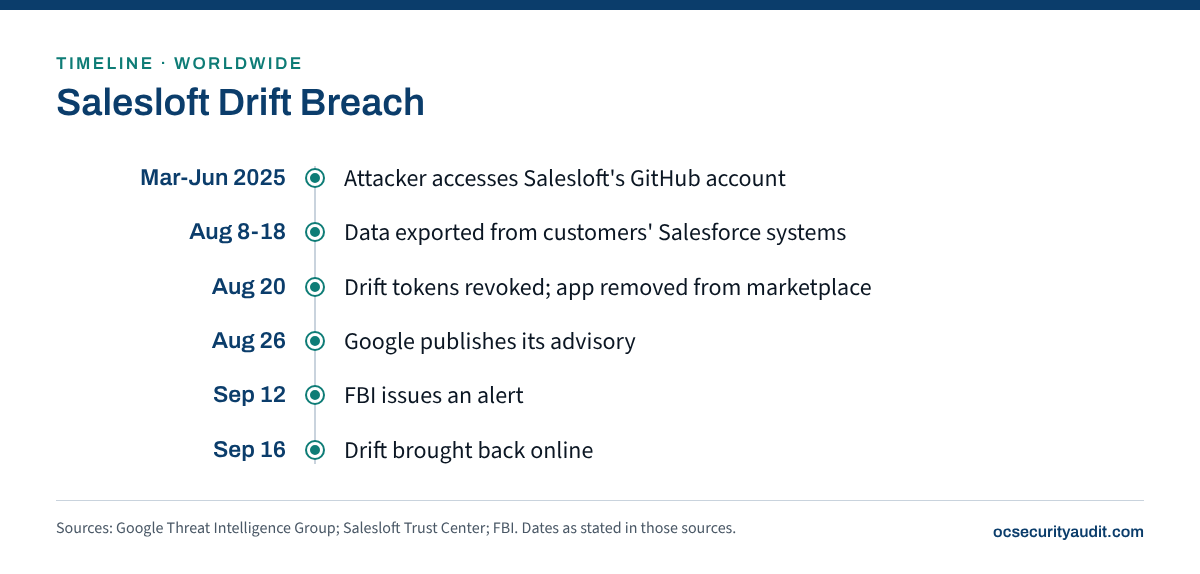
Google’s Threat Intelligence Group reported that between August 8 and at least August 18, 2025, an actor it tracks as UNC6395 used compromised Drift tokens to sign in to customers’ Salesforce systems and export large volumes of data (Google Threat Intelligence Group, August 26, 2025).
The attackers then searched the exported data for other credentials. Google listed what they looked for: Amazon Web Services access keys, passwords and Snowflake access tokens. On August 28, Google added that tokens for the Drift Email integration had also been compromised and used to read mail in a very small number of Google Workspace accounts.
On August 20, 2025, Salesloft and Salesforce revoked all active Drift tokens, and Salesforce removed the Drift app from its marketplace pending further investigation (Google Threat Intelligence Group).
How it started
Salesloft published the findings of an investigation by Mandiant. According to that update, the attacker accessed Salesloft’s GitHub account from March through June 2025, then accessed Drift’s Amazon Web Services environment and obtained the OAuth tokens for Drift customers’ technology integrations (Salesloft Trust Center).
Salesloft’s update does not say how the GitHub account was first compromised.
The FBI issued an alert on September 12, 2025 covering this campaign and a separate one. In the separate campaign, a different group phoned employees and talked them into approving a malicious app. The FBI describes them as two groups using different methods (FBI FLASH, September 12, 2025). A criminal group has claimed responsibility for the Drift campaign to journalists (BleepingComputer, September 17, 2025). We found no official confirmation of that claim.
How long it took to detect
No source gives an exact day count. The published dates show that access to Salesloft’s GitHub account began in March 2025, roughly five months before the data theft was contained in August. Google observed the data theft over about ten days, from August 8 to at least August 18. The tokens were revoked on August 20.
Who was affected and what it cost
A Google analyst told CyberScoop that the company was aware of more than 700 potentially impacted organizations (CyberScoop, August 26, 2025).
Several technology companies published their own statements confirming that data in their Salesforce systems was accessed, including Cloudflare, Zscaler, Proofpoint, Tenable, Qualys, Rubrik and PagerDuty. Each said the incident was limited to data in its Salesforce system and reported no impact, or no evidence of impact, on its products or services. Those that described the data said it was mainly business contact details and the text of customer support cases.
Cloudflare’s account is the most detailed. It found 104 of its own API tokens inside the support case text that was taken. It said it had identified no suspicious activity associated with those tokens and rotated all of them.
We found no published cost figure from any company and no reliable independent estimate, so we give none. The work involved was substantial all the same: the companies that published statements described reviewing what was taken, rotating credentials and notifying customers.
What the published accounts show
We found no findings by a regulator or court. The following are facts stated by the companies involved and by Google. They are not findings of fault.
- Some support tickets contained secrets. Cloudflare and PagerDuty said some support cases contained API tokens or other sensitive information that customers had pasted in. Google reported that the attackers searched the exported data for credentials of this kind.
- A connected app’s tokens gave access to large volumes of data. Google reported that the tokens were used to export large volumes of data until they were revoked on August 20. Google’s guidance afterward was to restrict connected app permissions and limit the network addresses they can be used from.
- The first access was to a source code platform, months earlier. Salesloft’s account says the attacker had access to its GitHub account from March through June 2025. Salesloft’s update does not say which control failed.
How the risk could be reduced
Google and the FBI published similar recommendations (Google; FBI): review every third-party integration, restrict each connected app to the minimum permissions it needs, enforce IP address restrictions, monitor for unusual data exports, and rotate credentials for third-party integrations.
The same exposure exists in Microsoft 365. Every time a user clicks “Accept” on a permissions prompt, an app is granted standing access to mail, files or calendars. A checklist:
- List every app with access to your data. In Microsoft Entra ID, these are enterprise applications and app registrations. Most organizations have dozens that nobody remembers approving.
- Stop users from approving apps on their own. Require an administrator to review consent requests.
- Remove apps that are unused or over-permissioned. An app that needs to read one calendar should not be able to read every mailbox.
- Never put passwords or keys in tickets, email or chat. Use a password manager or a secrets vault, and tell your vendors to do the same.
- Rotate keys when a vendor reports an incident. Assume anything they could reach is exposed.
- Monitor for bulk downloads. Large exports by an application outside normal hours should raise an alert.
- Ask vendors how they protect the tokens they hold for you. Our vendor risk management service includes this.
What this means for your organization
App permissions are one of the least reviewed areas of Microsoft 365, and an app that has been granted access signs in with its own token, so it is not subject to a user’s MFA prompt once consent has been given. Our Microsoft 365 security audit lists the applications that hold access to your tenant and the permissions each one has, using read-only access. Managed devices are the other half of the picture, and our Intune security audit checks which devices and apps are allowed to reach company data.
Try the free Microsoft 365 Security Risk Check, or schedule a consultation with Ali Hassani, CISSP, C|CISO.
More in this series
- First article in the series: Change Healthcare Ransomware Attack: A Portal Without MFA and $3.09 Billion in Costs
- Previous: Article 8, Collins Aerospace Ransomware Attack: How One Supplier Disrupted Europe's Airports
- Next: Article 10, Cyberattacks in 2026 So Far: What Is Confirmed and What Businesses Should Do (publishes October 14, 2026)
Sources
- Google Threat Intelligence Group, August 26, 2025 (cloud.google.com): https://cloud.google.com/blog/topics/threat-intelligence/data-theft-salesforce-instance…
- Salesloft Trust Center (trust.salesloft.com): https://trust.salesloft.com/?uid=Update+on+Mandiant+Drift+and+Salesloft+Application+Inv…
- FBI FLASH, September 12, 2025 (ic3.gov): https://www.ic3.gov/CSA/2025/250912.pdf
- BleepingComputer, September 17, 2025 (bleepingcomputer.com): https://www.bleepingcomputer.com/news/security/shinyhunters-claims-15-billion-salesforc…
- CyberScoop, August 26, 2025 (cyberscoop.com): https://cyberscoop.com/salesforce-salesloft-drift-attack-spree-google/
- Cloudflare (blog.cloudflare.com): https://blog.cloudflare.com/response-to-salesloft-drift-incident
- Zscaler (zscaler.com): https://www.zscaler.com/blogs/company-news/salesloft-drift-supply-chain-incident-key-de…
- Proofpoint (proofpoint.com): https://www.proofpoint.com/us/blog/corporate-news/salesloft-drift-supply-chain-incident…
- Tenable (tenable.com): https://www.tenable.com/blog/tenable-response-to-salesforce-and-salesloft-drift-incident
- Qualys (blog.qualys.com): https://blog.qualys.com/misc/2025/09/06/salesloft-drift-supply-chain-incident
- Rubrik (rubrik.com): https://www.rubrik.com/blog/company/25/salesforce-connected-third-party-drift-applicati…
- PagerDuty (pagerduty.com): https://www.pagerduty.com/blog/news-announcements/salesloft-drift-data-breach-update-to…
Last verified: October 4, 2026. This article is general information based on the public sources cited, as of the date shown. It is not legal advice. OC Security Audit had no involvement in the incidents described and has no inside knowledge of them. Company names appear only to identify the organizations named in those public sources. Statements made in lawsuits are allegations and have not been proven. Where a source could not be confirmed, the article says so. If you believe anything here is inaccurate, contact us and we will review it.