

Collins Aerospace Ransomware Attack: How One Supplier Disrupted Europe’s Airports
Part 8 of 10 in the series Lessons from Major Cyber Incidents · Europe · 2025

What happened, in brief
- How it started: Not publicly disclosed by RTX
- Airports affected: Heathrow, Brussels, Berlin Brandenburg and Dublin
- Longest recovery: More than 2 weeks, at Berlin
- Cost: No figure published; RTX reported no material impact
Summary of public reporting; sources are listed in the briefing.

Want this checked in your own environment?
Ali Hassani, a Certified CISO (C|CISO) and CISSP with 25+ years in IT and cybersecurity, turns guidance like this into a ranked, practical plan. Based in Irvine, on-site across Southern California and remote nationwide.

Key facts
| How it started | Not publicly disclosed by RTX |
|---|---|
| Airports affected | Heathrow, Brussels, Berlin Brandenburg and Dublin |
| Longest recovery | More than 2 weeks, at Berlin |
| Cost | No figure published; RTX reported no material impact |
Each figure is sourced in the article below.
On a Friday night in September 2025, the check-in and boarding systems at several of Europe’s busiest airports stopped working. The airports had not been attacked directly. The software they shared had. Staff went back to handwritten boarding passes, and at one airport normal service took more than two weeks to return. The incident shows what happens when many organizations depend on one supplier’s system, and why a practiced manual fallback matters.
What happened
Collins Aerospace, a subsidiary of the U.S. company RTX Corporation, makes passenger processing software called MUSE. It lets different airlines share the same check-in desks, gates and baggage systems at an airport.
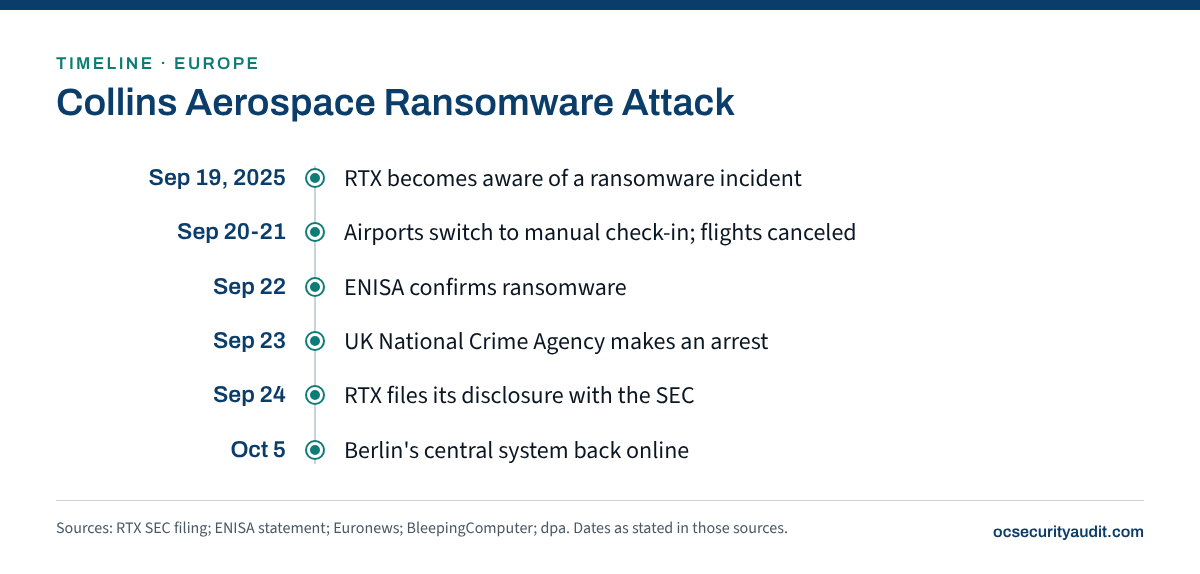
RTX told the U.S. Securities and Exchange Commission that on September 19, 2025 it became aware of “a product cybersecurity incident involving ransomware” on systems that support MUSE (RTX Form 8-K). The European Union Agency for Cybersecurity (ENISA) confirmed on September 22 that the disruption was caused by a third-party ransomware incident (TechCrunch, September 22, 2025).
London Heathrow, Brussels, Berlin Brandenburg and Dublin airports all reported disruption and moved to manual check-in and boarding (Euronews, September 22, 2025). The European Commission said aviation safety and air traffic control were unaffected (Euronews, September 21, 2025).
How it started
RTX has not, as far as we could find, publicly disclosed how the attackers gained access. Its SEC filing states only that the MUSE airport systems operate outside the RTX enterprise network and reside on customer-specific networks.
Other accounts exist, and they should be read with care. An extortion group called Everest later claimed that it had taken data through an exposed file transfer server with weak credentials, and denied deploying ransomware (Hackread, October 26, 2025). ENISA’s 2026 threat report lists the incident in a table of ransomware cases and attributes it to the Everest group gaining unauthorized file transfer access to the software’s infrastructure, without mentioning the credentials or the group’s denial (ENISA Threat Landscape 2026). Separately, one security researcher named a particular ransomware family, and BleepingComputer said it could not verify that (BleepingComputer). We found no confirmation from RTX of any of these accounts, and it is not clear whether the data theft and the ransomware were one event or two.
The UK National Crime Agency arrested a man in his forties in West Sussex on September 23, 2025 on suspicion of Computer Misuse Act offenses and released him on conditional bail (BleepingComputer, September 24, 2025). We found no record of charges, and his connection to the attack has not been explained publicly.
How long it took to detect
No official source gives the date of first access, so the time to detection is unknown. The recovery times are documented and they varied widely:
- Heathrow: the airport said the vast majority of flights continued to operate (Computer Weekly, September 22, 2025).
- Brussels: Euronews reported 38 cancellations on Saturday, September 20 (25 departures and 13 arrivals) and 75 on Sunday (45 departures and 30 arrivals). The airport asked airlines to cancel half of Monday’s flights (Euronews, September 21, 2025).
- Berlin: the central system came back online on Sunday, October 5, more than two weeks after the attack, with airlines reconnected gradually after that, according to the German news agency dpa (dpa, via Ghana News Agency).
At one airport most flights kept operating. At another, recovery took more than two weeks.
What it cost
RTX stated in its SEC filing that, while its investigation was ongoing, the incident had not had, and was not reasonably expected to have, a material impact on its financial condition, business operations or results of operations. No airport has published a cost figure that we could find, and we found no reliable independent estimate. We therefore give no number.
The costs that are visible are operational: canceled flights, delays and weeks of manual work. There was also a data consequence. The operator of Dublin Airport confirmed that boarding pass data for flights departing Dublin in August 2025 had been compromised through Collins Aerospace, and that it had notified the Irish Data Protection Commission. RTE reported that the number of passengers affected was not yet clear (RTE, October 25, 2025).
Which controls failed: not publicly known
No official source, regulator or company statement that we found identifies a control that failed. We do not speculate.
One structural fact can be stated without assigning fault. Several airports depended on a single shared platform for check-in and boarding, and recovery times differed widely between them.
ENISA’s 2026 report, in its transport section, called this the most significant case, and the same report lists reliance on third-party platforms among the exposure points seen in transport (ENISA Threat Landscape 2026).
How the risk could be reduced
European law already treats this as a known risk. The EU’s NIS2 Directive covers the transport sector and requires organizations in scope to address security in their supply chains (Directive (EU) 2022/2555, Article 21). In January 2026, the European Commission proposed amendments that add specific ransomware reporting requirements (European Commission proposal COM(2026) 13).
For any business, the same thinking applies on a smaller scale:
- Identify the supplier systems you cannot work without. Payment terminals, booking systems, practice management software and your phone system are common examples.
- Write the manual procedure and rehearse it. Airports that could switch quickly to manual processing kept most flights moving. A procedure nobody has tried is a guess.
- Ask where the vendor’s system actually runs. Software installed on your network is partly your responsibility to patch, segment and monitor, even when the vendor supplies it.
- Isolate vendor-managed systems. Put them on their own network segment so that a problem there cannot spread, and so that a problem elsewhere cannot reach them. An internal security audit tests this.
- Close old file transfer and remote access services. Whatever the truth of the claims in this case, exposed services with old passwords are a common way in. An external security audit lists them.
- Agree recovery time commitments in the contract. Our vendor risk management service covers what to ask for.
What this means for your organization
You do not need to run an airport to have this problem. A medical practice that cannot reach its scheduling system, a law firm locked out of its document platform and a retailer whose card terminals are down are all in the same position on a smaller scale. Our BCDR services page explains how to set recovery targets and test them.
Take the free Cyber Incident Response Readiness Assessment to see where you stand, or schedule a consultation with Ali Hassani, CISSP, C|CISO.
More in this series
- First article in the series: Change Healthcare Ransomware Attack: A Portal Without MFA and $3.09 Billion in Costs
- Previous: Article 7, SharePoint ToolShell Attacks: Why Patching Alone Did Not Stop the Intruders
- Next: Article 9, Salesloft Drift Breach: How Stolen App Tokens Opened Hundreds of Salesforce Systems (publishes October 13, 2026)
Sources
- RTX Form 8-K (sec.gov): https://www.sec.gov/Archives/edgar/data/101829/000010182925000036/rtx-20250919.htm
- TechCrunch, September 22, 2025 (techcrunch.com): https://techcrunch.com/2025/09/22/eu-cyber-agency-confirms-ransomware-attack-causing-ai…
- Euronews, September 22, 2025 (euronews.com): https://www.euronews.com/2025/09/22/european-airports-face-fourth-day-of-disruption-on-…
- Euronews, September 21, 2025 (euronews.com): https://www.euronews.com/2025/09/21/brussel-airport-asks-airlines-to-cancel-half-of-mon…
- Hackread, October 26, 2025 (hackread.com): https://hackread.com/everest-ransomware-dublin-airport-passenger-data/
- ENISA Threat Landscape 2026 (enisa.europa.eu): https://www.enisa.europa.eu/sites/default/files/2026-09/ENISA%20Threat%20Landscape%2020…
- BleepingComputer (bleepingcomputer.com): https://www.bleepingcomputer.com/news/security/uk-arrests-suspect-for-rtx-ransomware-at…
- Computer Weekly, September 22, 2025 (computerweekly.com): https://www.computerweekly.com/news/366631592/Cyber-attack-that-downed-airport-systems-…
- dpa, via Ghana News Agency (gna.org.gh): https://gna.org.gh/2025/10/berlin-airport-systems-fixed-after-cyberattack-two-weeks-ago/
- RTE, October 25, 2025 (rte.ie): https://www.rte.ie/news/2025/1025/1540550-daa-data-breach/
- Directive (EU) 2022/2555, Article 21 (eur-lex.europa.eu): https://eur-lex.europa.eu/eli/dir/2022/2555/oj
- European Commission proposal COM(2026) 13 (eur-lex.europa.eu): https://eur-lex.europa.eu/legal-content/EN/TXT/HTML/?uri=COM:2026:13:FIN
Last verified: October 4, 2026. This article is general information based on the public sources cited, as of the date shown. It is not legal advice. OC Security Audit had no involvement in the incidents described and has no inside knowledge of them. Company names appear only to identify the organizations named in those public sources. Statements made in lawsuits are allegations and have not been proven. Where a source could not be confirmed, the article says so. If you believe anything here is inaccurate, contact us and we will review it.