

Change Healthcare Ransomware Attack: A Portal Without MFA and $3.09 Billion in Costs
Part 1 of 10 in the series Lessons from Major Cyber Incidents · United States · 2024

What happened, in brief
- How it started: Compromised credentials used on a remote access portal that had no MFA
- Time undetected: 9 days, by the company's own dates
- Cost: $3.09 billion in 2024, reported by UnitedHealth Group
- People affected: About 192.7 million, as reported to HHS OCR
Summary of public reporting; sources are listed in the briefing.

Know where your HIPAA security gaps are
CISO-led HIPAA readiness for practices in Southern California and nationwide: risk analysis, safeguards review and a plan your team can act on. Led by Ali Hassani, C|CISO and CISSP.

Key facts
| How it started | Compromised credentials used on a remote access portal that had no MFA |
|---|---|
| Time undetected | 9 days, by the company's own dates |
| Cost | $3.09 billion in 2024, reported by UnitedHealth Group |
| People affected | About 192.7 million, as reported to HHS OCR |
Each figure is sourced in the article below.
In February 2024, compromised credentials and a remote access portal without multi-factor authentication (MFA) led to a breach that Change Healthcare later told federal regulators affected approximately 192.7 million people. This article walks through what the company itself told Congress, what the attack cost, and what a smaller organization can take from it.
What happened
Change Healthcare is a claims and payment processing company owned by UnitedHealth Group. The U.S. House Energy and Commerce Committee described it as a clearinghouse that handles about 15 billion medical claims a year, nearly 40 percent of all claims (House Energy and Commerce Committee, May 3, 2024).
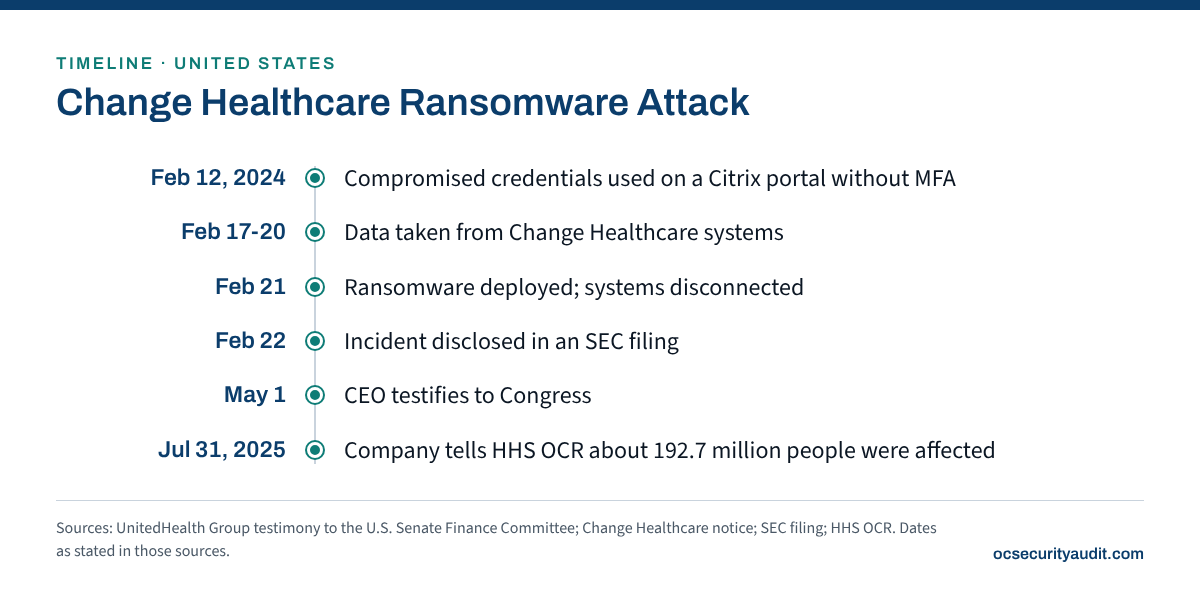
On February 21, 2024, ransomware was deployed inside Change Healthcare’s systems. UnitedHealth Group disconnected the affected systems and disclosed the incident the next day in a filing with the Securities and Exchange Commission (UnitedHealth Group Form 8-K, filed February 22, 2024). The House committee wrote that the outage created a backlog of unpaid claims and left doctors’ offices and hospitals with serious cash flow problems (House Energy and Commerce Committee).
How it started
The clearest account comes from UnitedHealth Group’s chief executive, Andrew Witty, in written testimony to the U.S. Senate Committee on Finance on May 1, 2024. He stated that on February 12 criminals used compromised credentials to remotely access a Change Healthcare Citrix portal, and that “the portal did not have multi-factor authentication” (Witty testimony, Senate Finance Committee).
According to the same testimony, the intruders then moved laterally within the systems and exfiltrated data, and ransomware was deployed nine days later. Witty identified the attacker as a cybercriminal calling itself ALPHV or BlackCat. The testimony does not say how the credentials were stolen in the first place.
How long it took to detect
By the company’s own dates, the attackers were inside for nine days, from February 12 to February 21, before the ransomware was deployed and the company became aware of it. Change Healthcare’s public notice states that data was taken between February 17 and February 20, 2024 (Change Healthcare HIPAA notice, June 20, 2024).
By the company’s own dates, the data had been taken before the company became aware of the ransomware.
What it cost
- Total cost to the company: UnitedHealth Group reported $3.09 billion in total cyberattack impacts for 2024, made up of $2.223 billion in direct response costs and $867 million in business disruption (UnitedHealth Group 2024 results, January 16, 2025).
- Ransom: Witty testified that the decision to pay a ransom was his (Witty testimony). The House Energy and Commerce Committee recorded the amount as $22 million in Bitcoin (House Energy and Commerce Committee).
- People affected: Change Healthcare notified the U.S. Department of Health and Human Services Office for Civil Rights (HHS OCR) on July 31, 2025 that approximately 192.7 million individuals were impacted (HHS OCR FAQ).
- Support to providers: UnitedHealth Group advanced more than $6.5 billion in accelerated payments and no-interest loans to care providers by April 26, 2024 (Witty testimony).
The reported ransom was equal to less than one percent of the $3.09 billion impact the company reported.
The security gaps the company described
These points come from the company’s testimony and from the House Energy and Commerce Committee’s summary of the hearing.
- No MFA on a remote access portal. This is the company’s own statement, quoted above. The House committee described multi-factor authentication as an industry standard practice.
- Compromised credentials were used to get in. By the company’s account, they were used on a portal that did not have MFA.
- Nine days between first access and ransomware. During that time, by the company’s timeline, the intruders moved between systems and removed data.
- Older technology. The House committee’s summary records Witty describing Change Healthcare as a relatively older company with older technologies that UnitedHealth Group was still upgrading after acquiring it.
State attorneys general in Nebraska and Iowa have filed lawsuits that make further claims. Nebraska’s alleges poorly segmented IT systems, and both allege outdated systems and delayed notification. Those are allegations and have not been proven (Nebraska Attorney General; Iowa Attorney General).
How the risk could have been reduced
No single control guarantees prevention. Official guidance does, however, address several of the gaps above. The joint CISA, FBI and HHS advisory on ALPHV Blackcat recommends phishing-resistant MFA, tight control of remote access tools, and network monitoring and endpoint detection tools (CISA advisory AA23-353A).
For a small or mid-size organization, that translates into a short checklist:
- Require MFA on every remote entry point. That includes VPN, Citrix, remote desktop gateways, email and every administrator account. One exception is enough for an attacker.
- Find the systems nobody remembers. Acquired companies, old portals and test servers are where exceptions hide. An external security audit lists what is reachable from the internet.
- Watch for stolen passwords being used. Sign-ins from unfamiliar locations or devices should raise an alert the same day.
- Segment the network. A remote access portal should not lead straight to the systems that hold patient or payment data. An internal security audit tests how far an intruder could move.
- Keep offline backups and rehearse recovery. The joint #StopRansomware Guide from CISA is a free place to start.
Where things stand now
As of October 2026, the consolidated federal lawsuits against Change Healthcare and its parent companies are in the discovery stage in the District of Minnesota, and no class settlement has been announced (U.S. District Court, District of Minnesota). HHS OCR states that it opened investigations of Change Healthcare and UnitedHealth Group (HHS OCR FAQ). We found no published outcome as of October 2026.
What this means for your organization
Many businesses in Southern California run on Microsoft 365, and the same weakness shows up there: an account, an app or an old sign-in method that was never brought under MFA. Our Microsoft 365 security audit checks identity and MFA coverage, administrator access and legacy authentication with read-only access, for a fixed price of $3,500.
Healthcare practices carry the added weight of HIPAA. Our pages on HIPAA compliance and cybersecurity for healthcare clinics explain how an audit maps to the Security Rule. You can also take the free Ransomware Resilience Assessment in a few minutes.
To talk through your own exposure with Ali Hassani, CISSP, C|CISO, schedule a consultation.
More in this series
- Next: Article 2, Jaguar Land Rover Cyberattack: Five Weeks Without Production and a £1.9 Billion Estimate (publishes October 6, 2026)
Sources
- House Energy and Commerce Committee, May 3, 2024 (energycommerce.house.gov): https://energycommerce.house.gov/posts/what-we-learned-change-healthcare-cyber-attack
- UnitedHealth Group Form 8-K, filed February 22, 2024 (sec.gov): https://www.sec.gov/Archives/edgar/data/731766/000073176624000045/unh-20240221.htm
- Witty testimony, Senate Finance Committee (finance.senate.gov): https://www.finance.senate.gov/imo/media/doc/0501_witty_testimony.pdf
- Change Healthcare HIPAA notice, June 20, 2024 (businesswire.com): https://www.businesswire.com/news/home/20240620726809/en
- UnitedHealth Group 2024 results, January 16, 2025 (unitedhealthgroup.com): https://www.unitedhealthgroup.com/content/dam/UHG/PDF/investors/2024/2025-16-01-uhg-rep…
- HHS OCR FAQ (hhs.gov): https://www.hhs.gov/hipaa/for-professionals/special-topics/change-healthcare-cybersecur…
- Nebraska Attorney General (ago.nebraska.gov): https://ago.nebraska.gov/news/attorney-general-mike-hilgers-files-lawsuit-against-chang…
- Iowa Attorney General (iowaattorneygeneral.gov): https://www.iowaattorneygeneral.gov/newsroom/attorney-general-brenna-bird-announces-law…
- CISA advisory AA23-353A (cisa.gov): https://www.cisa.gov/news-events/cybersecurity-advisories/aa23-353a
- #StopRansomware Guide from CISA (cisa.gov): https://www.cisa.gov/resources-tools/resources/stopransomware-guide
- U.S. District Court, District of Minnesota (mnd.uscourts.gov): https://www.mnd.uscourts.gov/content/change-healthcare-inc-data-breach
Last verified: October 4, 2026. This article is general information based on the public sources cited, as of the date shown. It is not legal advice. OC Security Audit had no involvement in the incidents described and has no inside knowledge of them. Company names appear only to identify the organizations named in those public sources. Statements made in lawsuits are allegations and have not been proven. Where a source could not be confirmed, the article says so. If you believe anything here is inaccurate, contact us and we will review it.