Compliance analyst and IT engineer reviewing assessment results on a laptop in a server room

PCI DSS v4.0.1 readiness sample

PCI DSS Readiness Assessment Sample Report

Every deliverable from a PCI DSS v4.0.1 readiness assessment of a fictional retailer with store POS terminals and an online store: executive report, technical findings, risk register, roadmap and workbook.

25+ yearsIT & cybersecurity experience
Certified expertsCISSP · C|CISO · Microsoft · Cisco
Southern CaliforniaLocal and on-site, based in Irvine
NationwideRemote audits & advisory

Our deliverables

Five deliverables from one PCI DSS readiness assessment

A PCI DSS readiness assessment is only worth paying for if leadership can decide from it and the people doing the work can act on it. This sample shows every deliverable we hand over at the end of a PCI DSS v4.0.1 readiness assessment, slide by slide, so you can judge the depth before you book. It covers all 12 requirements across store POS terminals, an e-commerce payment page, the cardholder data environment network, servers and databases, encryption keys, user and vendor access, logging, vulnerability management, physical security and the policies that hold it together.

OC Security Audit runs these assessments for retailers, restaurants, e-commerce businesses, SaaS and service providers from Irvine, on-site across Orange County, Los Angeles and Southern California, and remotely nationwide. We review evidence, configurations and documents and interview your control owners; nothing in your environment is changed.

Sample notice. Contoso Retail Inc. is a fictional organization. Every name, account, address and figure in these pages is invented for illustration and describes no real customer. The structure, depth and format are the same as the reports our clients receive.

200controls across all 12 PCI DSS requirements
50.5readiness score out of 100, target 85
142findings, each with a fix and closure evidence
24business risks with owners and dates
35roadmap actions over 180 days

Deliverable 1 of 5 · PDF and Word · 9 pages

Executive Security Report

The report leadership reads first. It turns 200 control results into a readiness score, the business risks that could lead to stolen card data, the decisions leadership needs to make and a 180-day plan, written so an owner or CFO can act on it without a technical background.

Who uses it

Owner or CEO, CFO and finance, the executive owner for PCI DSS, and the board or partners who approve the budget.

PCI DSS 12.4 Executive responsibilityPCI DSS 12.1 Security policyPCI DSS 12.3 Targeted risk analysis

What is included

  1. Readiness score and rating
  2. 24 business risks, 8 Critical
  3. Chained attack path to card data
  4. Scores for 10 areas against 85
  5. What is already working
  6. Ten priority recommendations
  7. Decisions requested from leadership
  8. Scope, method and limits

SAMPLE · Contoso Retail Inc. (fictional)

1 / 8
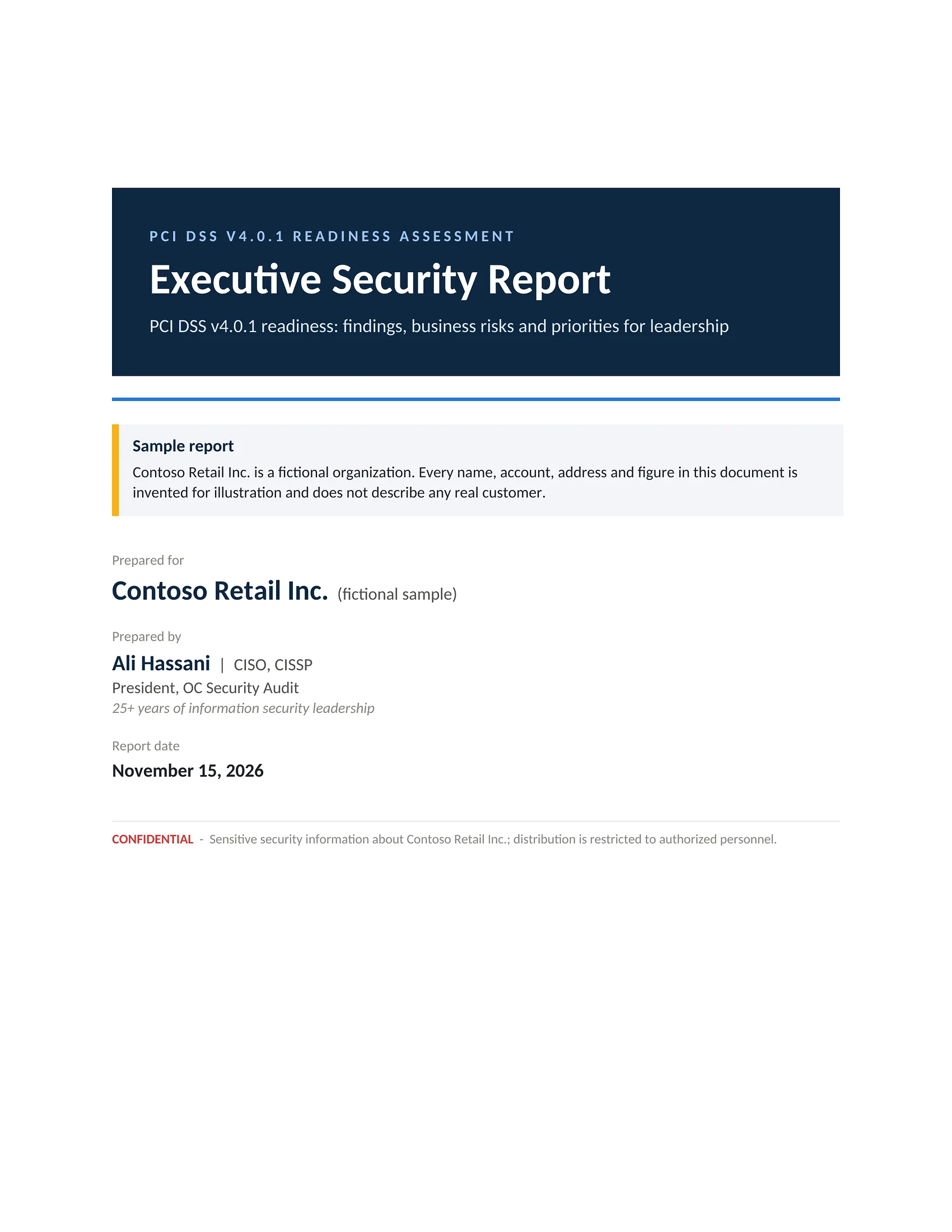
Executive Security Report, slide 1 of 8: Cover page (fictional company, illustrative data)
Slide 1 of 8Cover pageThe Executive Security Report for Contoso Retail Inc., a PCI DSS v4.0.1 readiness assessment of a fictional retailer with store POS terminals, an e-commerce storefront and supporting corporate and cloud systems.
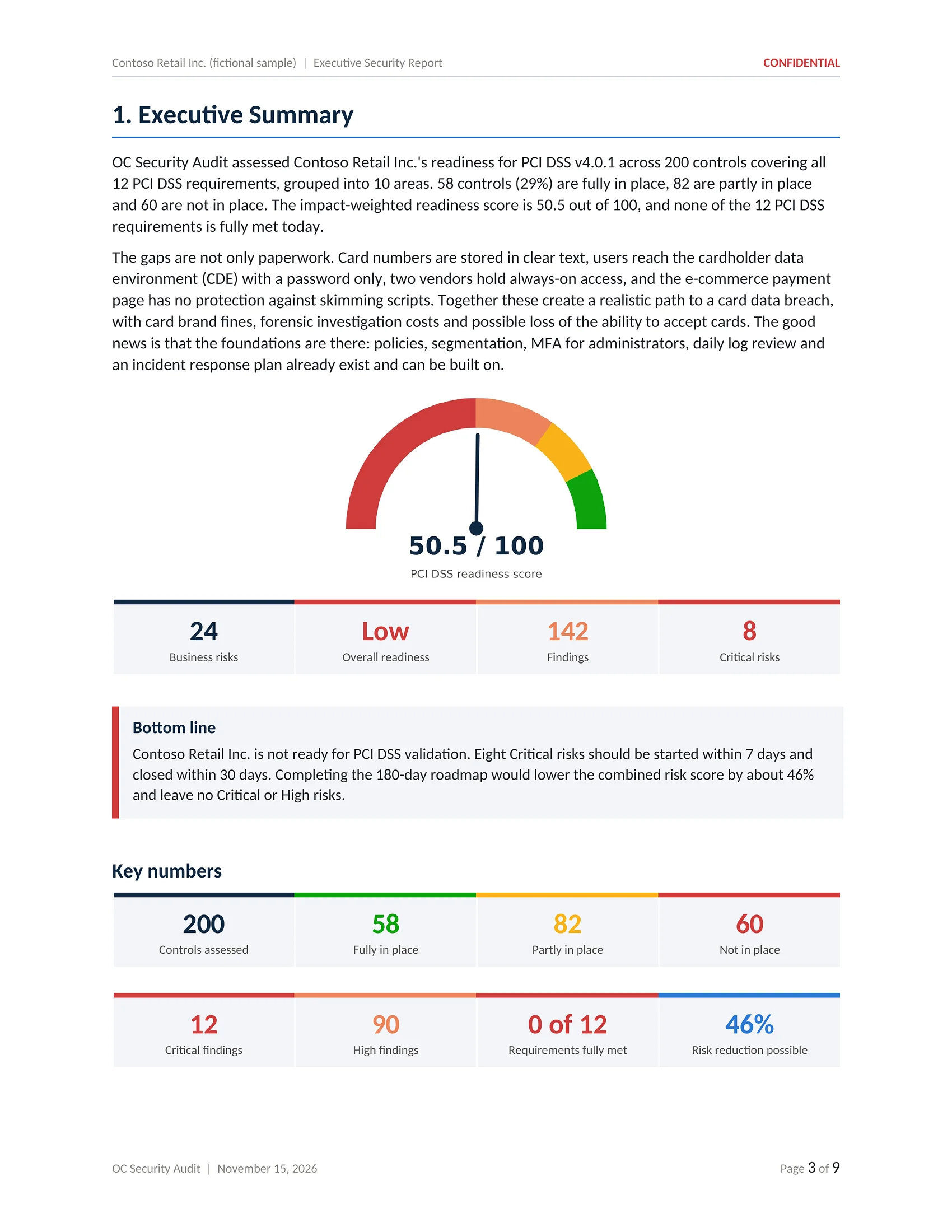
Executive Security Report, slide 2 of 8: Executive summary and readiness score (fictional company, illustrative data)
Slide 2 of 8Executive summary and readiness score200 controls across all 12 PCI DSS requirements: 58 fully in place, 82 partly in place and 60 not in place, for an impact-weighted readiness score of 50.5 out of 100 and a bottom line for leadership.
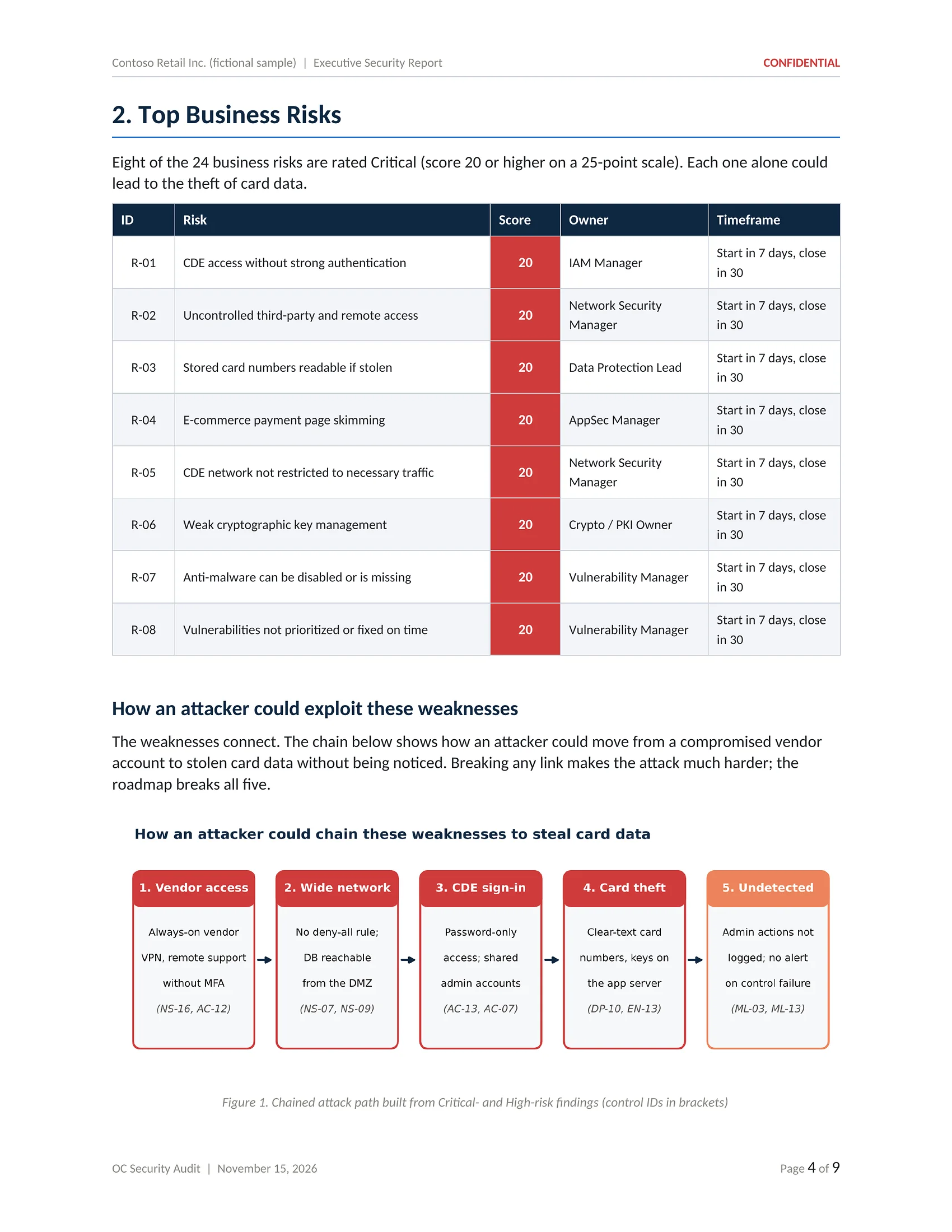
Executive Security Report, slide 3 of 8: Top business risks and the attack path (fictional company, illustrative data)
Slide 3 of 8Top business risks and the attack pathThe eight Critical business risks with owners and timeframes, and a chained attack path showing how a compromised vendor account could lead to stolen card data.
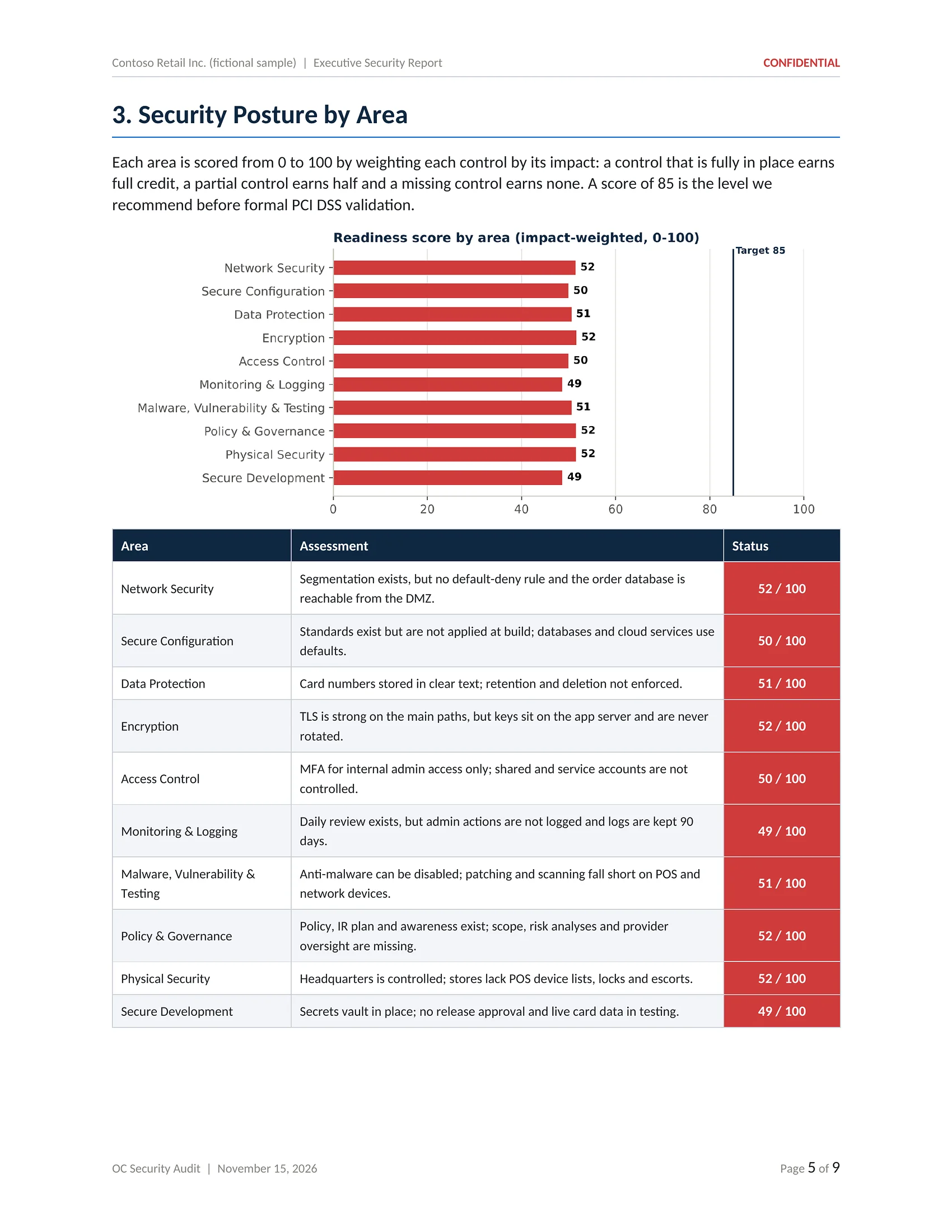
Executive Security Report, slide 4 of 8: Security posture by area (fictional company, illustrative data)
Slide 4 of 8Security posture by areaEach of the 10 areas scored from 0 to 100, weighted by control impact, against the score of 85 we recommend before formal PCI DSS validation, with a one-line assessment per area.
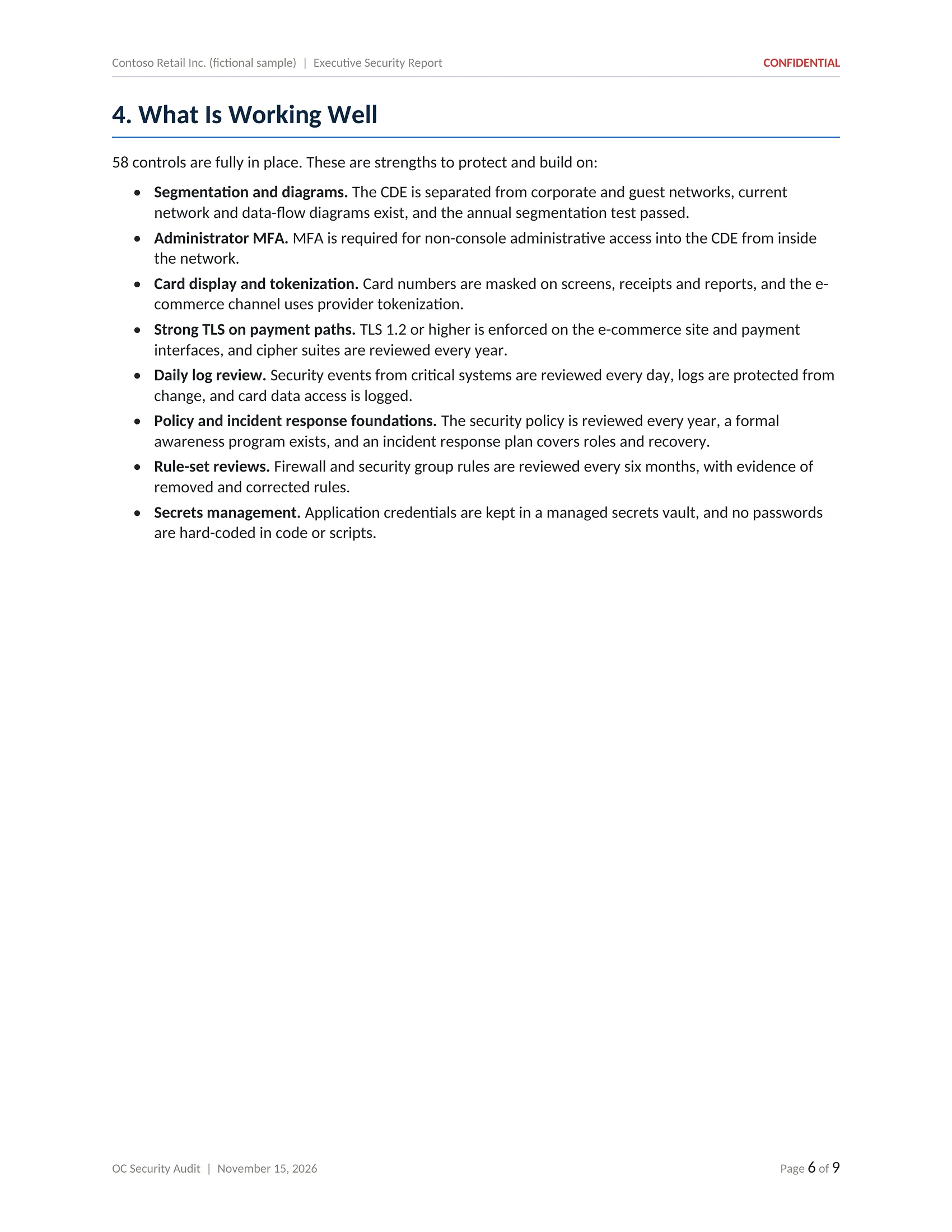
Executive Security Report, slide 5 of 8: What is working well (fictional company, illustrative data)
Slide 5 of 8What is working wellThe strengths to protect: segmentation and current diagrams, administrator MFA, card masking and tokenization, strong TLS on payment paths and daily log review.
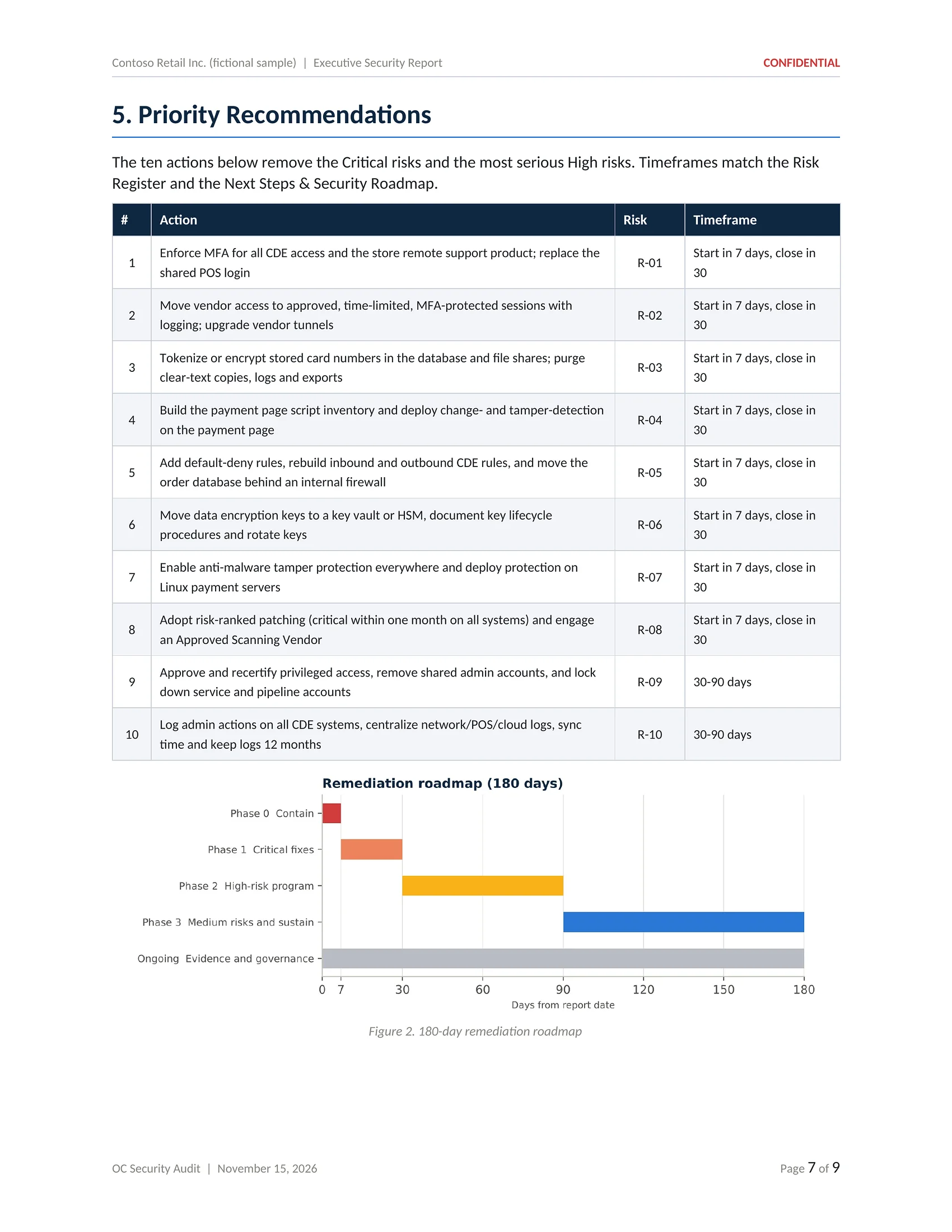
Executive Security Report, slide 6 of 8: Priority recommendations (fictional company, illustrative data)
Slide 6 of 8Priority recommendationsTen actions that remove the Critical risks and the most serious High risks, each linked to its risk and timeframe, with a 180-day roadmap chart.
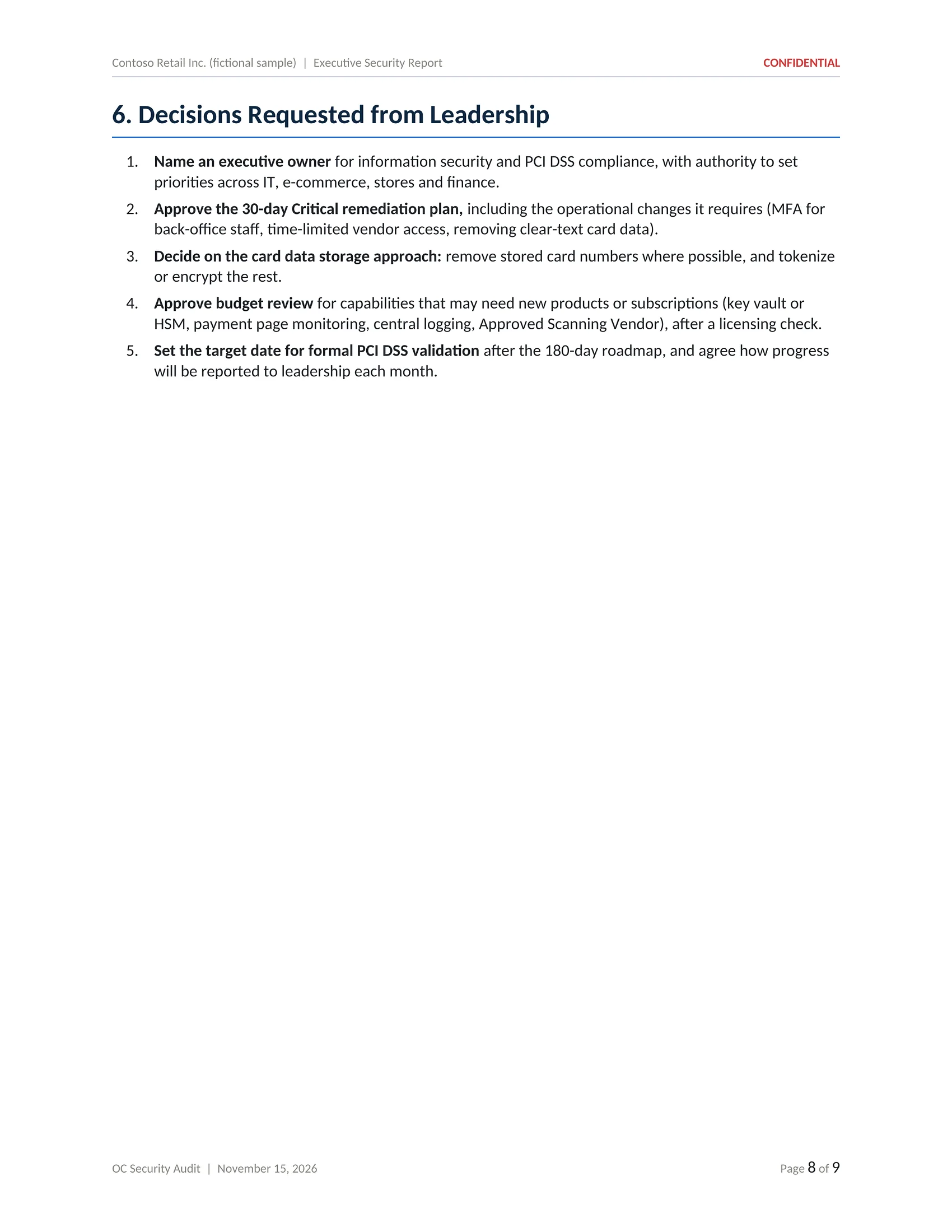
Executive Security Report, slide 7 of 8: Decisions requested from leadership (fictional company, illustrative data)
Slide 7 of 8Decisions requested from leadershipThe decisions only leadership can make: an executive owner for PCI DSS, approval of the 30-day Critical plan, the card data storage approach, a budget review and a validation date.
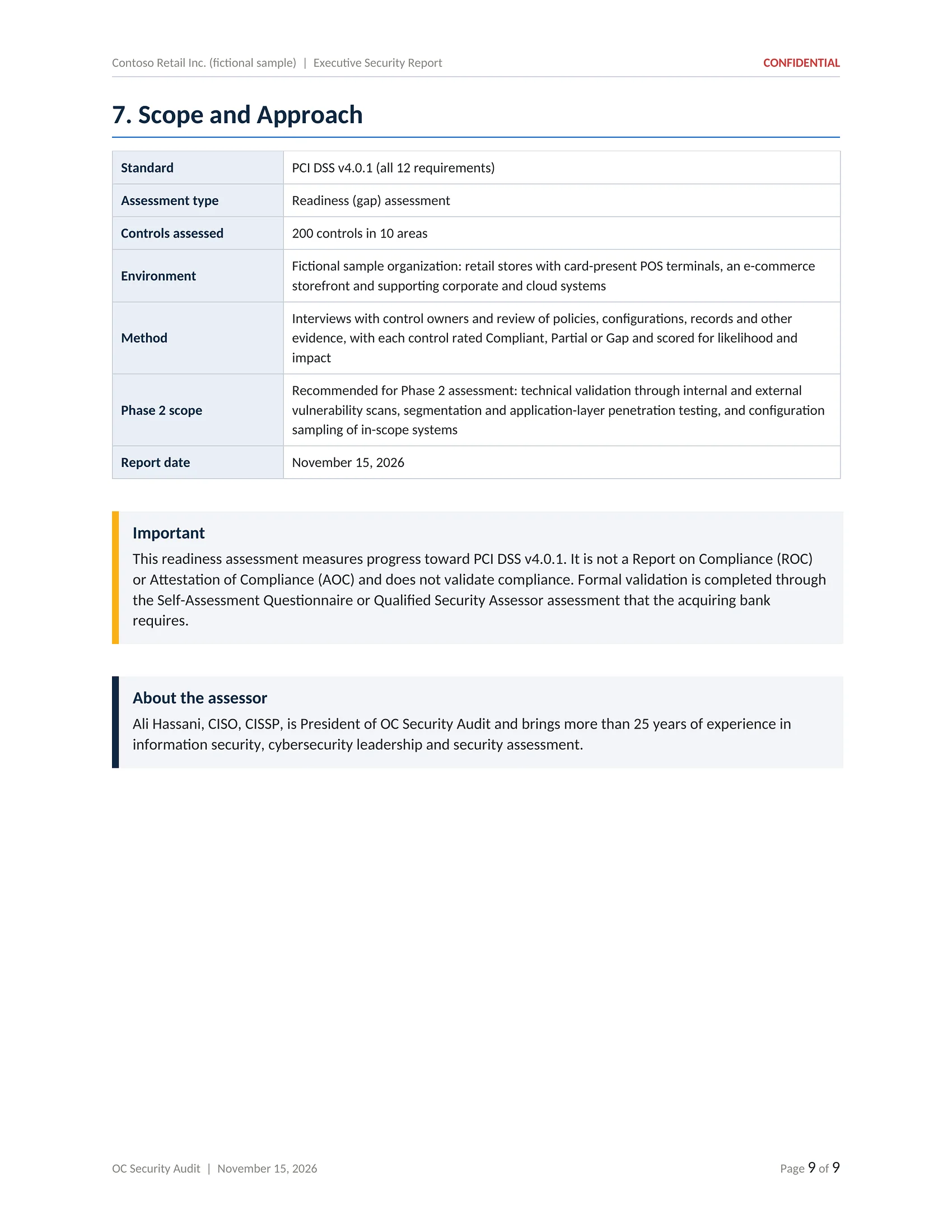
Executive Security Report, slide 8 of 8: Scope and approach (fictional company, illustrative data)
Slide 8 of 8Scope and approachStandard, assessment type, the 200 controls in 10 areas, the method, recommended Phase 2 technical testing and a note that a readiness assessment is not a formal PCI DSS validation.

Click the page in the centre to open it full size and zoom in.

Deliverable 2 of 5 · PDF and Word · 69 pages

Technical Security Report

The working document for whoever does the fixes. Every finding shows the PCI DSS v4.0.1 requirement, what was observed, the business impact, the exact recommendation, the closure evidence and the owner and target date, grouped into 10 areas and ordered by severity.

Who uses it

IT team or managed service provider, e-commerce developers, the network and security engineers, and the compliance lead who prepares the SAQ or the QSA evidence.

PCI DSS 1 Network security controlsPCI DSS 3 Stored account dataPCI DSS 6.4.3 and 11.6.1 Payment page scriptsPCI DSS 8.4 Multi-factor authentication

What is included

  1. Control results for all 12 requirements
  2. Index of all 142 findings
  3. Twelve Critical findings first
  4. Where card data is exposed
  5. Every access path into the CDE
  6. Findings with fix and closure evidence
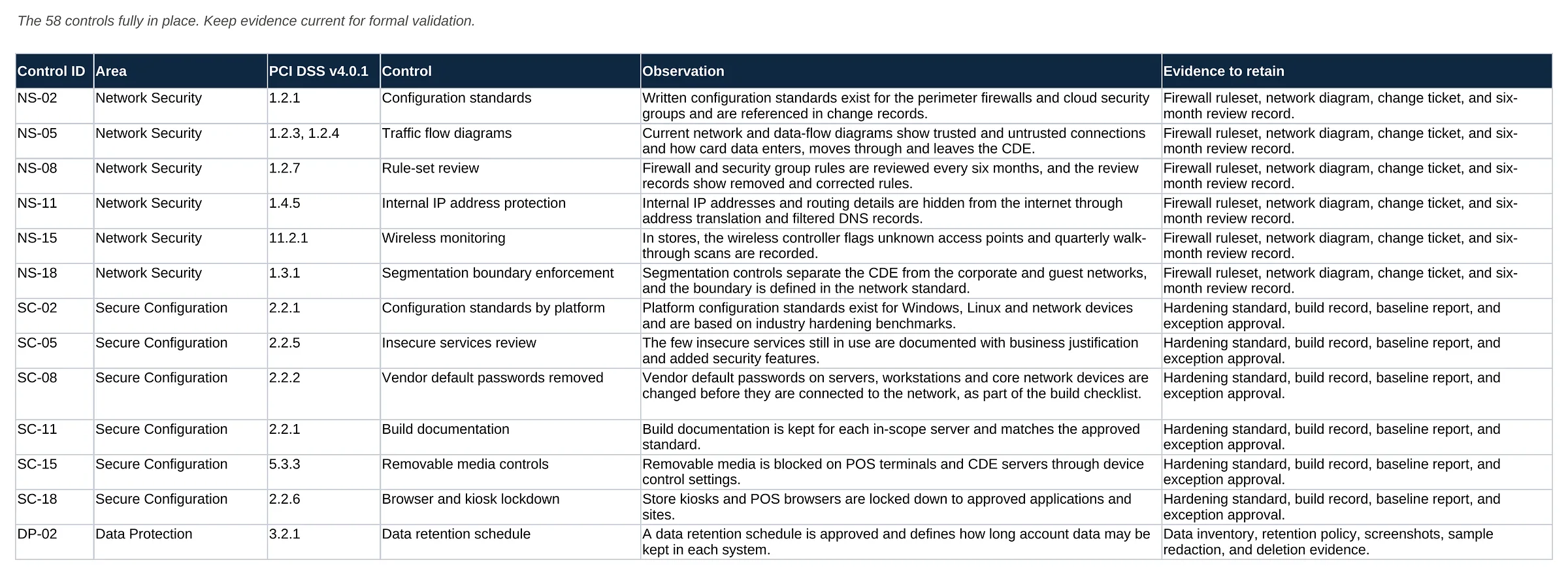
  7. 58 controls meeting the benchmark
  8. Mapping to NIST CSF 2.0 and ISO 27001

SAMPLE · Contoso Retail Inc. (fictional)

1 / 14
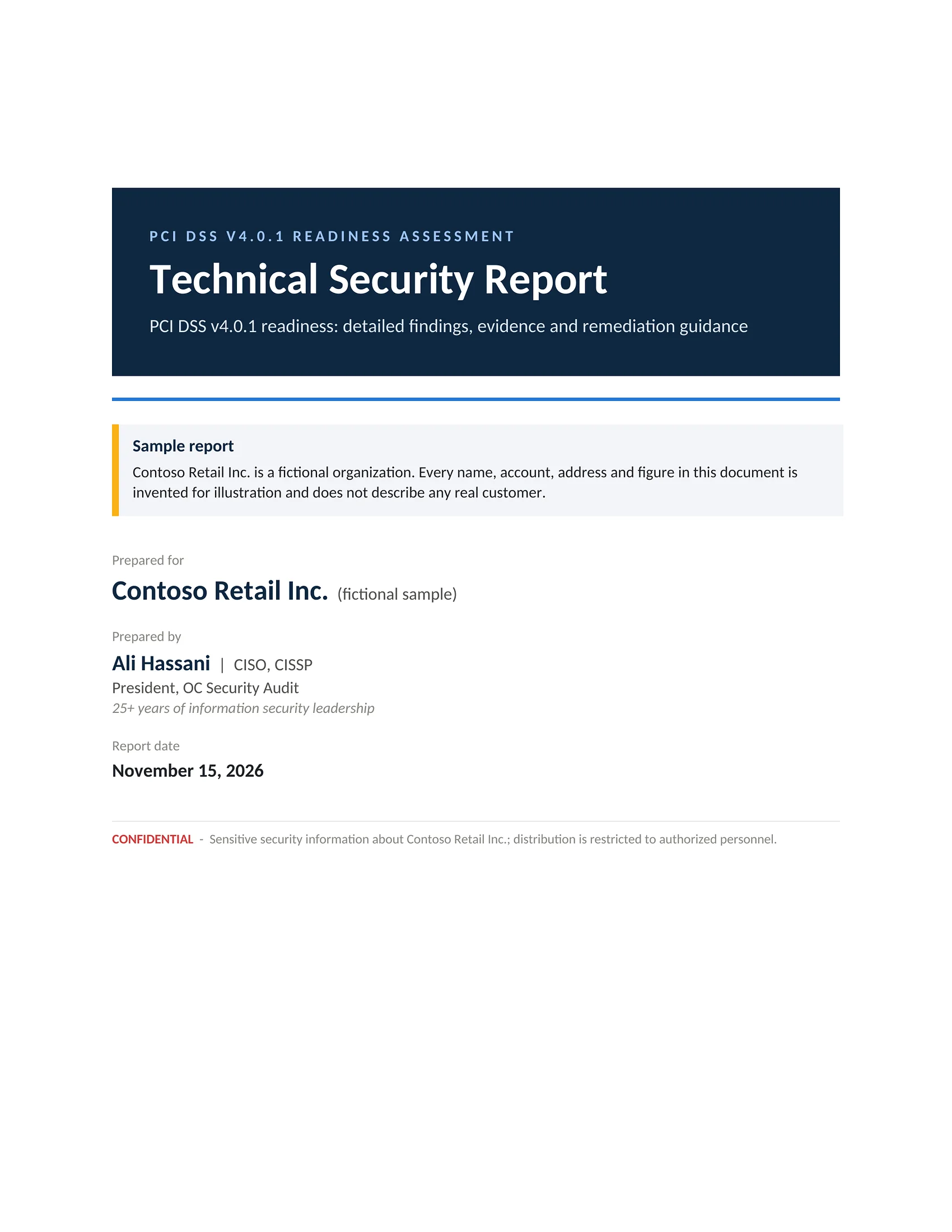
Technical Security Report, slide 1 of 14: Cover page (fictional company, illustrative data)
Slide 1 of 14Cover pageThe Technical Security Report: detailed findings, evidence and remediation guidance for the IT, security and compliance teams.
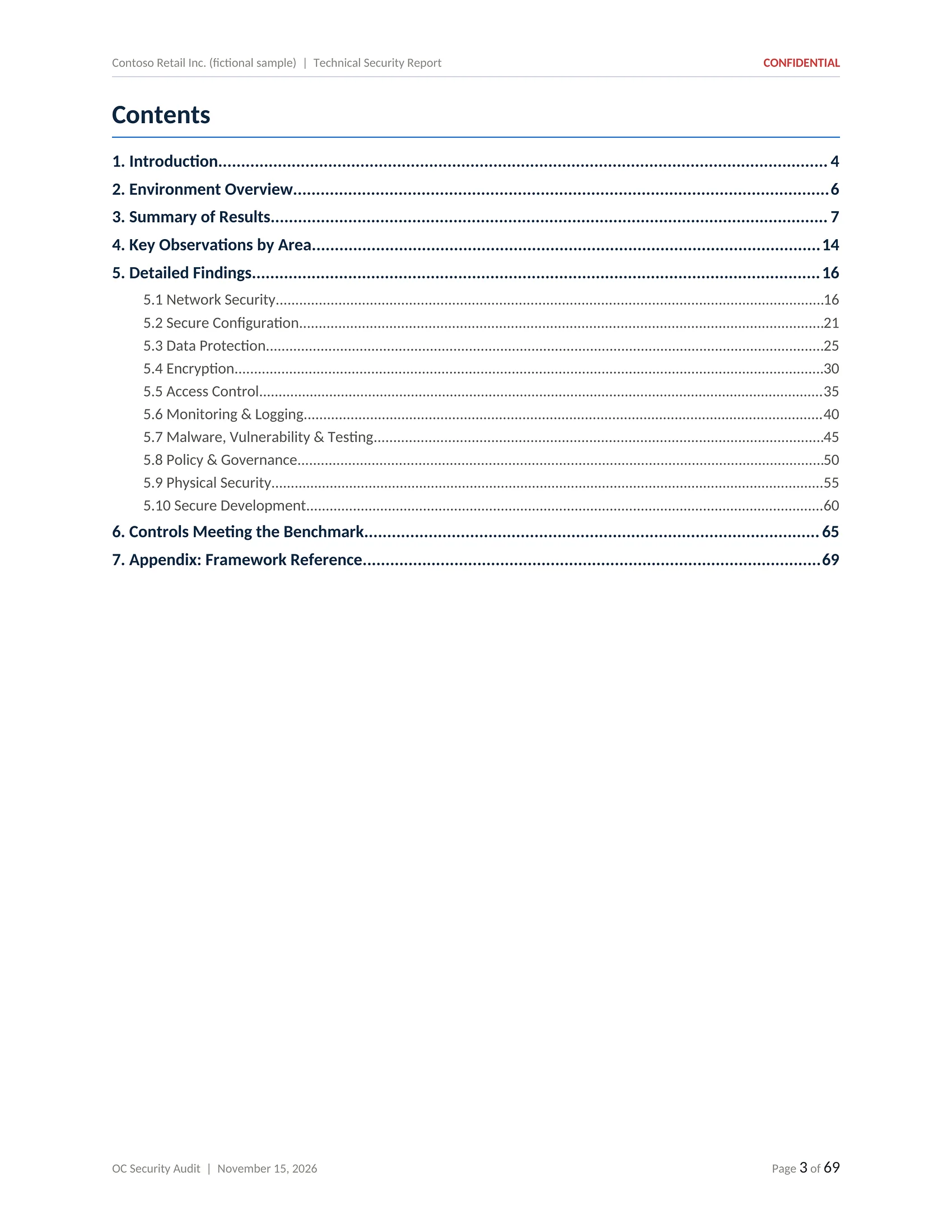
Technical Security Report, slide 2 of 14: Contents (fictional company, illustrative data)
Slide 2 of 14ContentsIntroduction, environment overview, summary of results, key observations, detailed findings in 10 areas, controls meeting the benchmark and the framework reference appendix.
Technical Security Report, slide 3 of 14: Introduction, scope and method (fictional company, illustrative data)
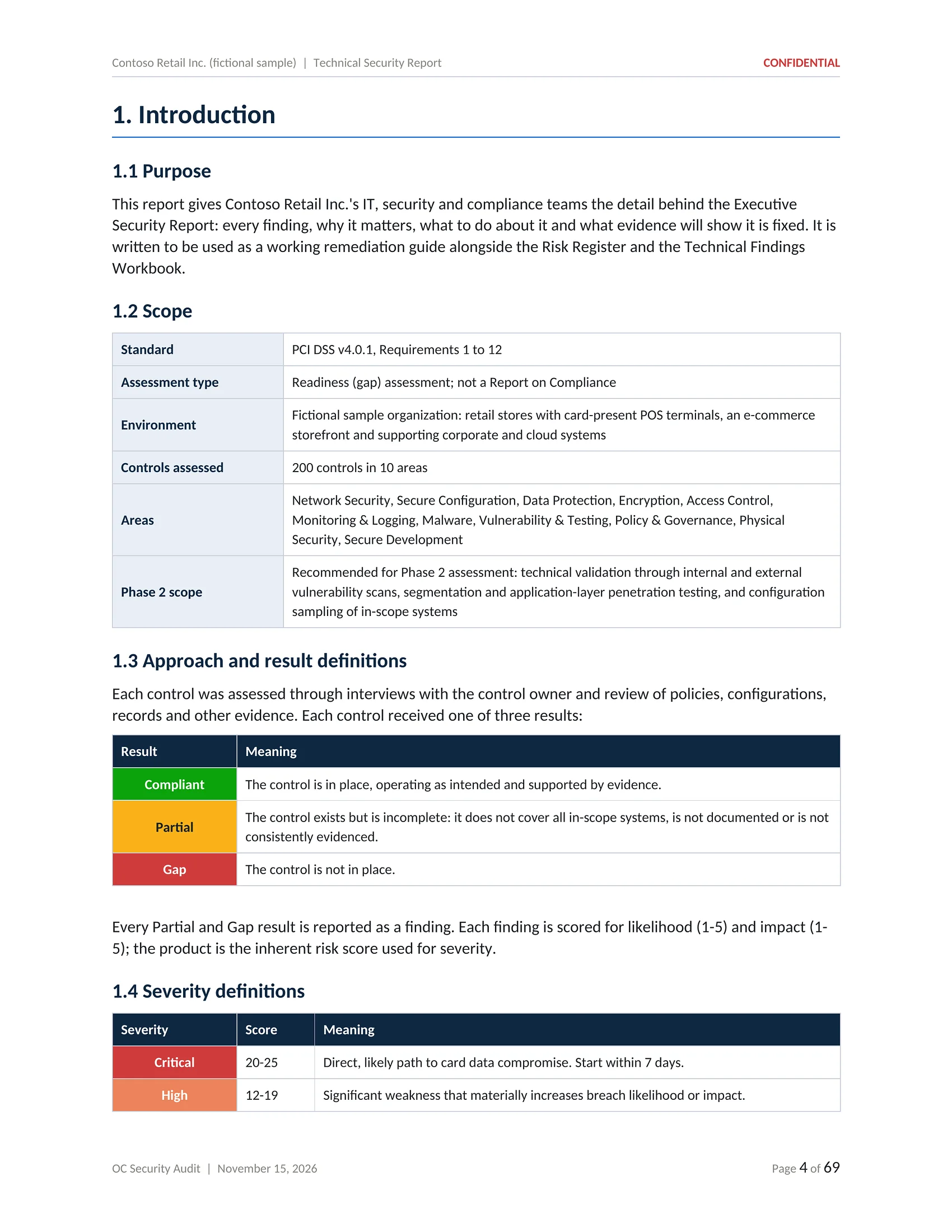
Slide 3 of 14Introduction, scope and methodPurpose, scope (PCI DSS v4.0.1 Requirements 1 to 12, readiness rather than a Report on Compliance), how each control is rated and how severity is scored.
Technical Security Report, slide 4 of 14: Environment overview by requirement (fictional company, illustrative data)
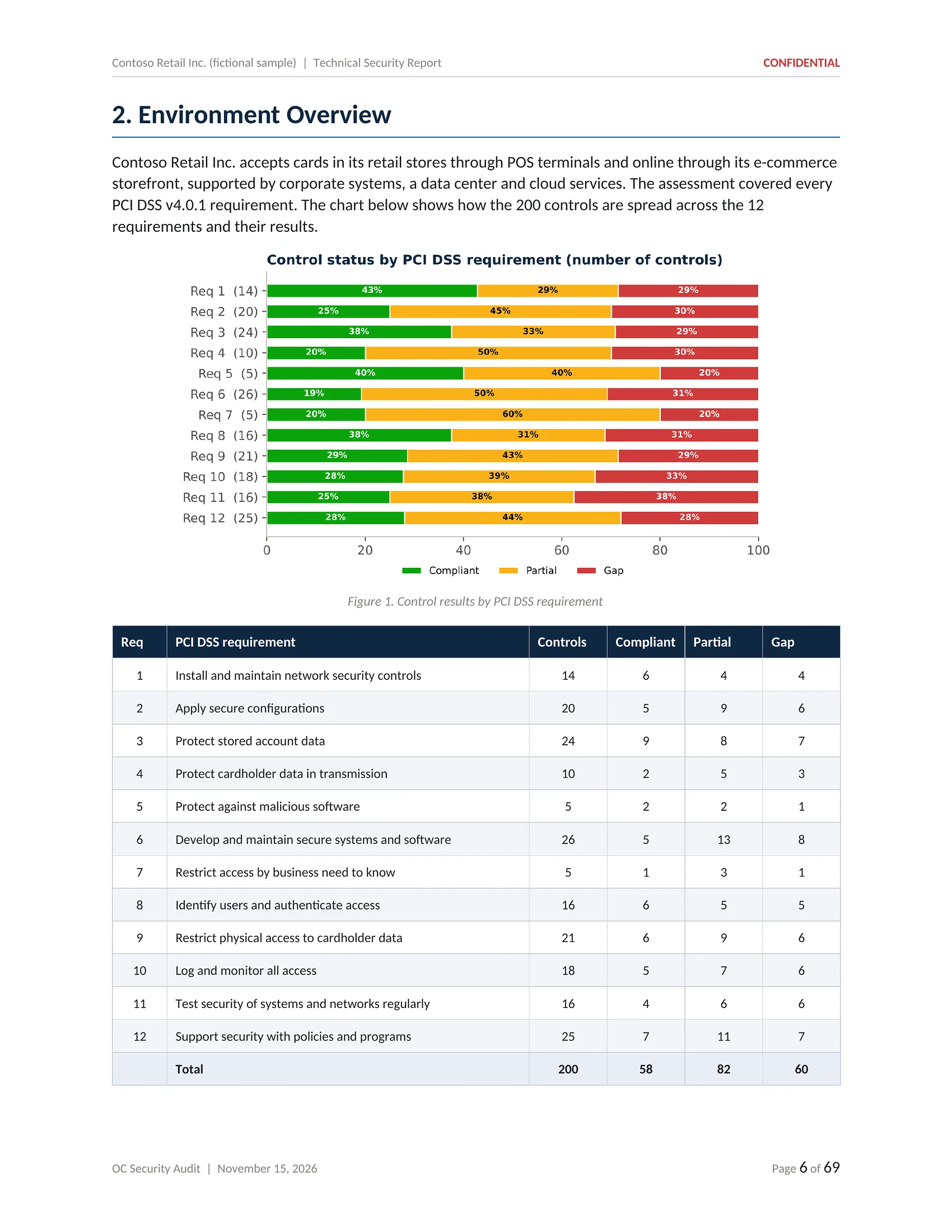
Slide 4 of 14Environment overview by requirementHow the 200 controls spread across the 12 PCI DSS requirements, with compliant, partial and gap counts for each requirement.
Technical Security Report, slide 5 of 14: Summary of results (fictional company, illustrative data)
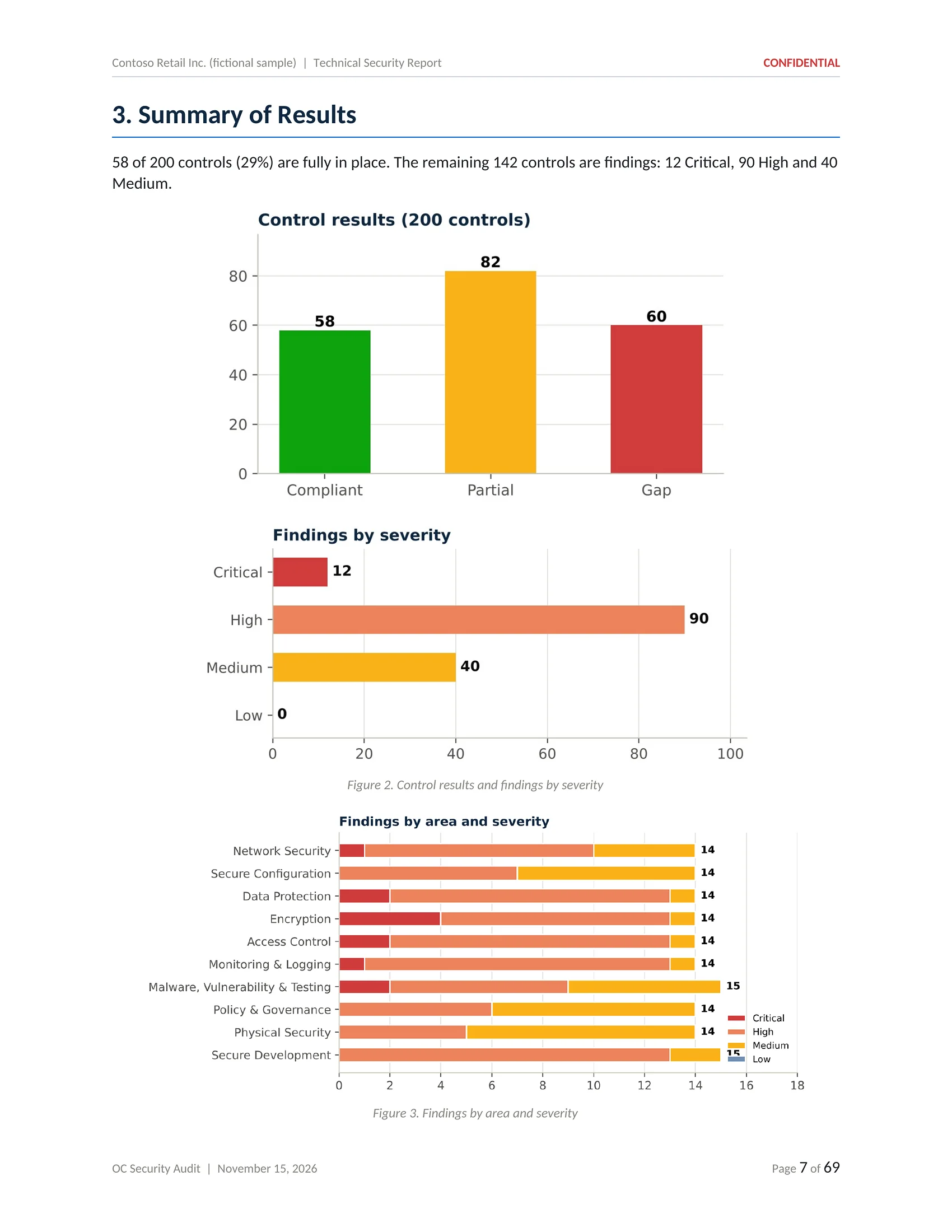
Slide 5 of 14Summary of results58 of 200 controls fully in place and 142 findings: 12 Critical, 90 High and 40 Medium, shown by result, severity and area.
Technical Security Report, slide 6 of 14: Readiness by area and findings index (fictional company, illustrative data)
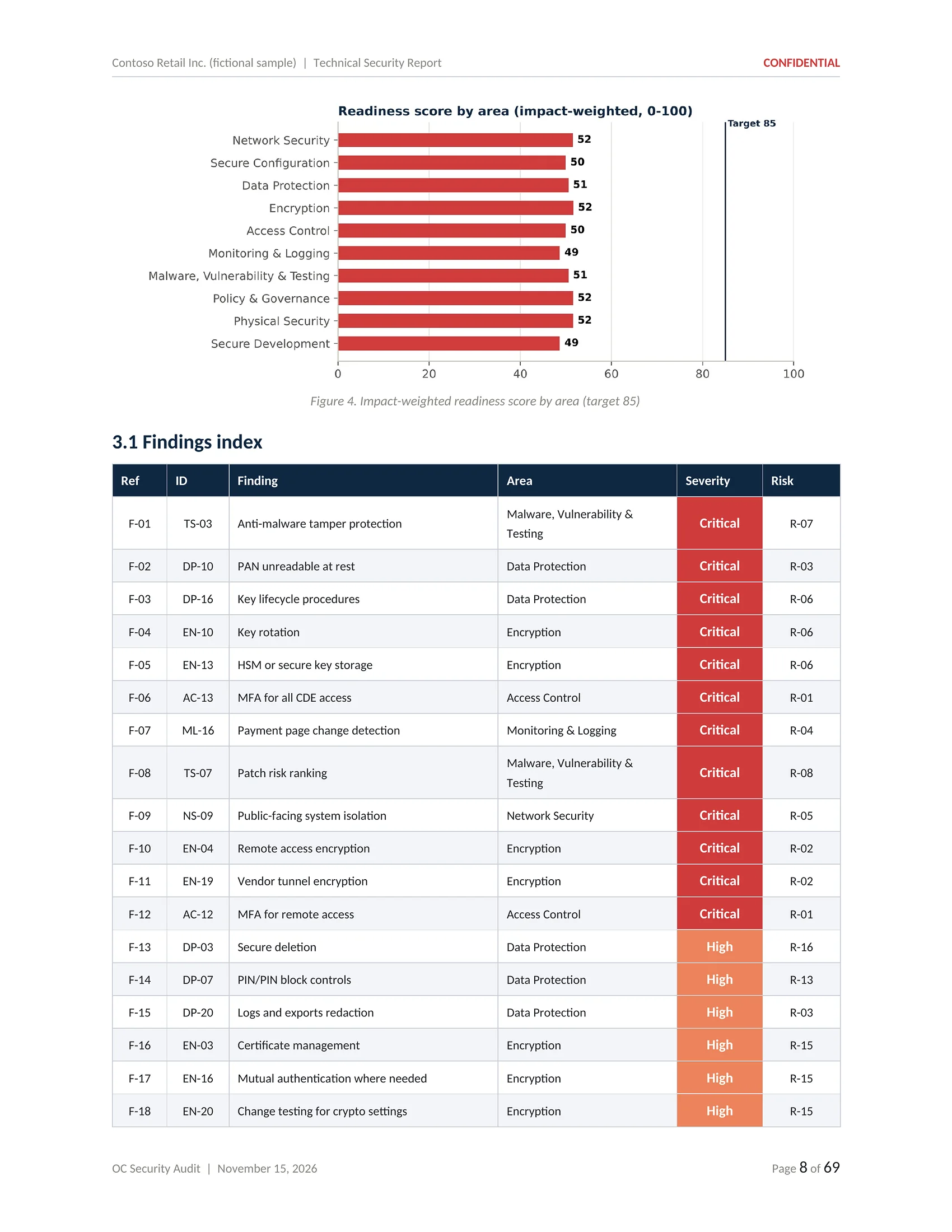
Slide 6 of 14Readiness by area and findings indexImpact-weighted readiness score for each area against the target of 85, and the start of the index of all 142 findings with area, severity and linked risk.
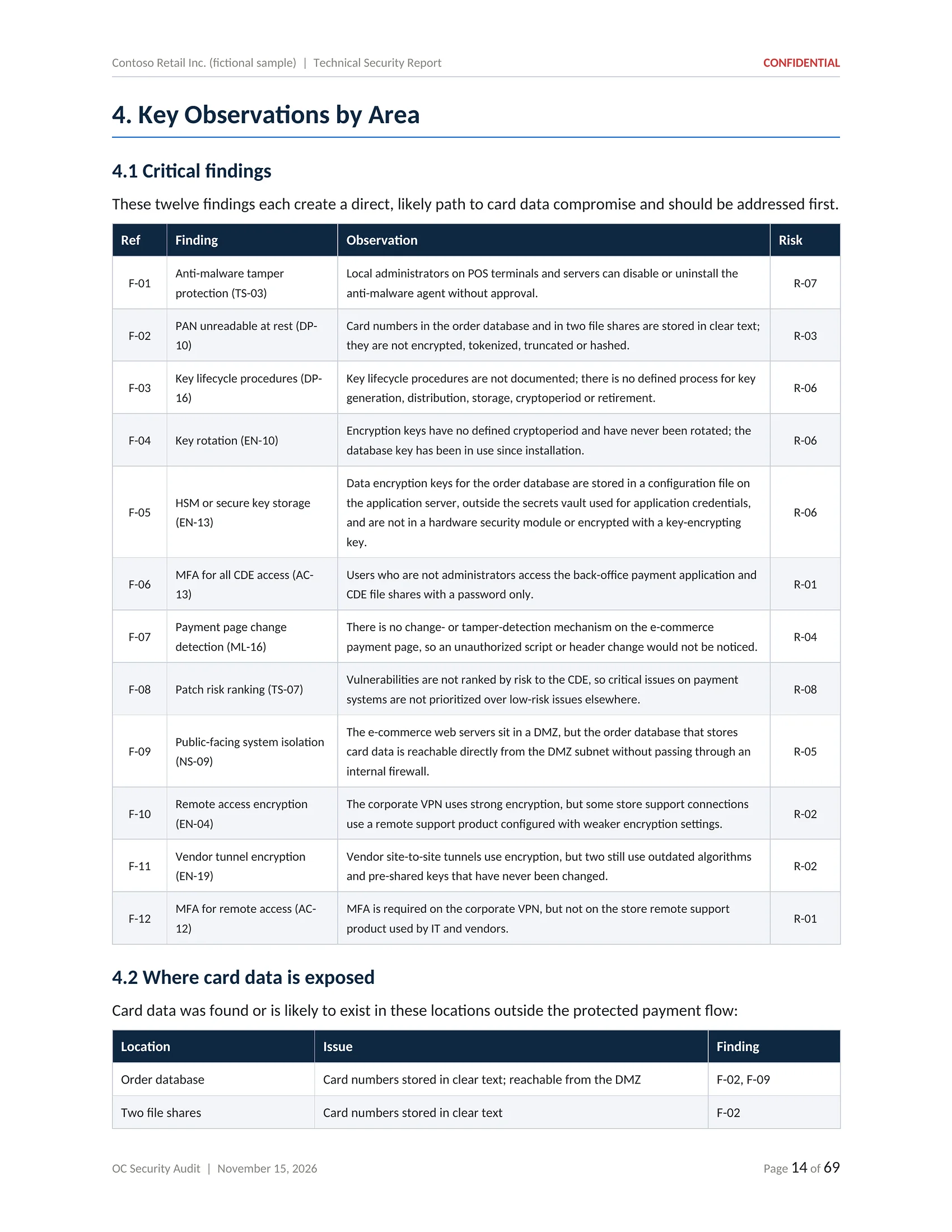
Technical Security Report, slide 7 of 14: Critical findings (fictional company, illustrative data)
Slide 7 of 14Critical findingsThe twelve Critical findings that each create a direct path to card data compromise, with the observation and the business risk each one feeds.
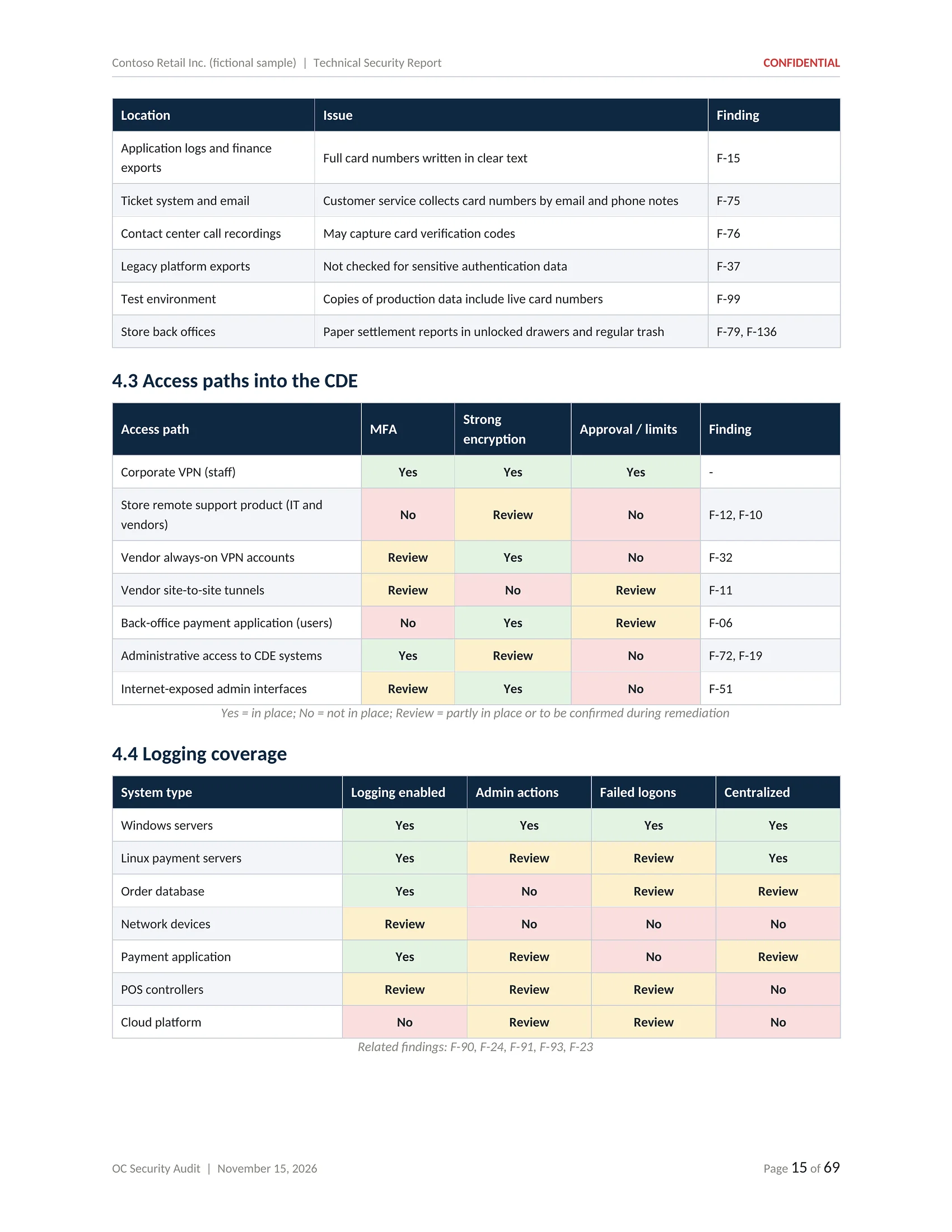
Technical Security Report, slide 8 of 14: Where card data is exposed and how the CDE is reached (fictional company, illustrative data)
Slide 8 of 14Where card data is exposed and how the CDE is reachedPlaces where card numbers or verification codes appear outside the intended systems, and every access path into the cardholder data environment rated for encryption, MFA and approval.
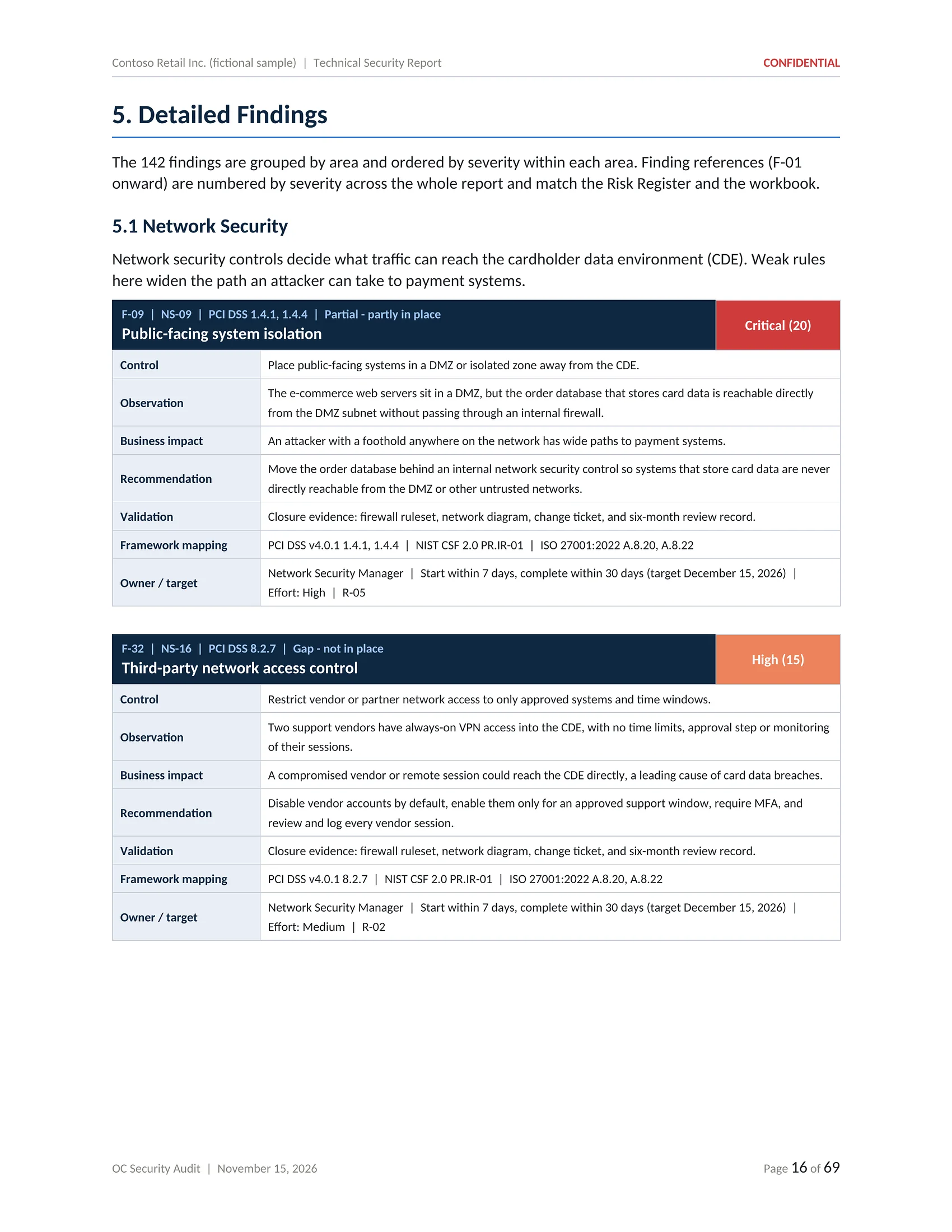
Technical Security Report, slide 9 of 14: Detailed findings: network security (fictional company, illustrative data)
Slide 9 of 14Detailed findings: network securityThe first detailed findings, starting with the order database reachable from the DMZ: control, observation, business impact, recommendation and validation for each.
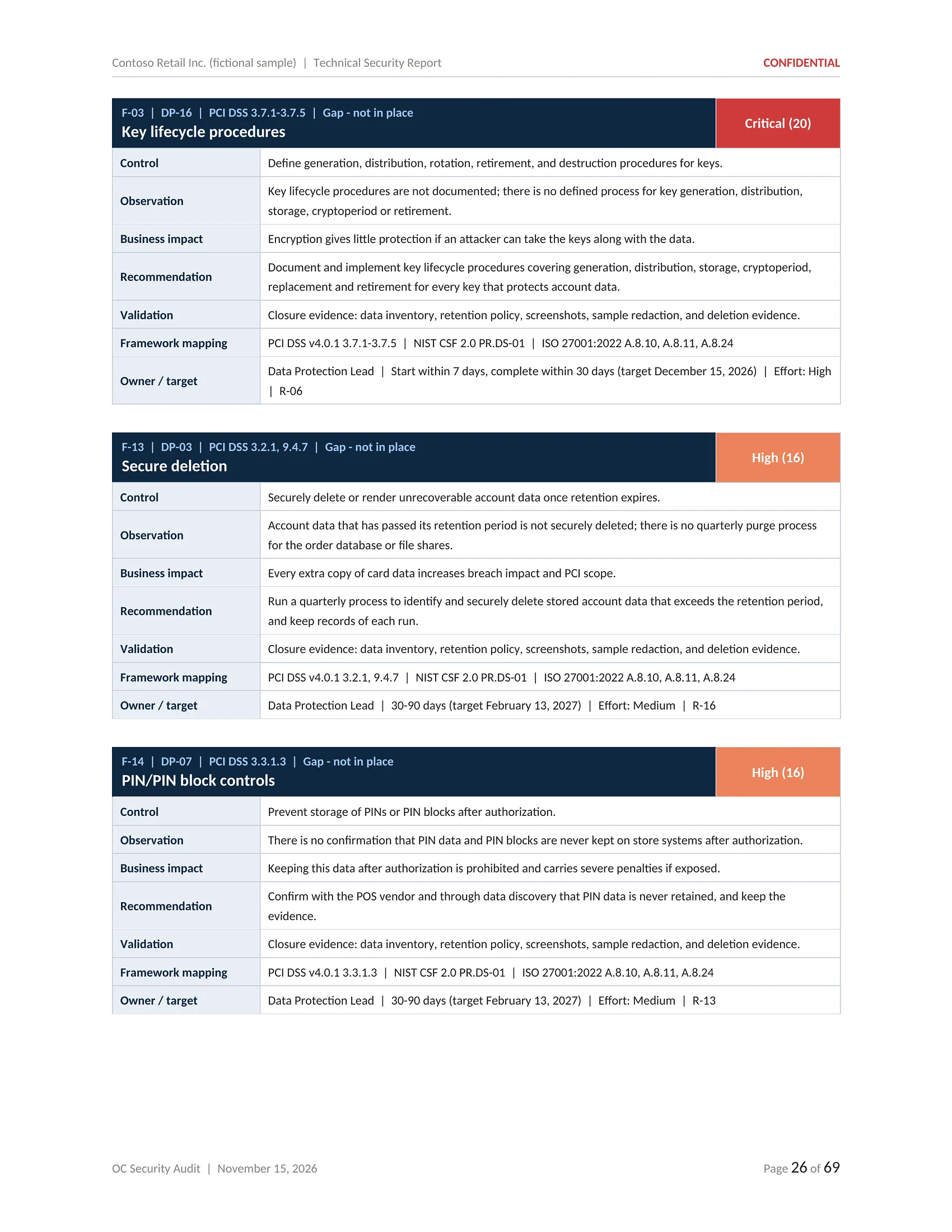
Technical Security Report, slide 10 of 14: Detailed finding: key lifecycle procedures (fictional company, illustrative data)
Slide 10 of 14Detailed finding: key lifecycle proceduresA Critical encryption finding: no documented process for key generation, distribution, storage, cryptoperiod or retirement, with the fix and the closure evidence.
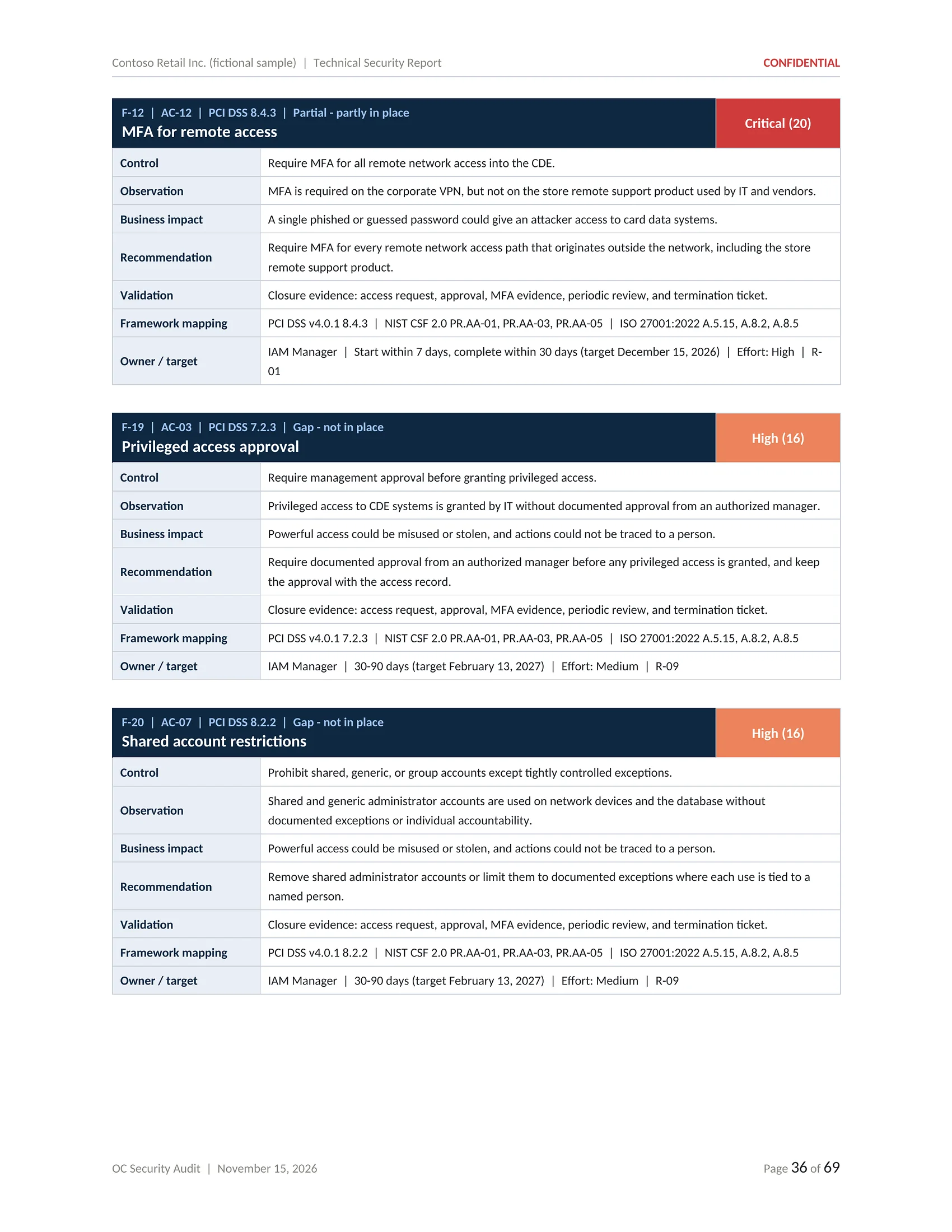
Technical Security Report, slide 11 of 14: Detailed finding: MFA for remote access (fictional company, illustrative data)
Slide 11 of 14Detailed finding: MFA for remote accessMFA on the corporate VPN but not on the store remote support product used by IT and vendors, with the recommendation, framework mapping, owner and target date.
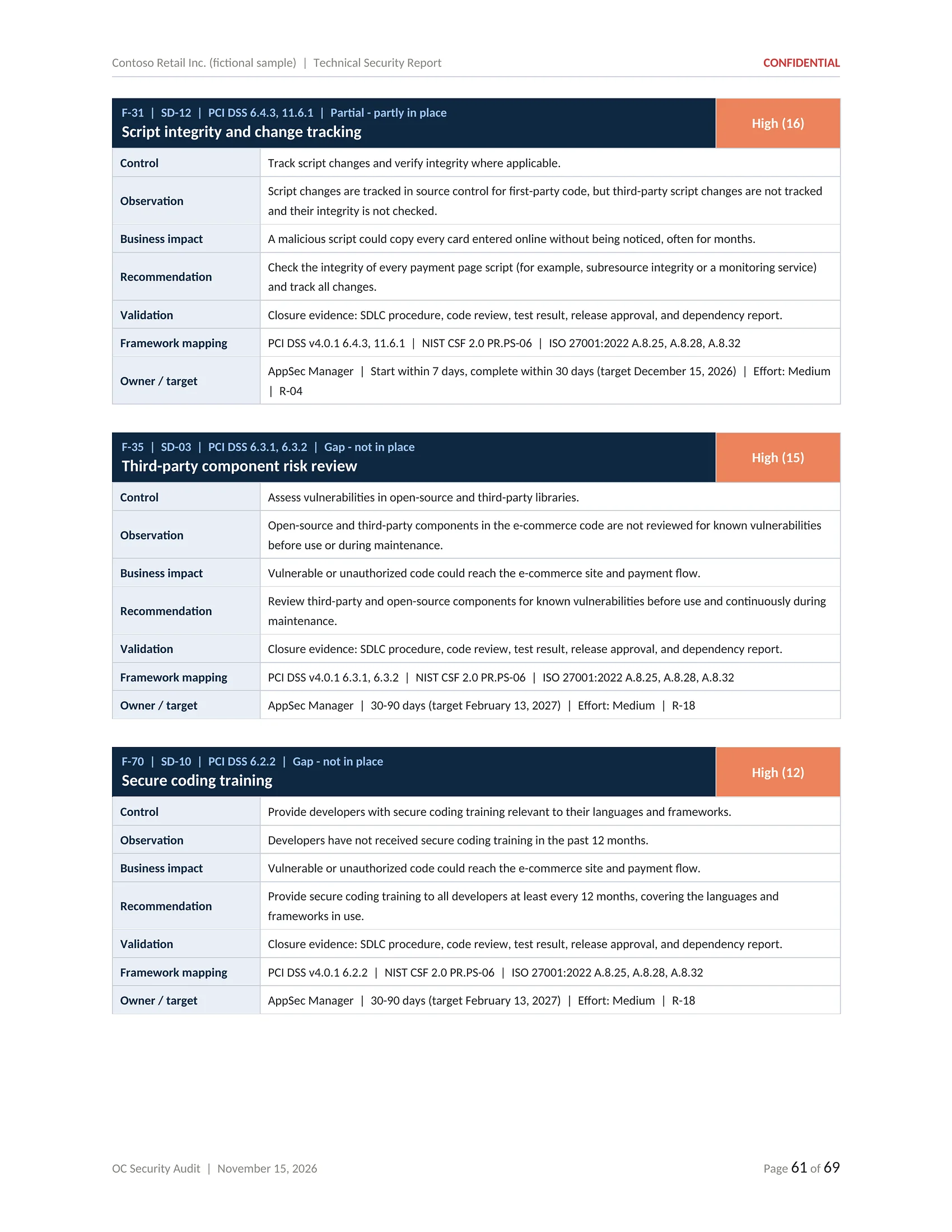
Technical Security Report, slide 12 of 14: Detailed finding: payment page scripts (fictional company, illustrative data)
Slide 12 of 14Detailed finding: payment page scriptsThird-party scripts on the e-commerce payment page are not tracked or integrity-checked, mapped to PCI DSS 6.4.3 and 11.6.1, the e-skimming controls.
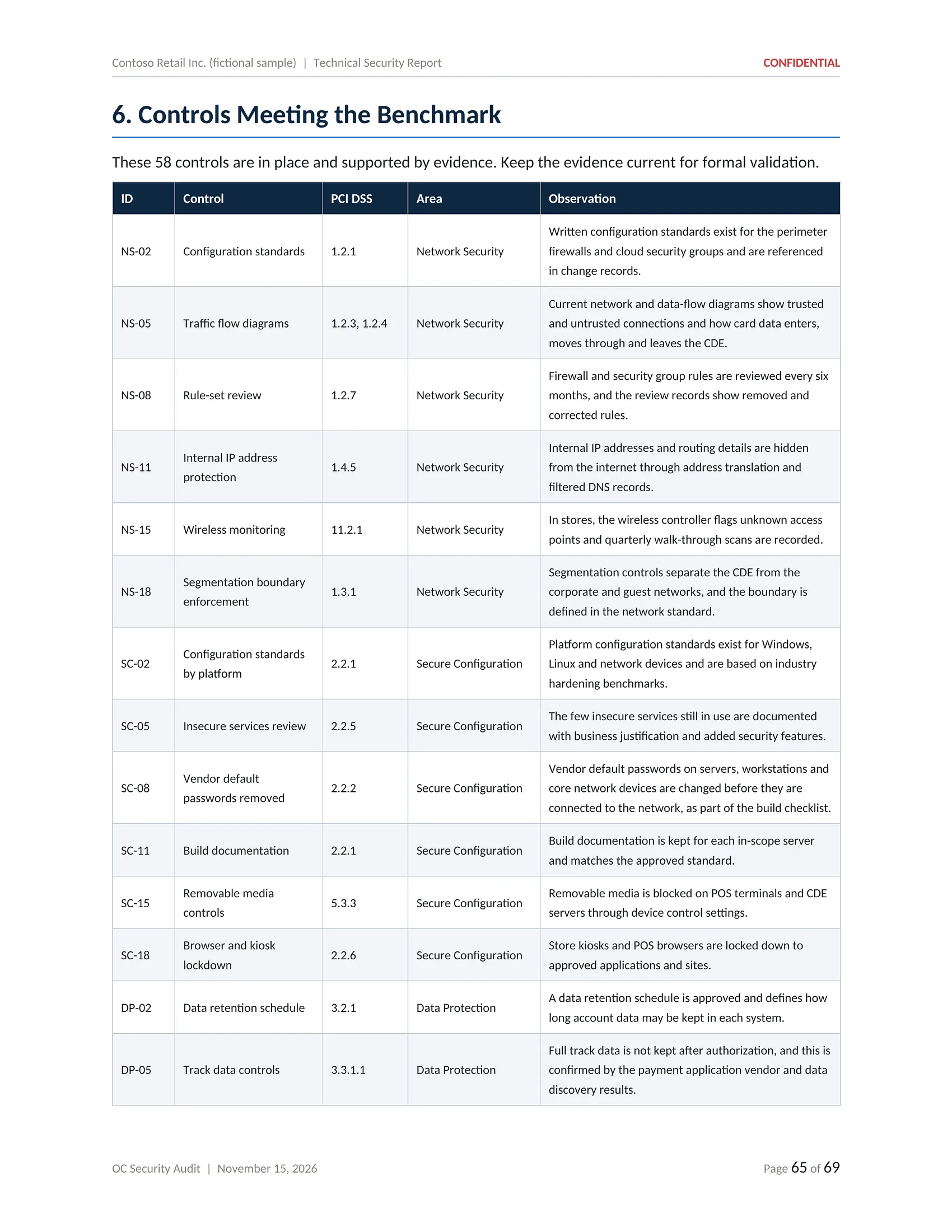
Technical Security Report, slide 13 of 14: Controls meeting the benchmark (fictional company, illustrative data)
Slide 13 of 14Controls meeting the benchmarkThe 58 controls already in place and supported by evidence, with the observation for each, to keep current for formal validation.
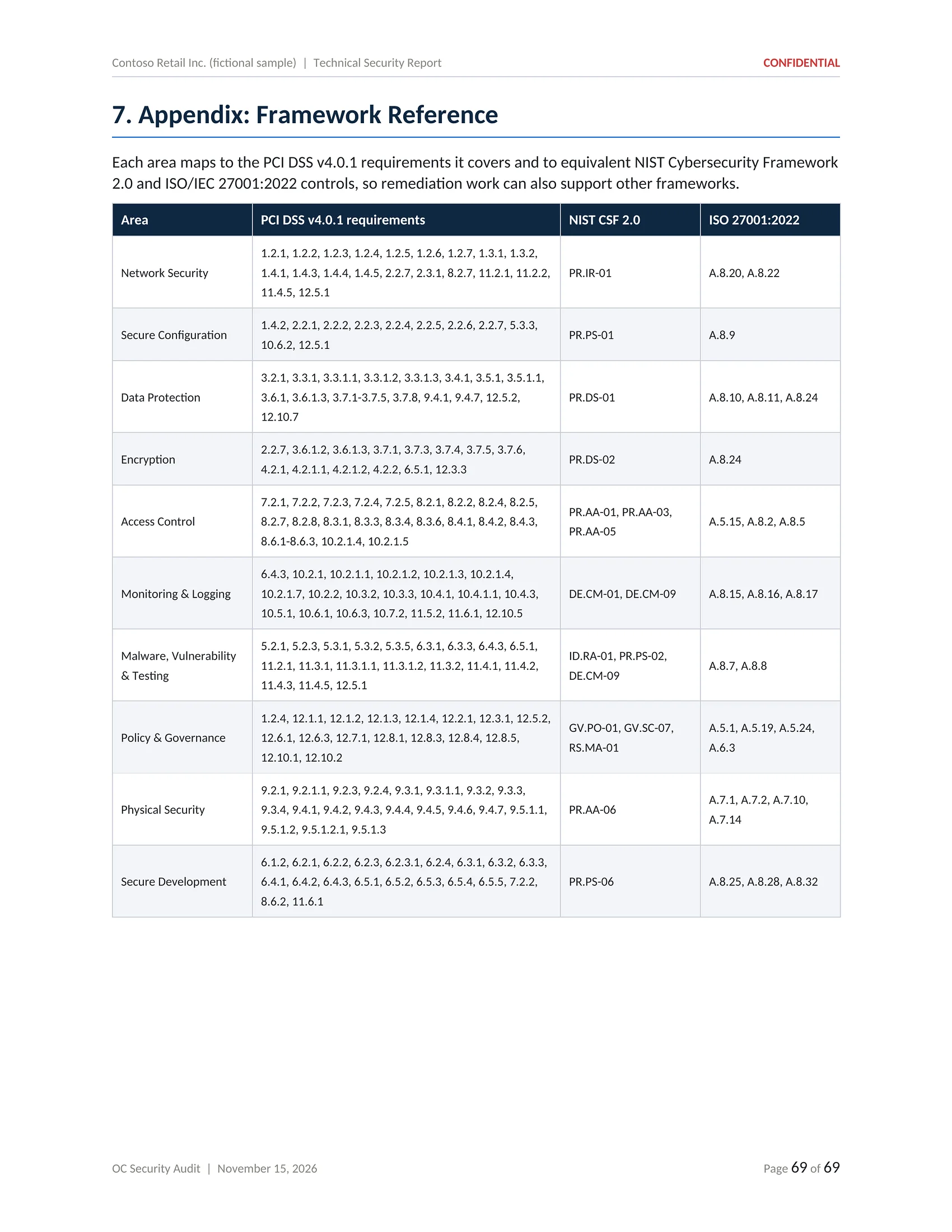
Technical Security Report, slide 14 of 14: Appendix: framework reference (fictional company, illustrative data)
Slide 14 of 14Appendix: framework referenceEach area mapped to the PCI DSS v4.0.1 requirements it covers and to NIST CSF 2.0 and ISO/IEC 27001:2022 controls.

Click the page in the centre to open it full size and zoom in.

Deliverable 3 of 5 · PDF and Word · 25 pages · landscape

Risk Register

The 142 findings rolled up into 24 business risks, each scored for likelihood and impact on card data, card acceptance and the business, with an owner, a treatment, a target rating and a target date. It doubles as the starting point for the targeted risk analyses PCI DSS v4.0.1 asks for.

Who uses it

The executive owner for PCI DSS, the GRC or compliance manager at the monthly risk review, your acquiring bank or processor contact if they ask, and your cyber insurance broker.

PCI DSS 12.3.1 Targeted risk analysisPCI DSS 12.4 AccountabilityPCI DSS 12.10 Incident response

What is included

  1. Scoring method from 1 to 25
  2. Heat maps today and after treatment
  3. Summary of all 24 risks
  4. Full record for each risk
  5. Linked findings for every risk
  6. Owner, target date and rating
  7. Finding-to-risk traceability

SAMPLE · Contoso Retail Inc. (fictional)

1 / 9
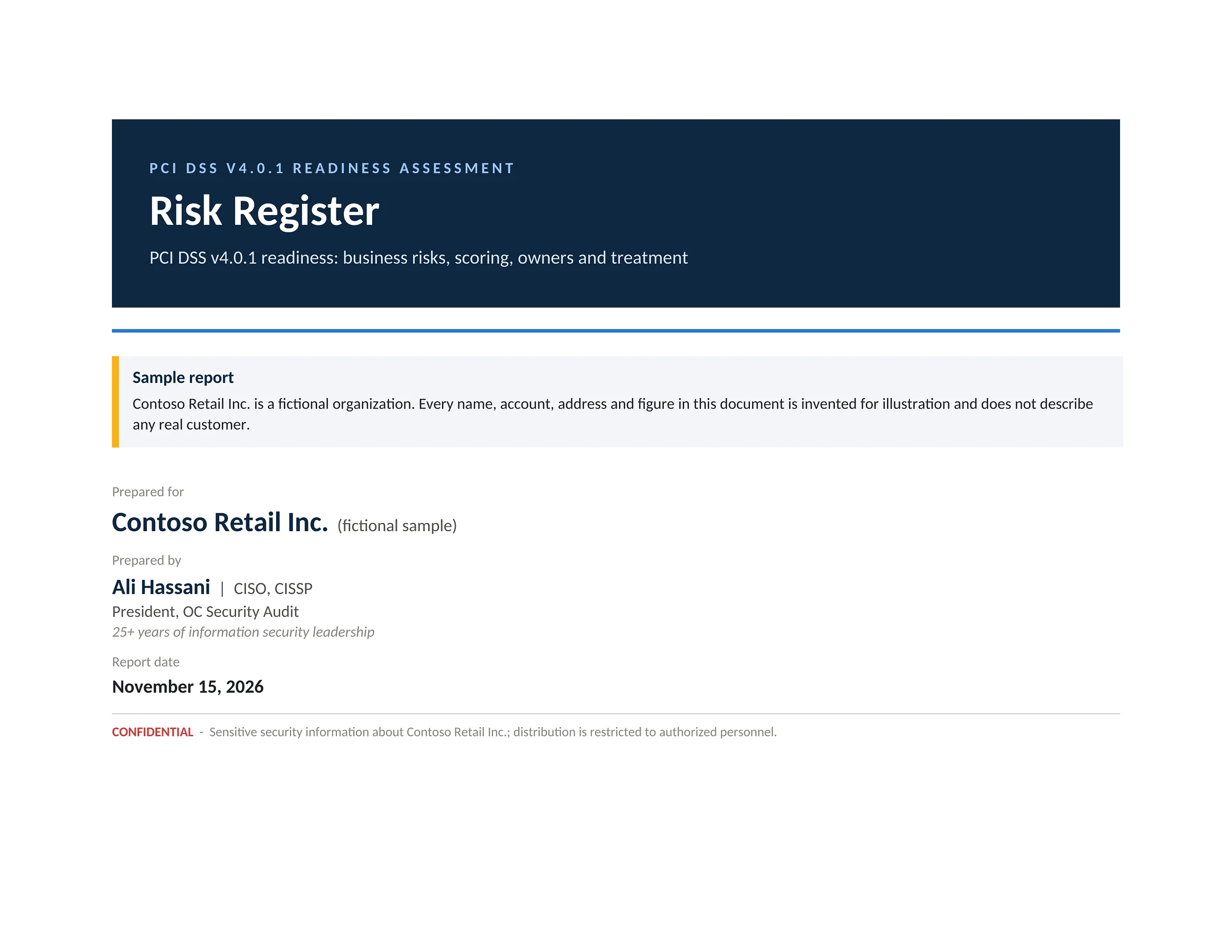
Risk Register, slide 1 of 9: Cover page (fictional company, illustrative data)
Slide 1 of 9Cover pageThe Risk Register: business risks, scoring, owners and treatment for Contoso Retail Inc.
Risk Register, slide 2 of 9: Risk scoring method (fictional company, illustrative data)
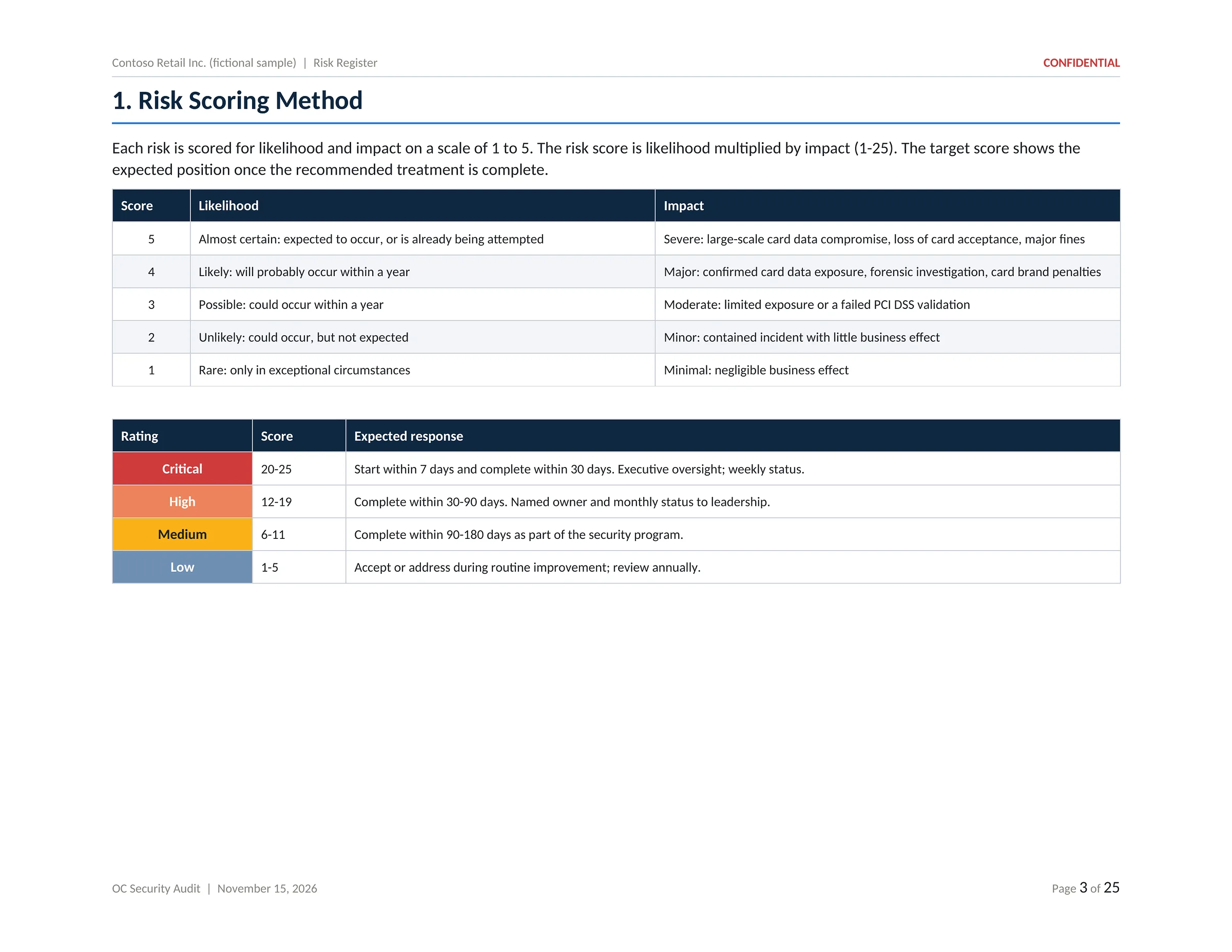
Slide 2 of 9Risk scoring methodLikelihood and impact on a 1 to 5 scale, written for a card-accepting business, multiplied into a risk score from 1 to 25 with rating bands.
Risk Register, slide 3 of 9: Risk profile and heat maps (fictional company, illustrative data)
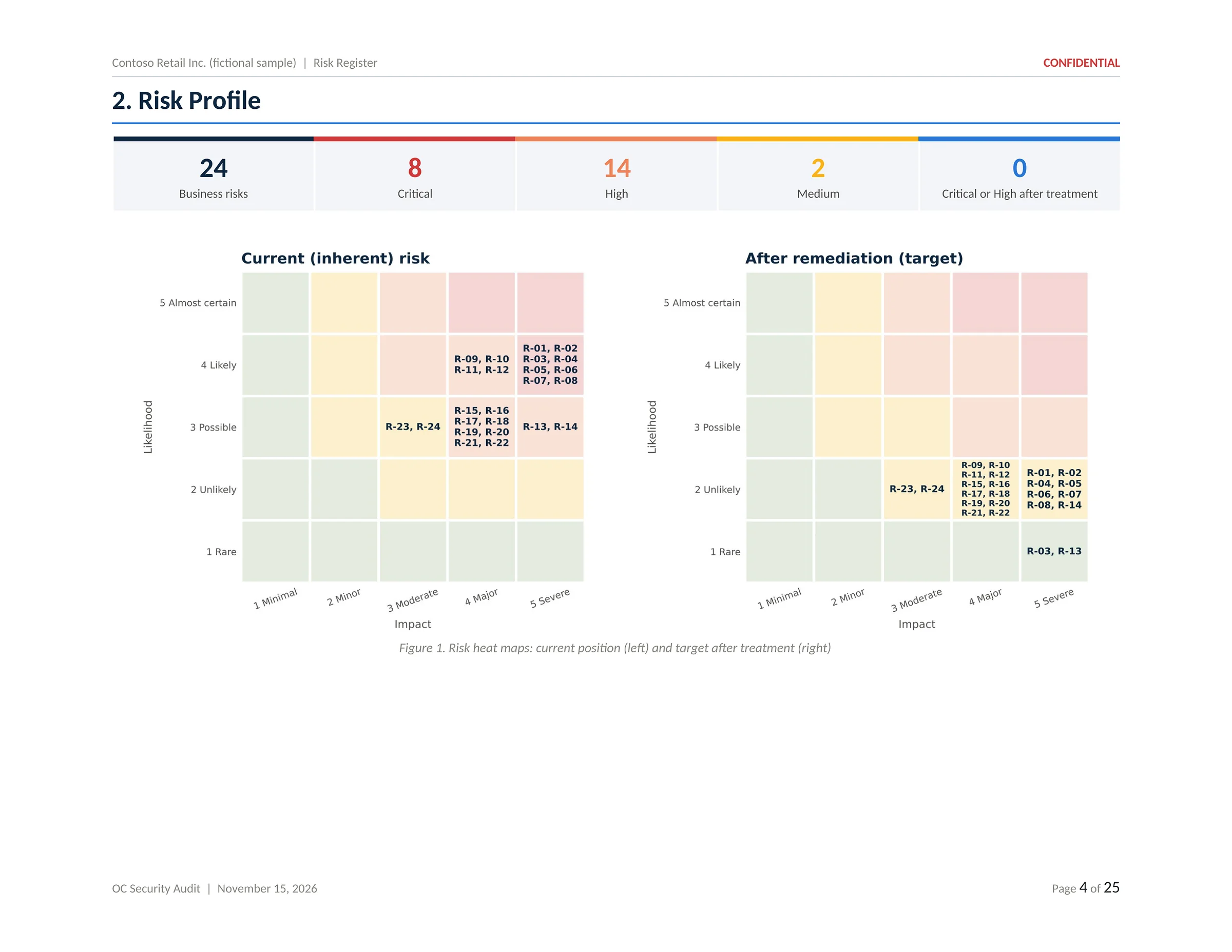
Slide 3 of 9Risk profile and heat maps24 business risks, 8 Critical, 14 High and 2 Medium, on a heat map today and after treatment, when none remain Critical or High.
Risk Register, slide 4 of 9: Risk summary (fictional company, illustrative data)
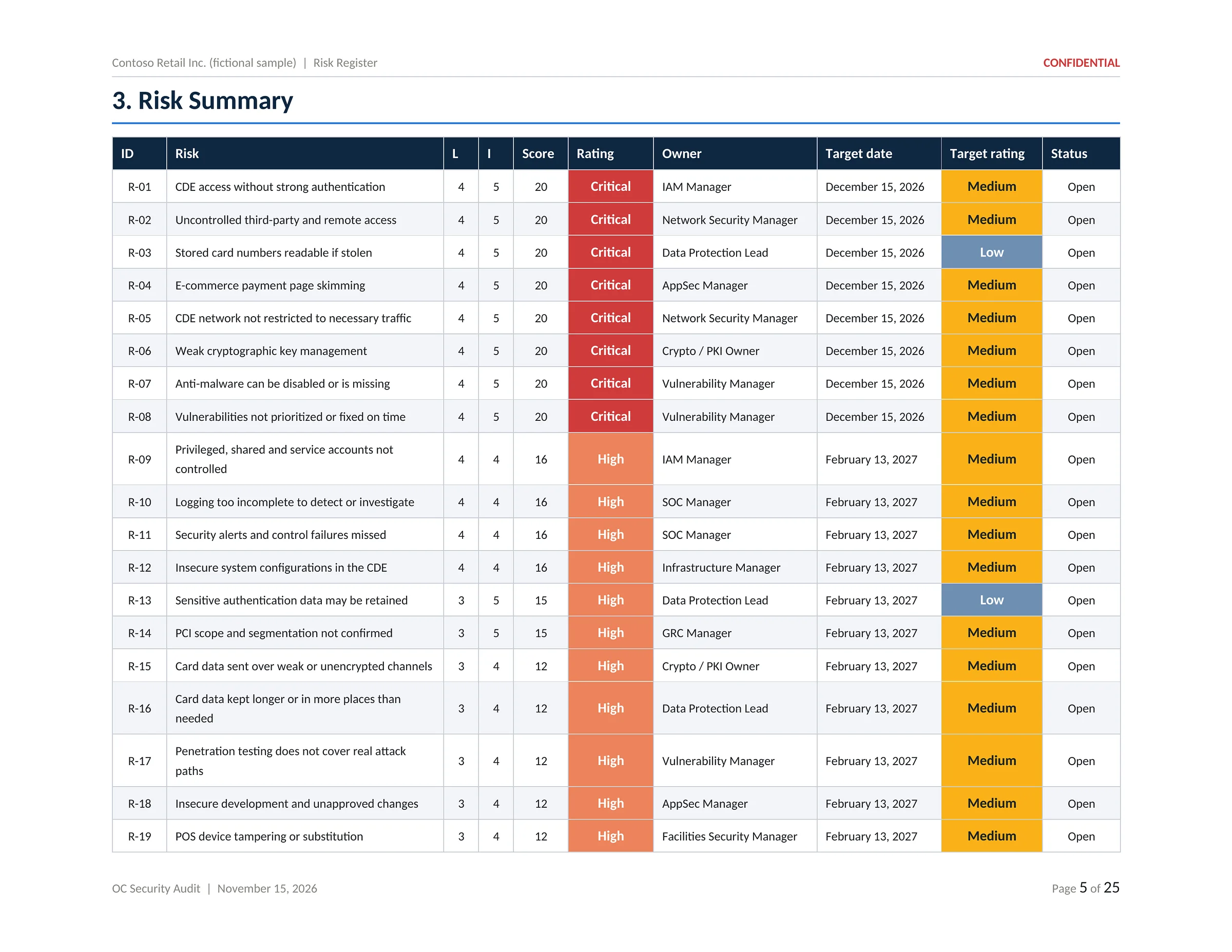
Slide 4 of 9Risk summaryAll risks in one table with likelihood, impact, score, rating, owner, target date and target rating.
Risk Register, slide 5 of 9: Risk summary and before-and-after chart (fictional company, illustrative data)
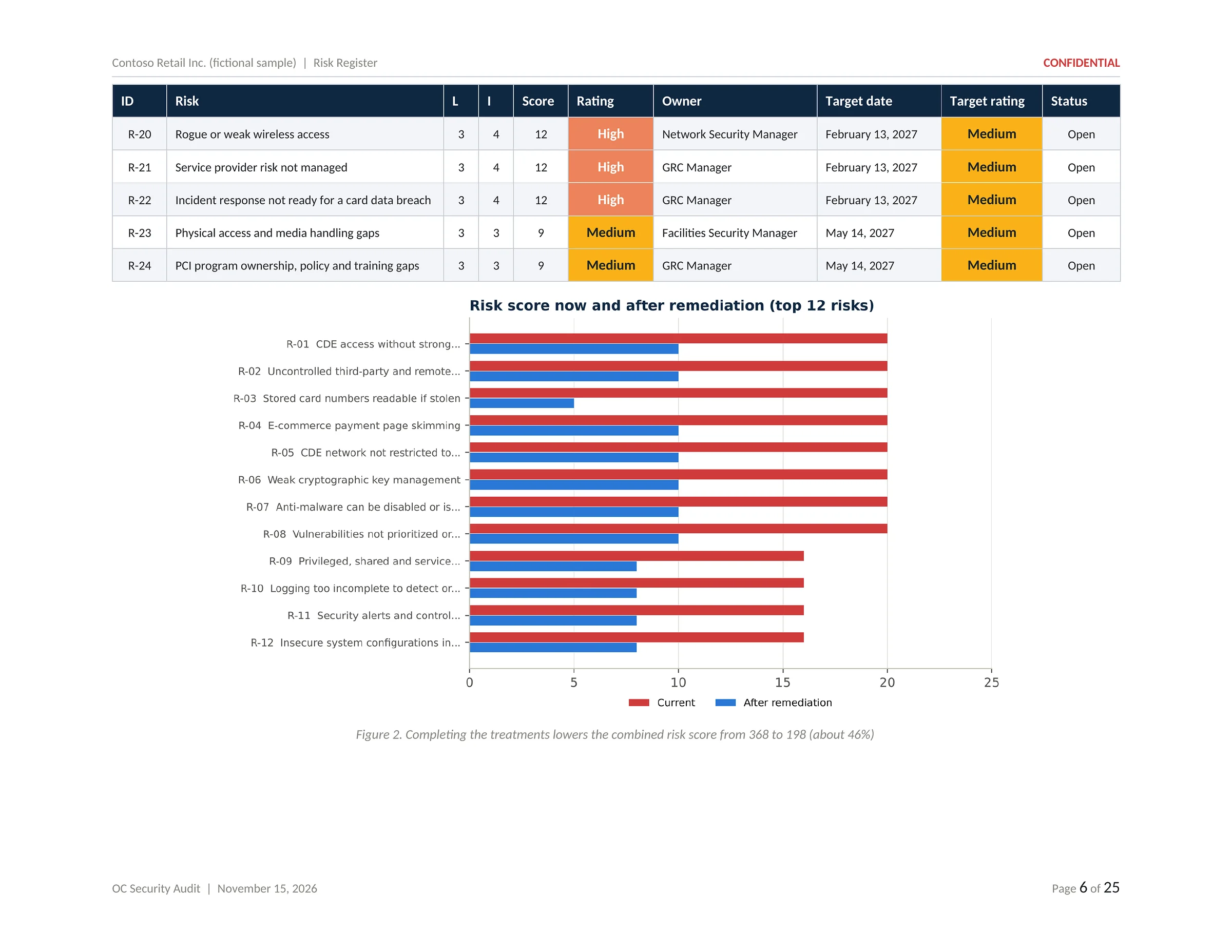
Slide 5 of 9Risk summary and before-and-after chartThe rest of the risk table and a chart showing how completing the treatments lowers each risk score.
Risk Register, slide 6 of 9: Risk detail: CDE access without strong authentication (fictional company, illustrative data)
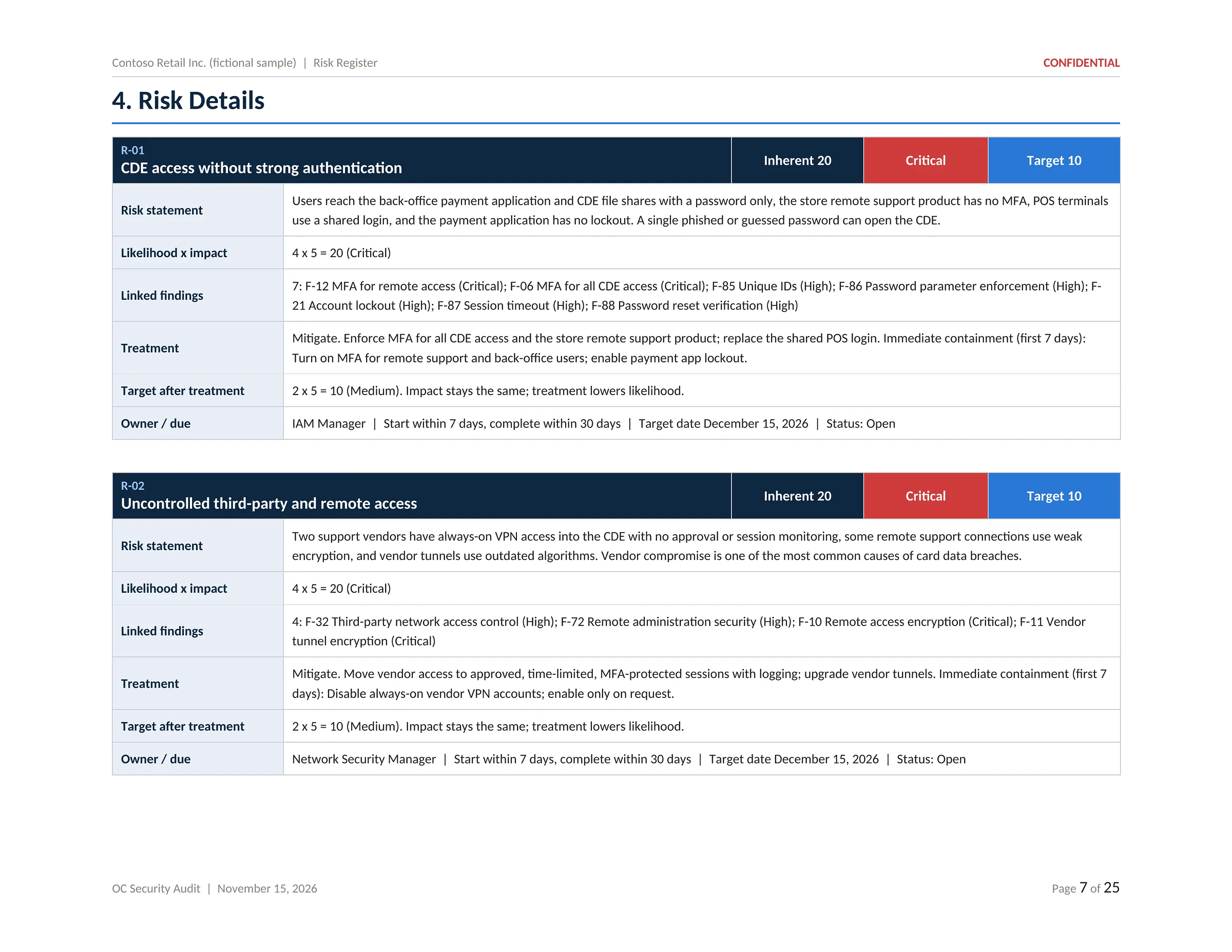
Slide 6 of 9Risk detail: CDE access without strong authenticationR-01 in full: the risk statement, likelihood times impact, the seven linked findings, the treatment, the target after treatment and the owner.
Risk Register, slide 7 of 9: Risk detail: stored card numbers readable if stolen (fictional company, illustrative data)
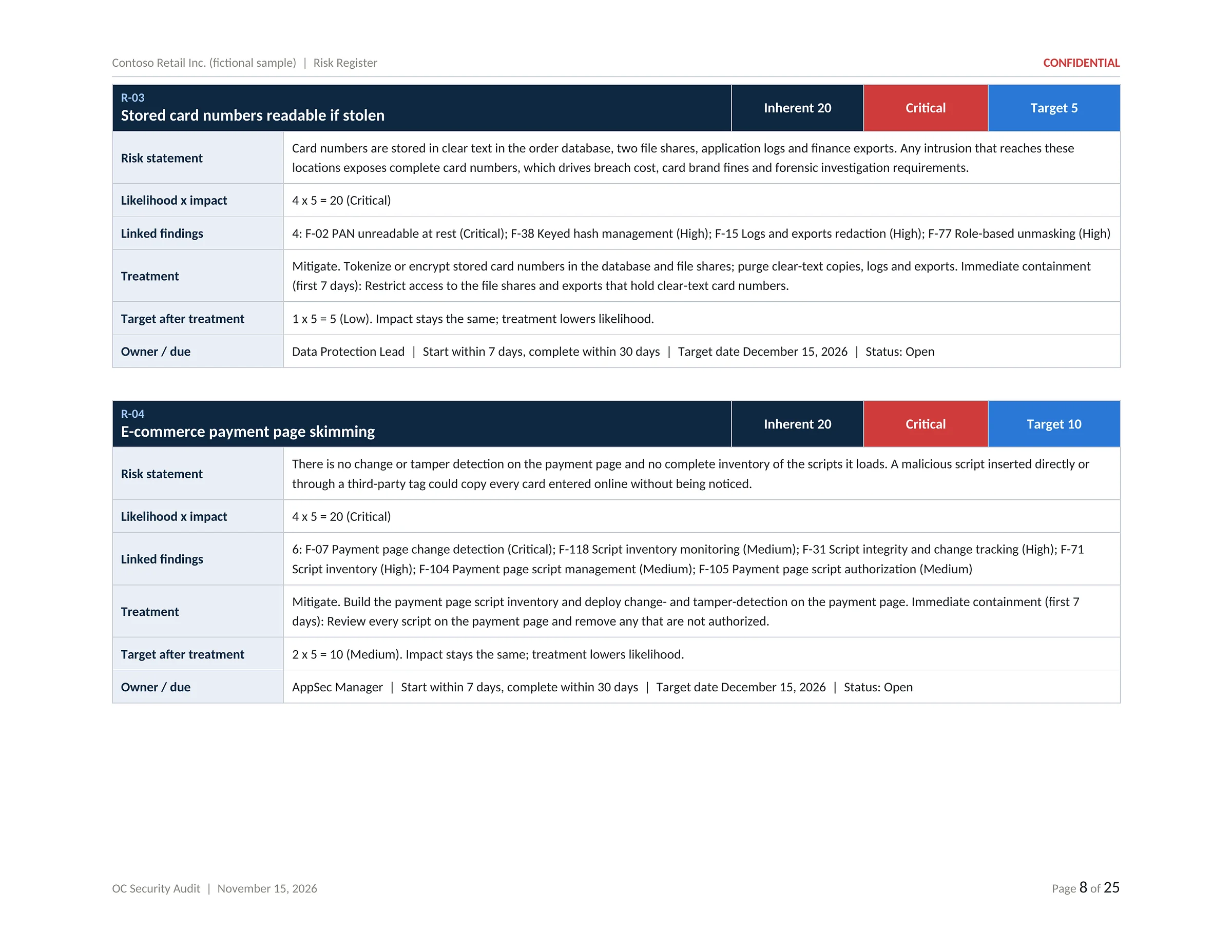
Slide 7 of 9Risk detail: stored card numbers readable if stolenR-03: card numbers in clear text in the order database, file shares, logs and exports, with linked findings and a treatment that brings the score from 20 to 5.
Risk Register, slide 8 of 9: Risk detail: sensitive authentication data retained (fictional company, illustrative data)
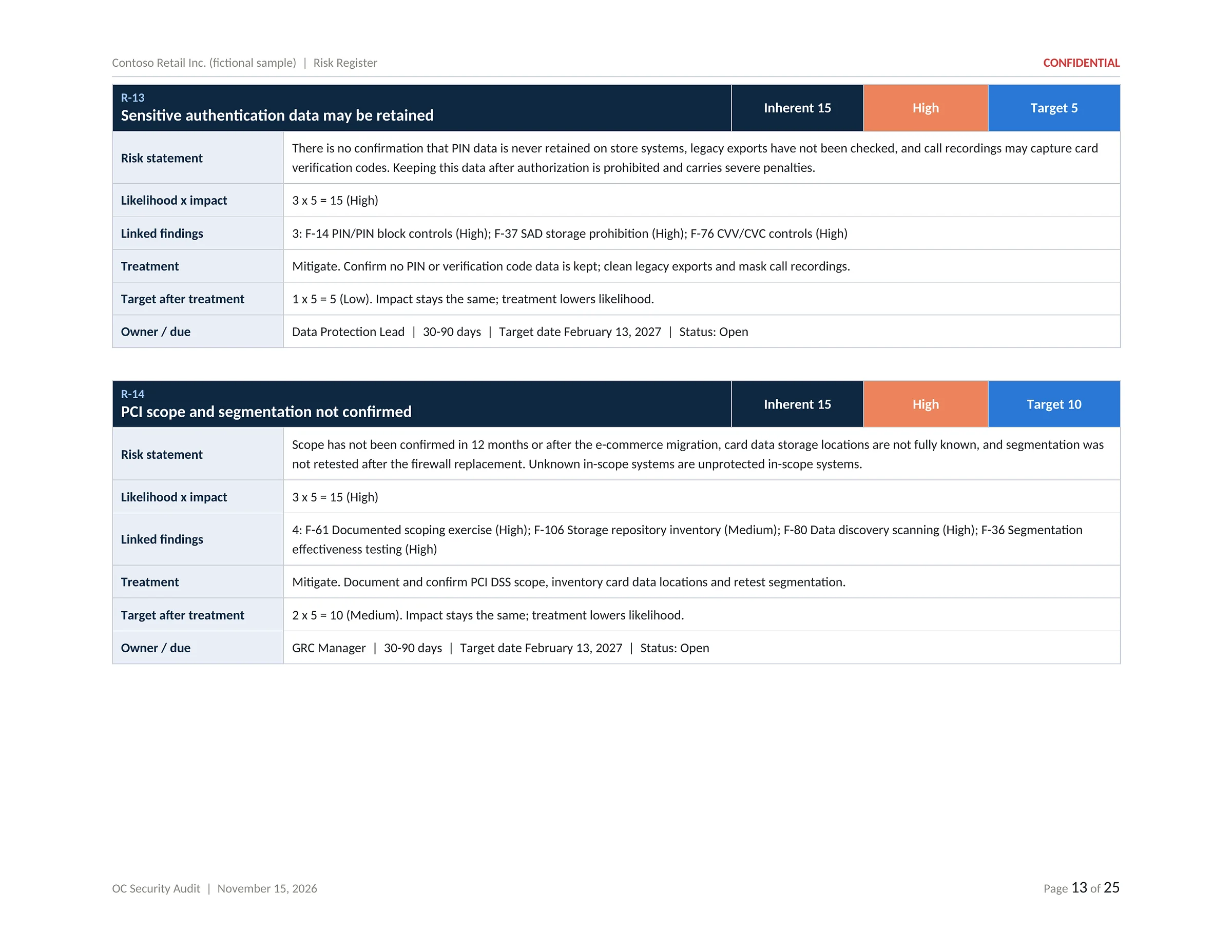
Slide 8 of 9Risk detail: sensitive authentication data retainedR-13: no confirmation that PIN data and verification codes are never kept after authorization, with the linked findings and treatment.
Risk Register, slide 9 of 9: Finding-to-risk traceability (fictional company, illustrative data)
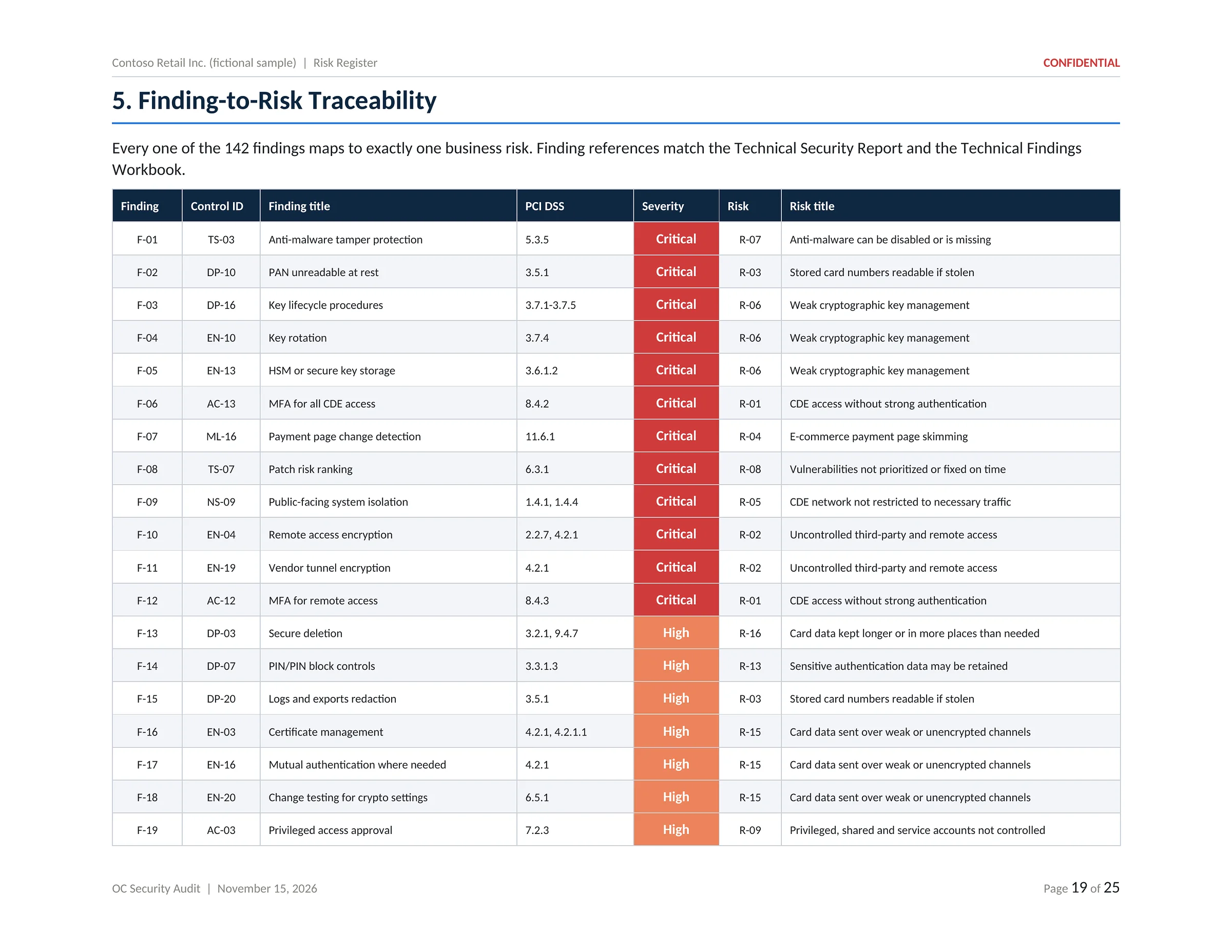
Slide 9 of 9Finding-to-risk traceabilityEvery one of the 142 findings mapped to exactly one business risk, with the control ID, PCI DSS reference and severity.

Click the page in the centre to open it full size and zoom in.

Deliverable 4 of 5 · PDF and Word · 15 pages

Next Steps & Security Roadmap

The order of work. 35 actions in four phases over 180 days, grouped into eleven projects with one owner each, today’s measures against 30-day and 180-day targets, the expected drop in risk and the operating rhythm that keeps the evidence current for validation.

Who uses it

The executive owner and finance for budgeting, the IT team or MSP for scheduling, and the compliance lead for tracking progress toward formal validation.

PCI DSS 12.4 Compliance programPCI DSS 11.3 and 11.4 Scans and testingPCI DSS 12.10 Incident readiness

What is included

  1. Where you are against targets
  2. Phase 0: contain in 7 days
  3. Phases 1 to 3 over 180 days
  4. Eleven security projects
  5. Project sheets with success measures
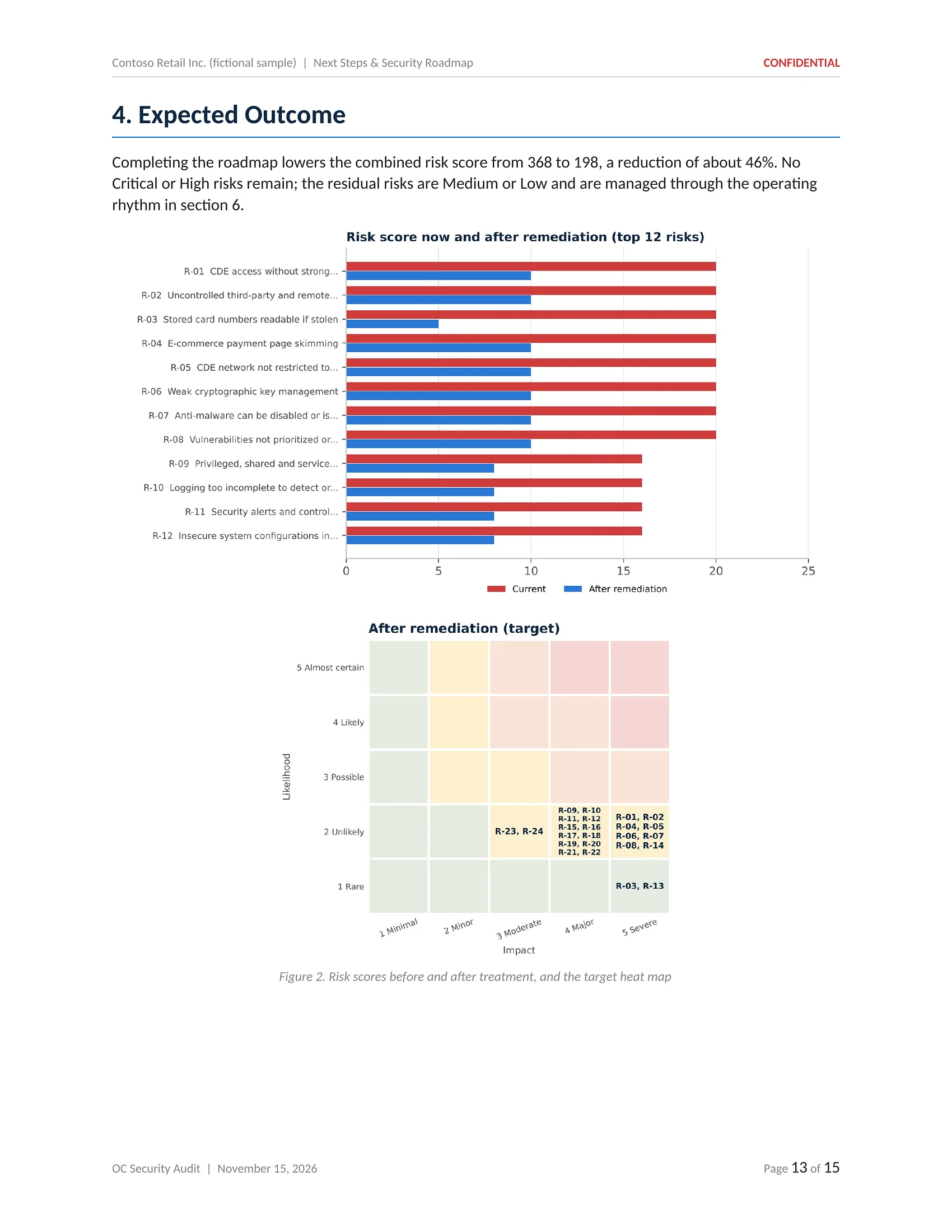
  6. Expected outcome: risk down about 46%
  7. Future goals for 6 to 18 months
  8. Governance and operating rhythm

SAMPLE · Contoso Retail Inc. (fictional)

1 / 9
Next Steps & Security Roadmap, slide 1 of 9: Cover page (fictional company, illustrative data)
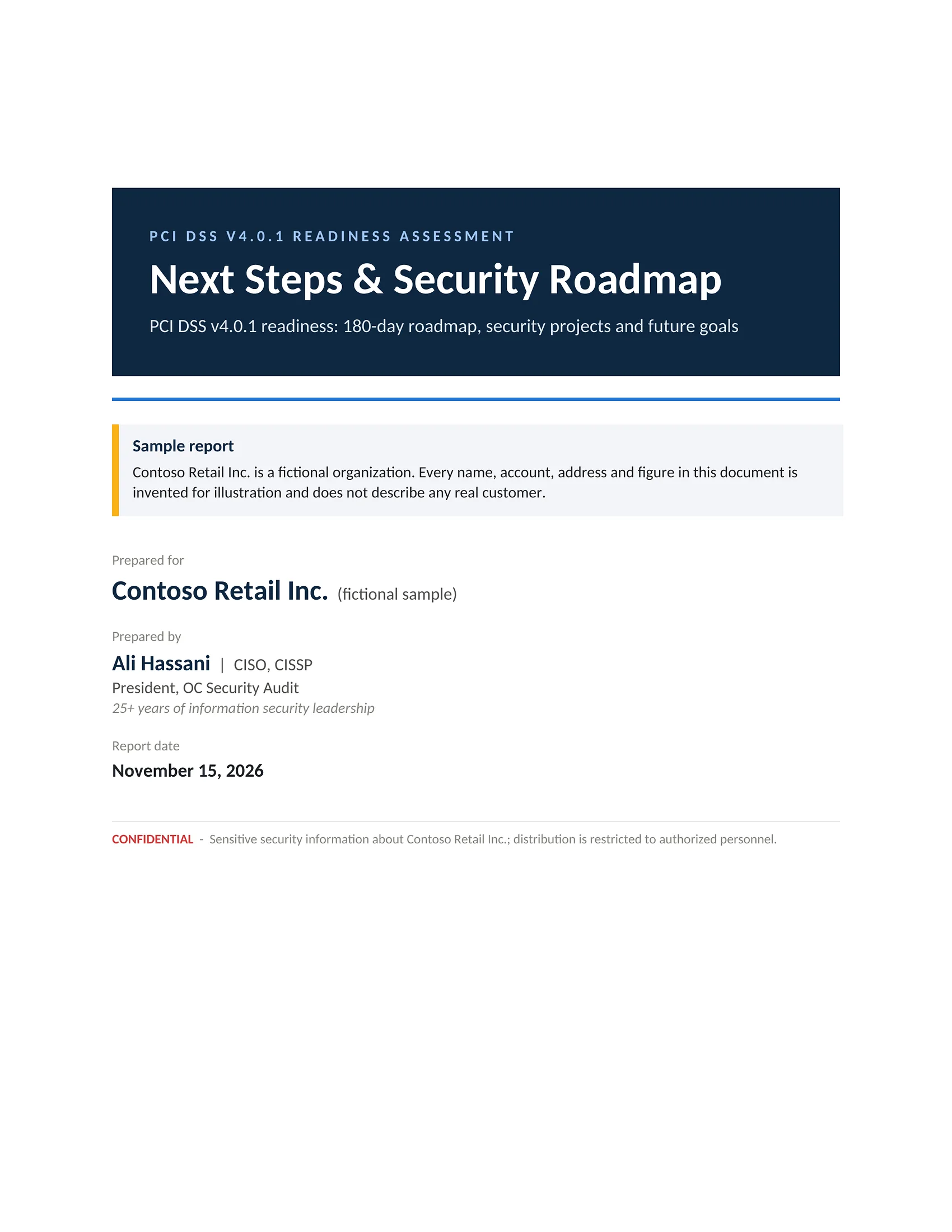
Slide 1 of 9Cover pageThe Next Steps and Security Roadmap: a 180-day roadmap, security projects and future goals for Contoso Retail Inc.
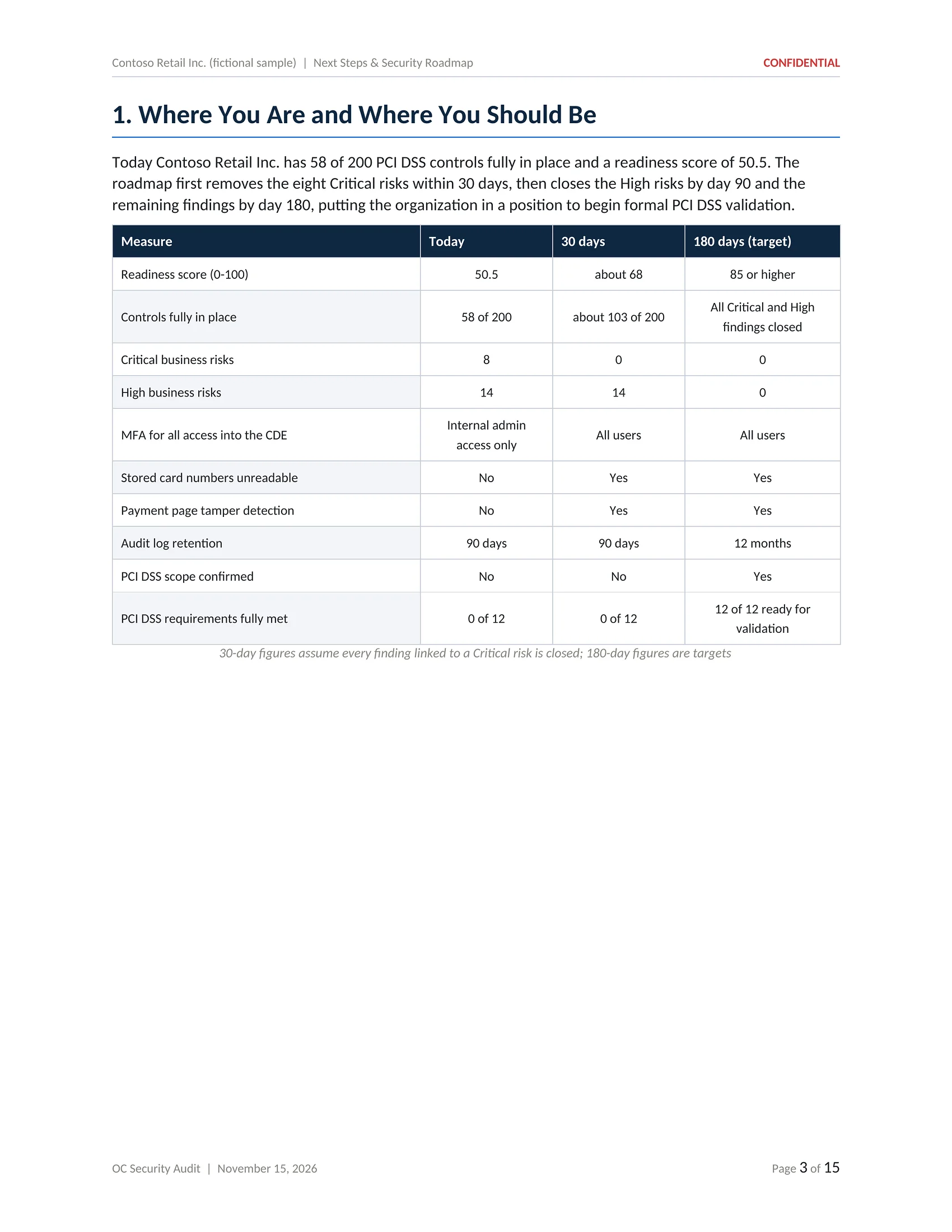
Next Steps & Security Roadmap, slide 2 of 9: Where you are and where you should be (fictional company, illustrative data)
Slide 2 of 9Where you are and where you should beToday's measures against 30-day and 180-day targets: readiness score, controls in place, Critical and High risks, MFA coverage and stored clear-text card numbers.
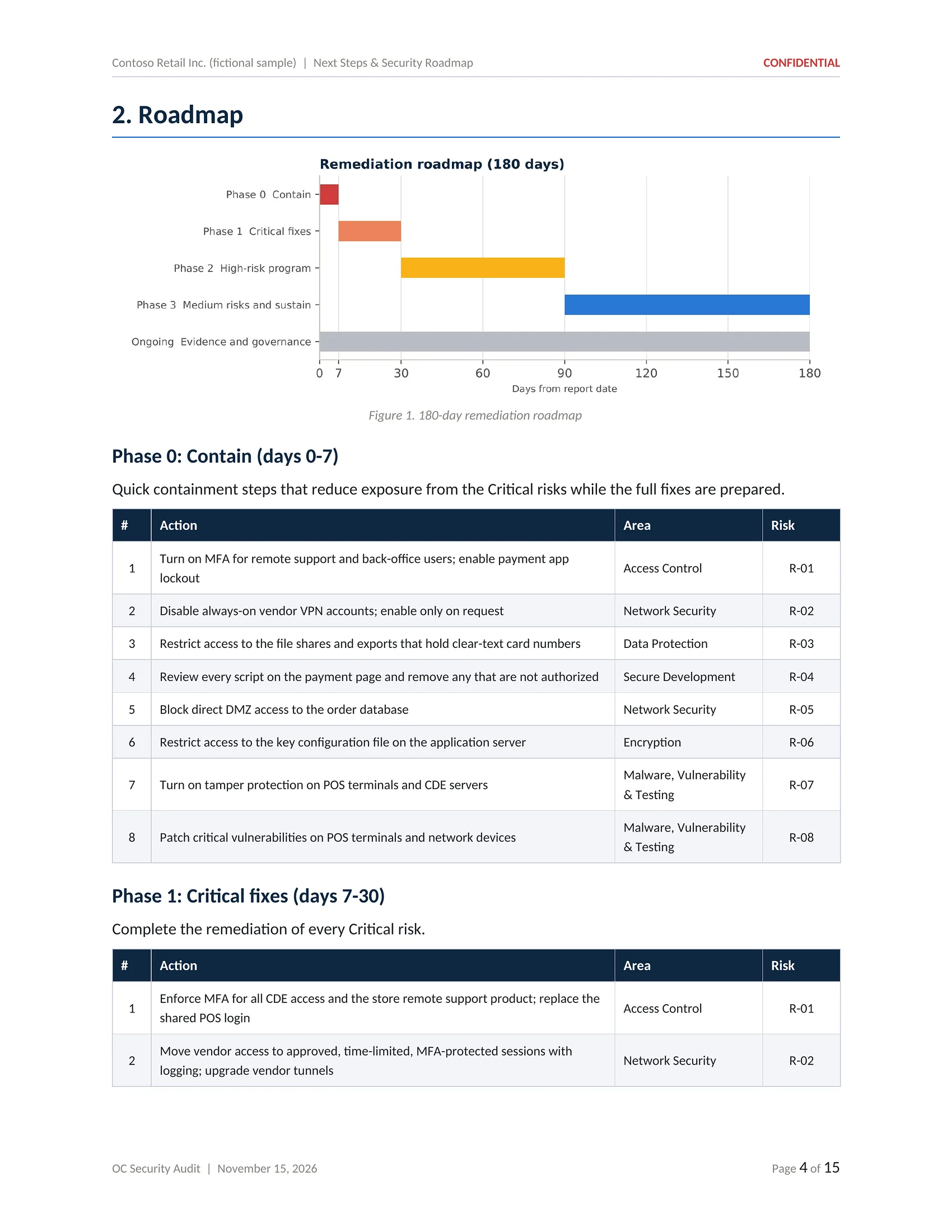
Next Steps & Security Roadmap, slide 3 of 9: Roadmap and Phase 0: contain (fictional company, illustrative data)
Slide 3 of 9Roadmap and Phase 0: containThe 180-day roadmap chart and the containment steps for the first seven days, each tied to its area and risk.
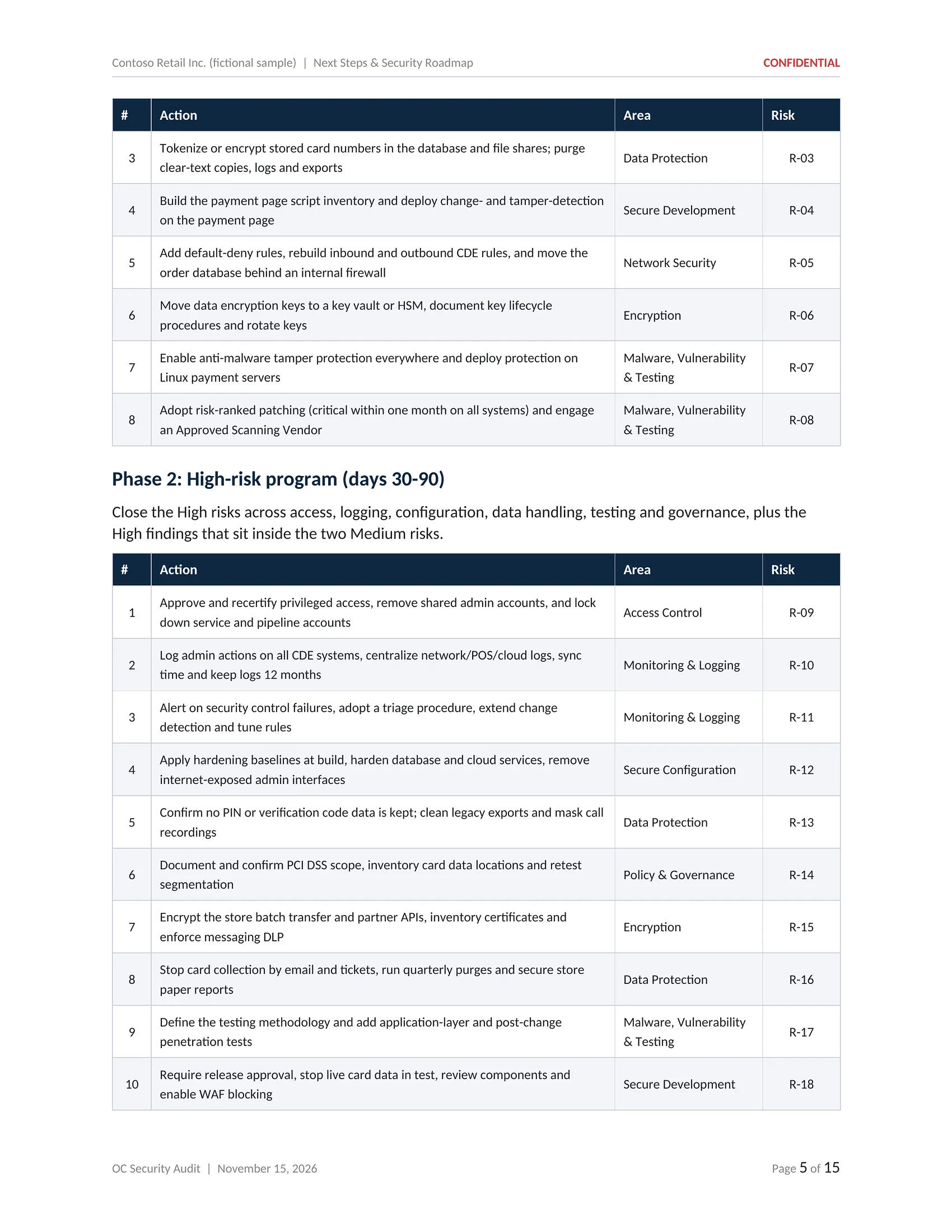
Next Steps & Security Roadmap, slide 4 of 9: Phase 1: critical fixes (fictional company, illustrative data)
Slide 4 of 9Phase 1: critical fixesThe actions for days 7 to 30 that remove the Critical risks: tokenization, payment page monitoring, default-deny rules, key management and anti-malware protection.
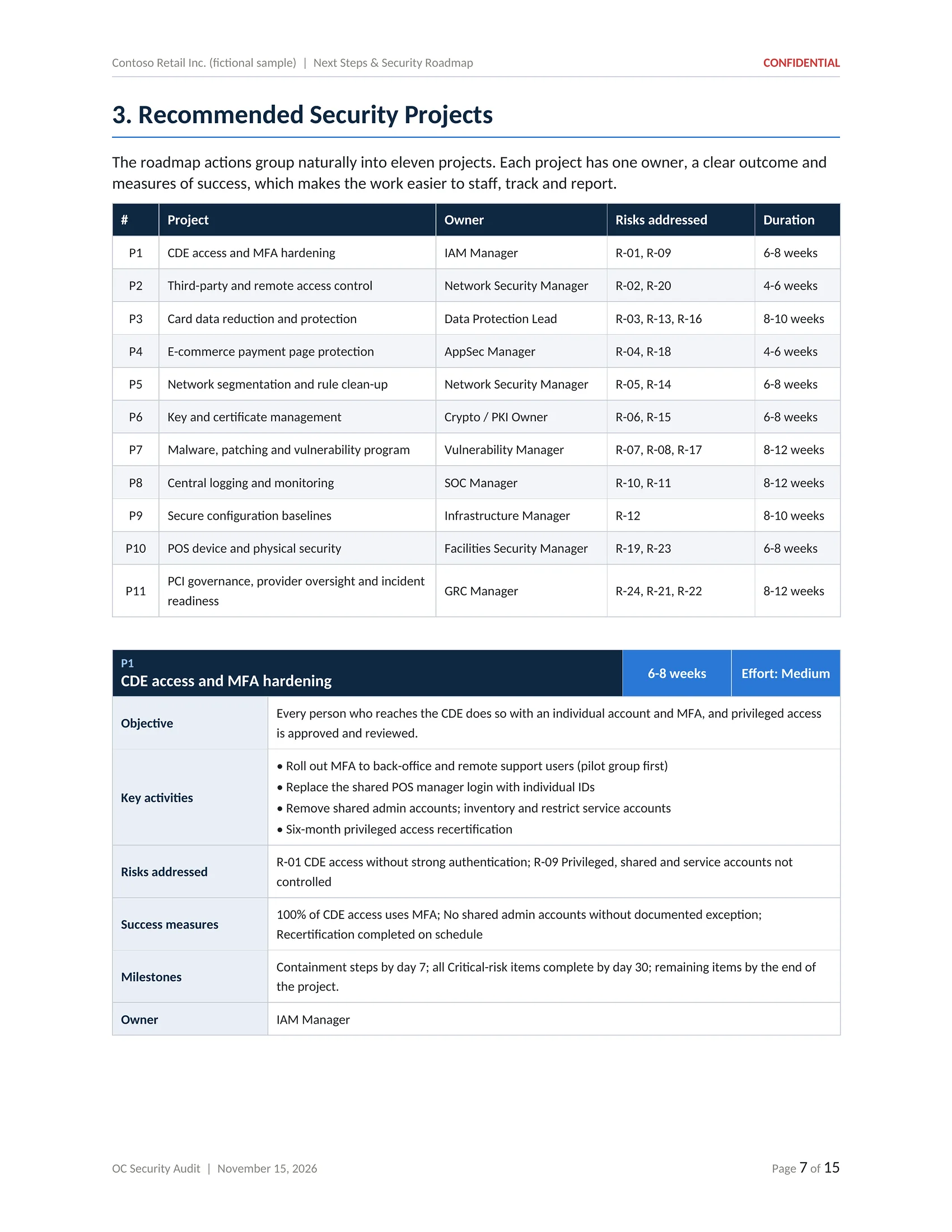
Next Steps & Security Roadmap, slide 5 of 9: Recommended security projects (fictional company, illustrative data)
Slide 5 of 9Recommended security projectsThe roadmap actions grouped into eleven projects, each with one owner, the risks it addresses and a duration.
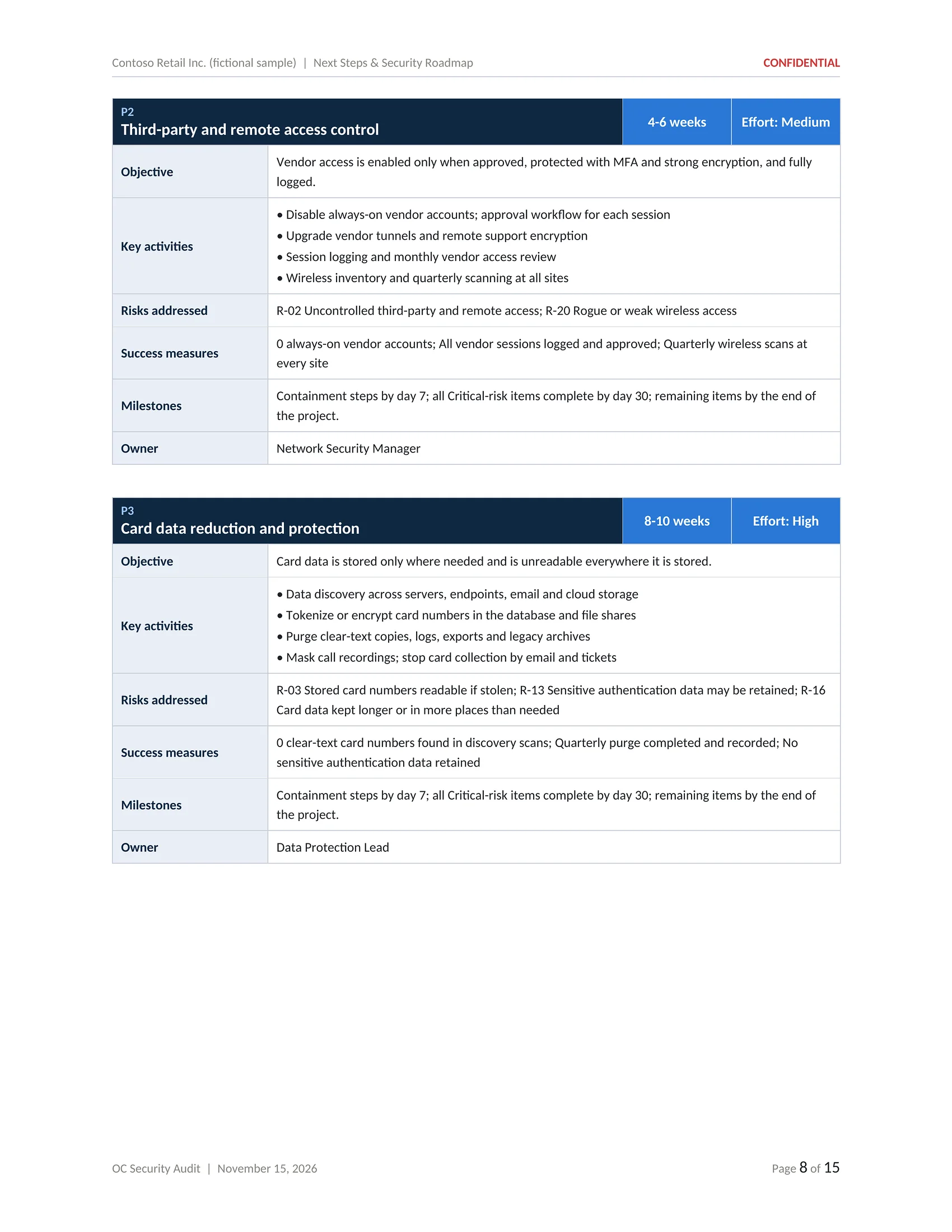
Next Steps & Security Roadmap, slide 6 of 9: Project sheets (fictional company, illustrative data)
Slide 6 of 9Project sheetsOne sheet per project with the objective, key activities, risks addressed and success measures, shown here for third-party and remote access control and for card data reduction and protection.
Next Steps & Security Roadmap, slide 7 of 9: Expected outcome (fictional company, illustrative data)
Slide 7 of 9Expected outcomeCompleting the roadmap lowers the combined risk score from 368 to 198, about 46%, with no Critical or High risks left.
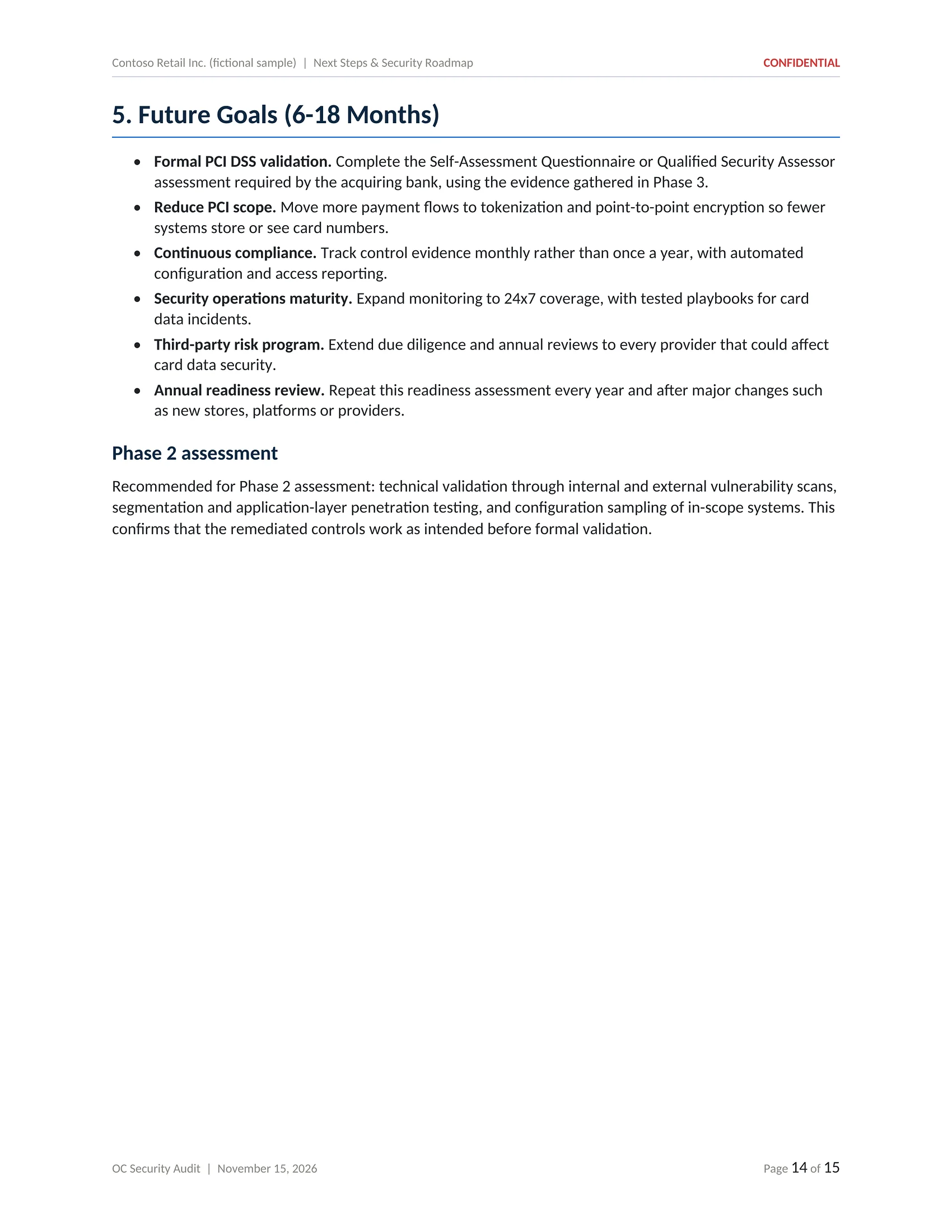
Next Steps & Security Roadmap, slide 8 of 9: Future goals for 6 to 18 months (fictional company, illustrative data)
Slide 8 of 9Future goals for 6 to 18 monthsFormal PCI DSS validation, scope reduction with tokenization and point-to-point encryption, continuous compliance and a stronger third-party program.
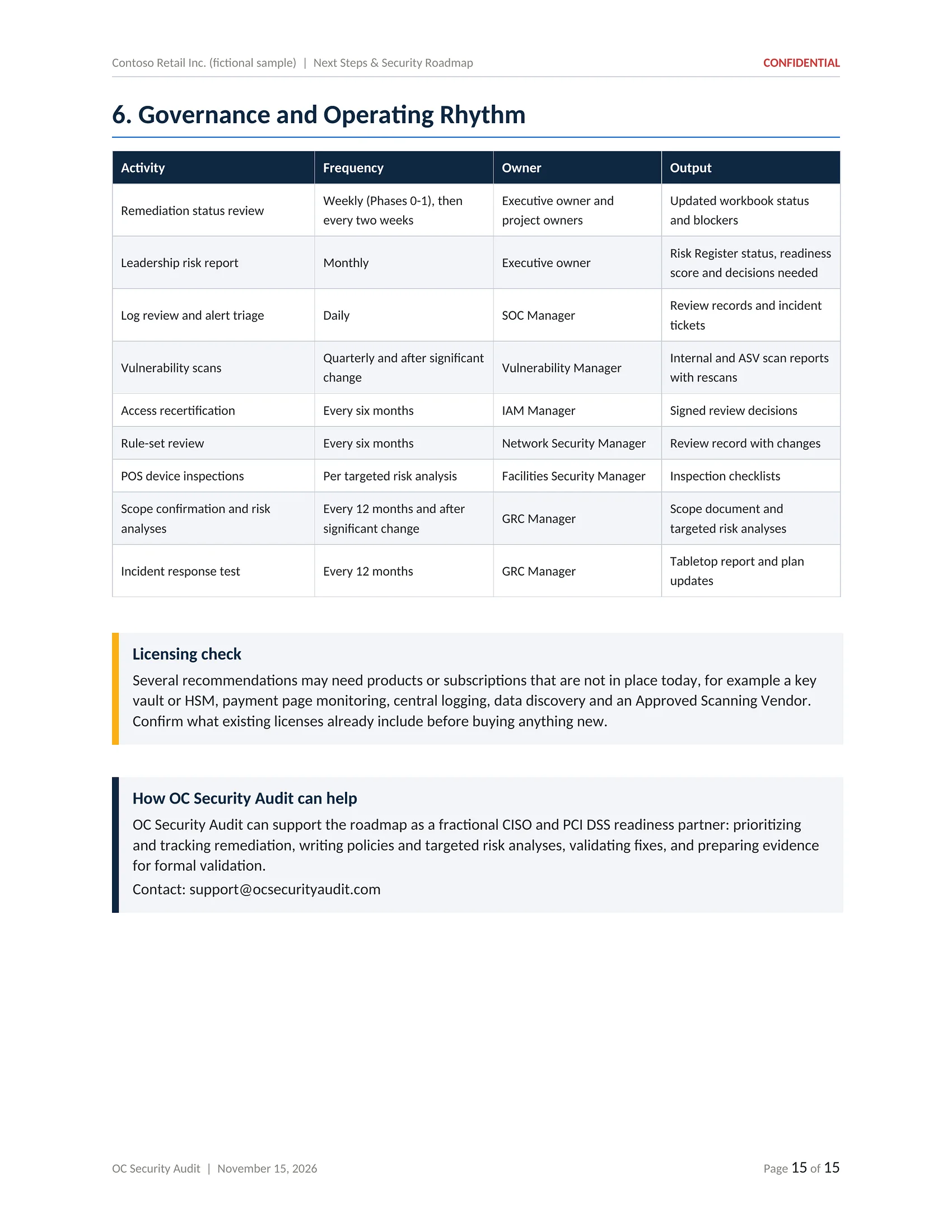
Next Steps & Security Roadmap, slide 9 of 9: Governance and operating rhythm (fictional company, illustrative data)
Slide 9 of 9Governance and operating rhythmWho reviews what and how often: remediation status, leadership risk reports, log review, quarterly scans, access recertification and rule-set reviews.

Click the page in the centre to open it full size and zoom in.

Deliverable 5 of 5 · Excel · 7 sheets

Technical Findings Workbook

Everything in the reports as filterable data: every finding, every risk, every roadmap action and all 200 controls, with yellow status, owner and due-date columns your team fills in. The summary tables update as items close.

Who uses it

The IT team or MSP for daily tracking, the compliance lead for evidence, and the next assessor for a fast follow-up comparison.

All 12 PCI DSS requirements200 controlsv4.0.1 references

What is included

  1. Summary with live counts
  2. All 142 findings
  3. Risk Register
  4. Remediation plan by phase
  5. Control register of 200 controls
  6. Strengths and evidence to retain
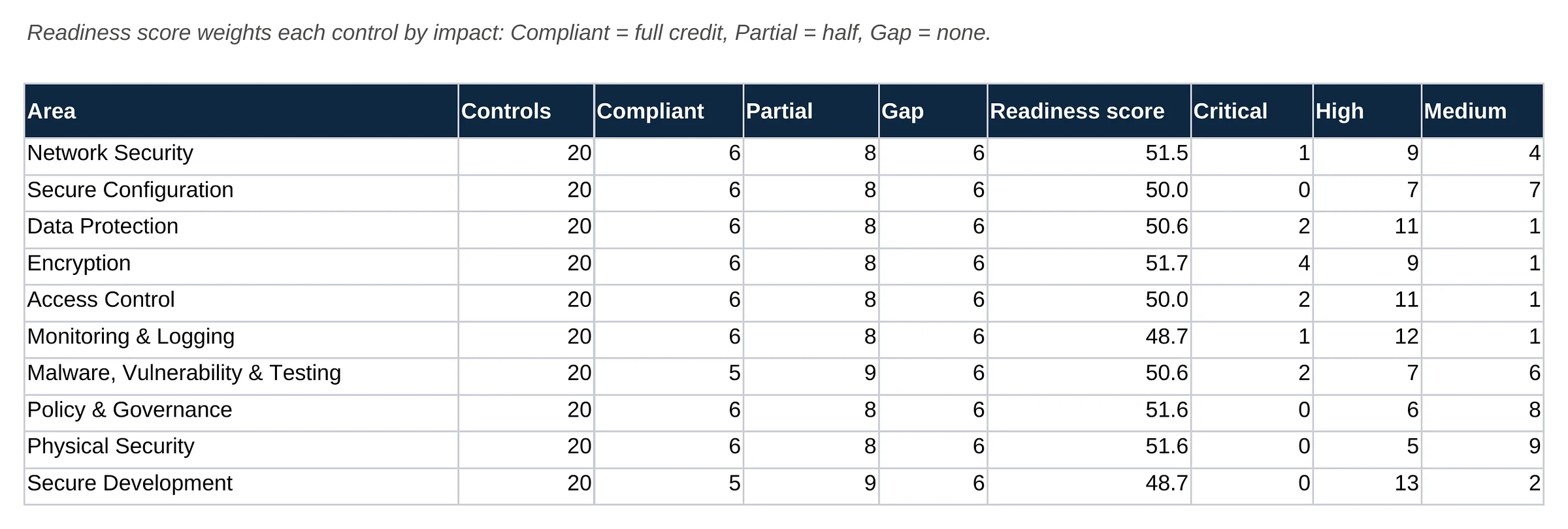
  7. Scores for the 10 areas

SAMPLE · Contoso Retail Inc. (fictional)

1 / 7
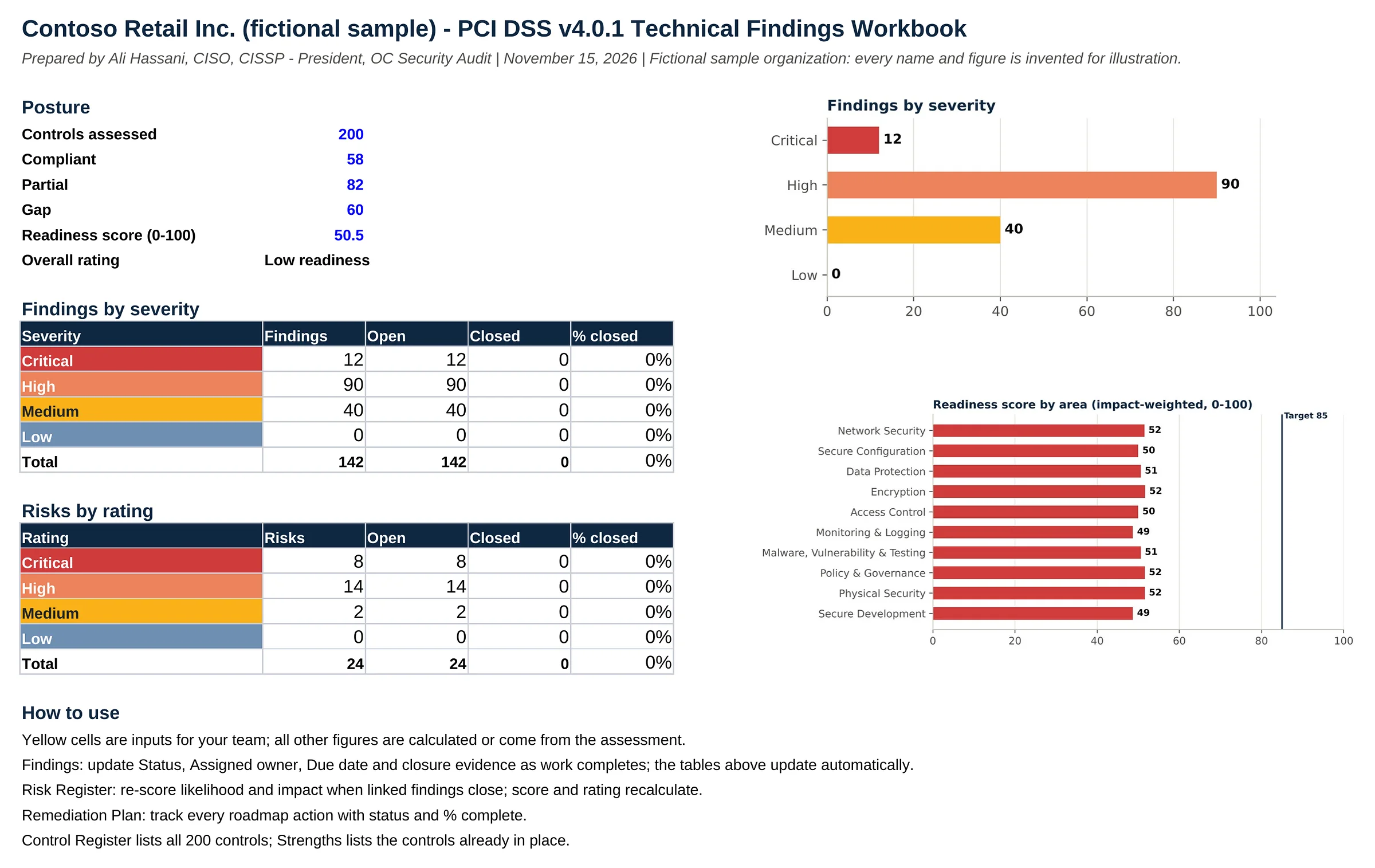
Technical Findings Workbook, Summary sheet (fictional company, illustrative data)
Sheet 1 of 7Summary sheetPosture, findings by severity and risks by rating with open and closed counts that update as your team works, plus the findings chart and readiness by area.
Technical Findings Workbook, Findings sheet (fictional company, illustrative data)
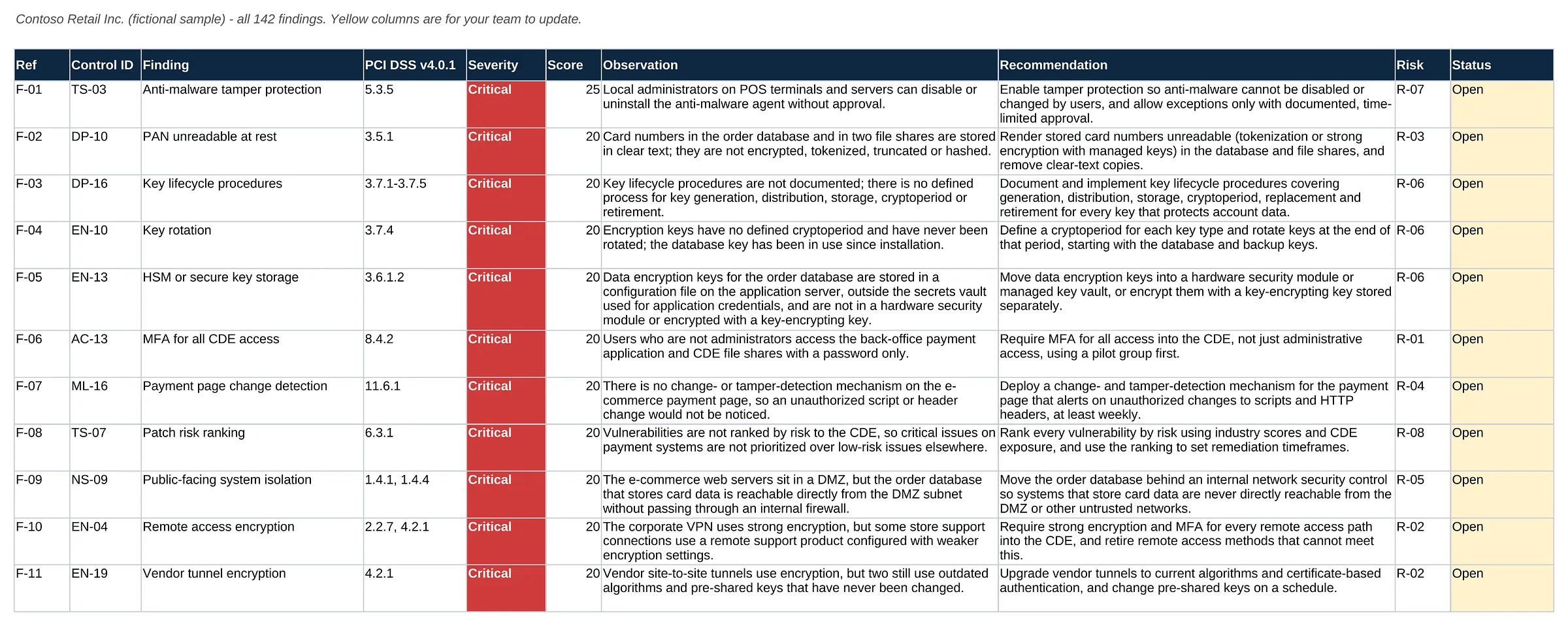
Sheet 2 of 7Findings sheetAll 142 findings with the PCI DSS v4.0.1 reference, severity, score, observation, recommendation, linked risk and a status column (selected columns shown).
Technical Findings Workbook, Risk Register sheet (fictional company, illustrative data)
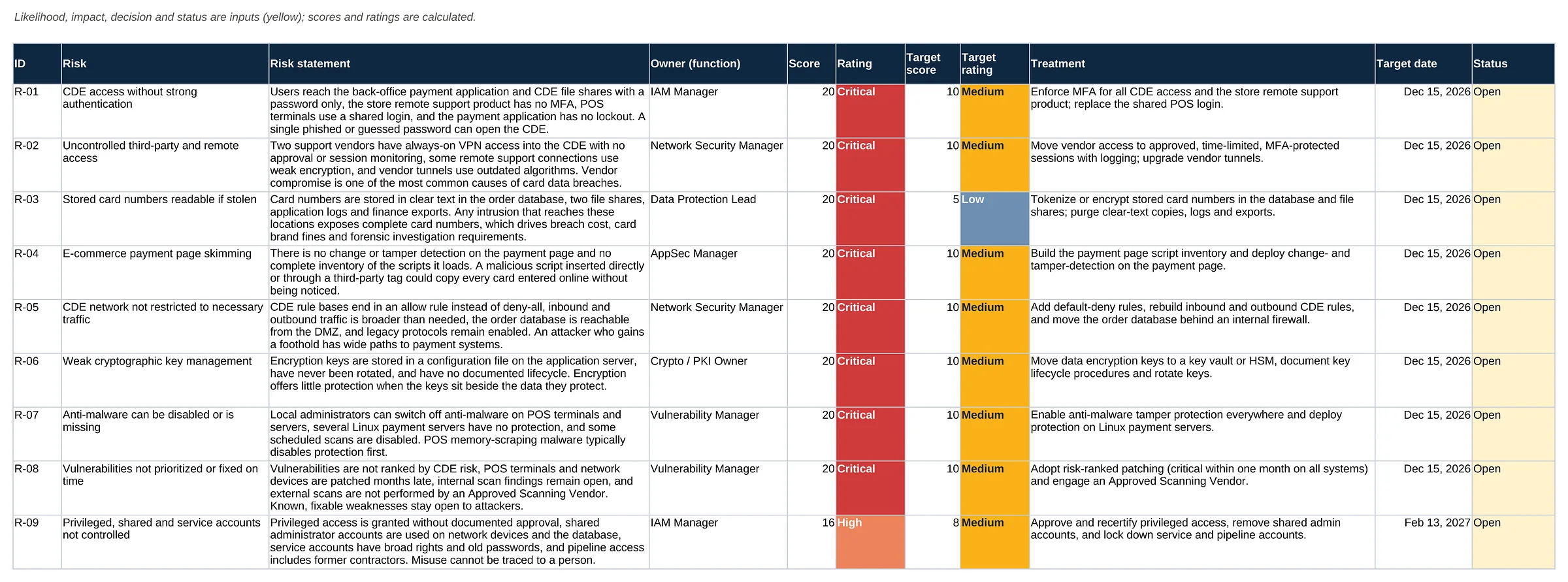
Sheet 3 of 7Risk Register sheetThe 24 risks with statement, owner, current and target rating, treatment, target date and status (selected columns shown).
Technical Findings Workbook, Remediation Plan sheet (fictional company, illustrative data)
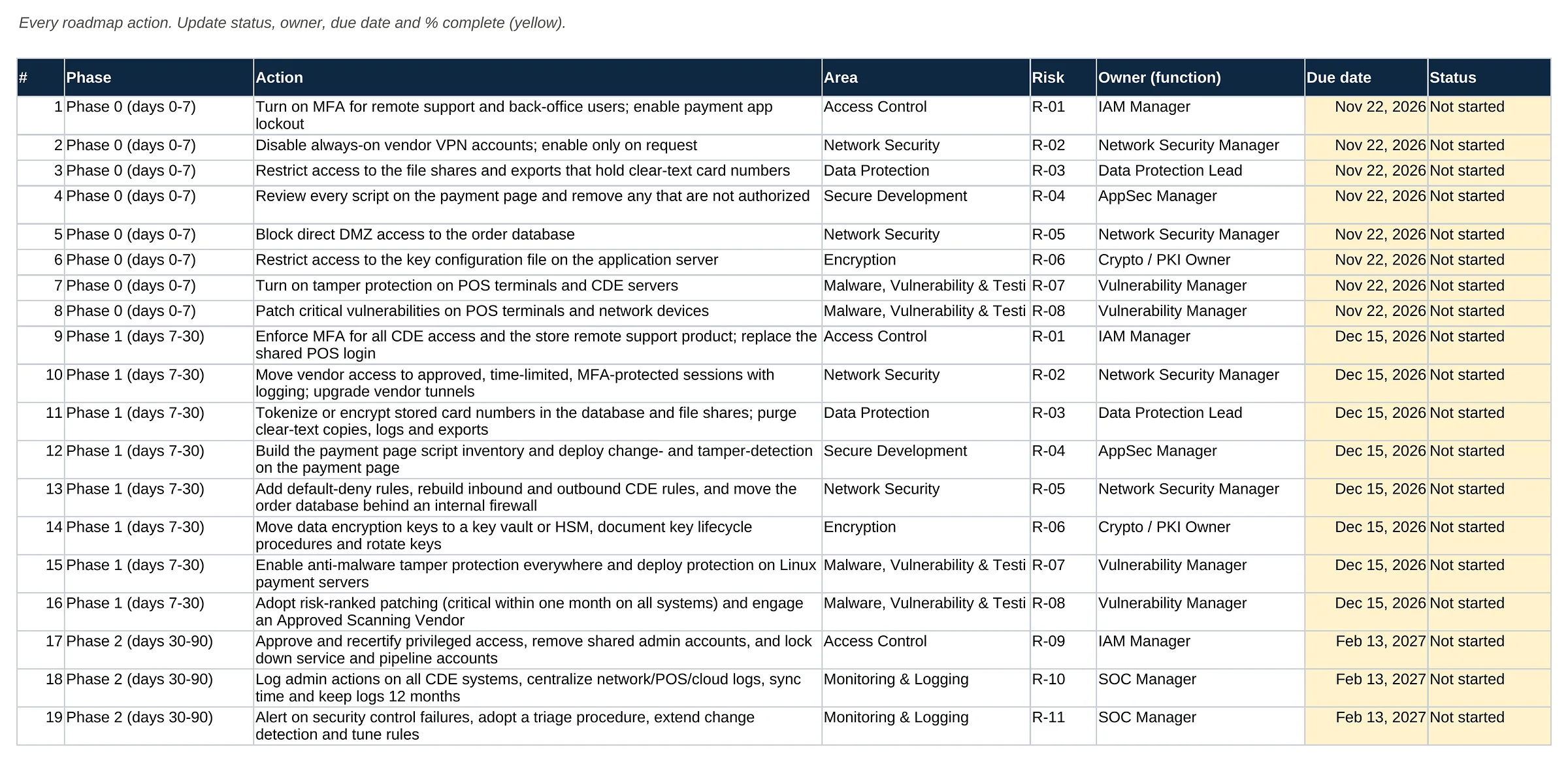
Sheet 4 of 7Remediation Plan sheetEvery roadmap action by phase with area, risk, owner, due date and status, ready for your team to track progress.
Technical Findings Workbook, Control Register sheet (fictional company, illustrative data)
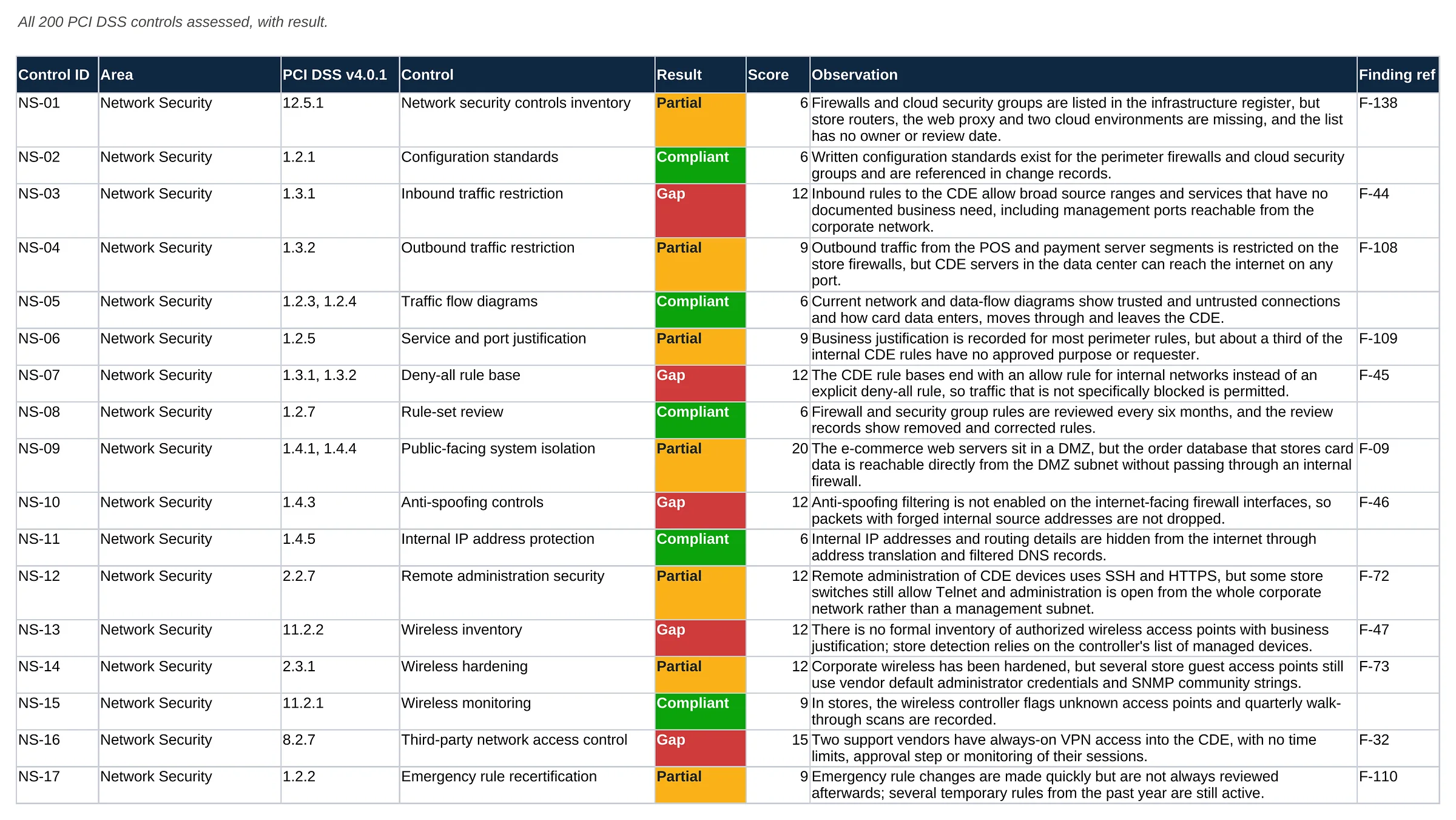
Sheet 5 of 7Control Register sheetAll 200 controls with area, PCI DSS reference, result, score, observation and the finding each gap produced (selected columns shown).
Technical Findings Workbook, Strengths sheet (fictional company, illustrative data)
Sheet 6 of 7Strengths sheetThe controls already in place with the observation and the evidence to retain for formal validation.
Technical Findings Workbook, Domain Scores sheet (fictional company, illustrative data)
Sheet 7 of 7Domain Scores sheetControls, compliant, partial and gap counts, the readiness score and findings by severity for each of the 10 areas.

Click the page in the centre to open it full size and zoom in.

How the deliverables connect

One finding, traced from evidence to closure

Every item keeps the same ID in all five deliverables, so nobody has to re-read a 69-page report to know what happens next. Here is one example from the sample.

  1. F-02

    Finding

    Technical Security Report: card numbers in the order database and two file shares are stored in clear text. PCI DSS 3.5.1, rated Critical (20).

  2. R-03

    Risk

    Risk Register: stored card numbers readable if stolen. Likelihood 4 × impact 5 = 20, Critical, owned by the Data Protection Lead, target score 5.

  3. P0·P1

    Action

    Roadmap: restrict access to the shares and exports in the first 7 days, then tokenize or encrypt the stored card numbers and purge the clear-text copies by day 30.

  4. XLS

    Tracking

    Workbook: the Findings, Risk Register and Remediation Plan sheets carry the same IDs, with owner, status and due date until the item closes.

What the assessment covers

All 12 PCI DSS requirements, scored control by control

The table shows how the sample’s 200 controls spread across the 12 requirements, how many were compliant, partial or a gap at the fictional retailer, and one example of what was found under each.

PCI DSS v4.0.1 requirementControlsCompliant / partial / gapExample from the sample
1Install and maintain network security controls146 / 4 / 4No default-deny rule; order database reachable from the DMZ
2Apply secure configurations205 / 9 / 6Standards not applied at build; vendor defaults on databases and cloud services
3Protect stored account data249 / 8 / 7Card numbers in clear text in the database, file shares, logs and exports
4Protect cardholder data in transmission102 / 5 / 3A batch transfer and two partner APIs unencrypted; expired certificates
5Protect against malicious software52 / 2 / 1Anti-malware can be switched off on POS terminals and servers
6Develop and maintain secure systems and software265 / 13 / 8Payment page scripts not inventoried or integrity-checked
7Restrict access by business need to know51 / 3 / 1Access granted without documented business need
8Identify users and authenticate access166 / 5 / 5Password-only access to the back-office payment application
9Restrict physical access to cardholder data216 / 9 / 6No POS device inventory; store network closets unlocked
10Log and monitor all access185 / 7 / 6Time synchronization and alerting on control failures missing
11Test security of systems and networks regularly164 / 6 / 6No application-layer penetration test of the e-commerce site
12Support security with policies and programs257 / 11 / 7No executive owner for PCI DSS; incident response plan never tested
Total20058 / 82 / 60Readiness score 50.5; none of the 12 requirements fully met yet

A readiness assessment measures progress toward PCI DSS v4.0.1 and prepares the evidence for validation. It is not a Report on Compliance, an Attestation of Compliance or a completed Self-Assessment Questionnaire, and OC Security Audit does not issue them. Formal validation depends on your merchant or service provider level and your acquiring bank’s requirements. PCI DSS is a standard of the PCI Security Standards Council.

Related

Next steps for your business

Ali Hassani, CISO and CISSP, founder of OC Security Audit

Who prepares the report

Led by Ali Hassani, CISO

Certified CISO (C|CISO) and CISSP with 25+ years in IT, cybersecurity, compliance and infrastructure, and dozens of Microsoft and Cisco certifications, including MCSE, MCITP, MCSA Security, CCNP and CCNA. Every PCI DSS readiness assessment is evidence-based and written so the owner, the finance team and the IT team can all act on it.

We stay independent: we assess and advise, and your IT team or provider carries out the fixes, with our help if you want it.

FAQ

Questions about the PCI DSS sample report

Is this a real client’s PCI DSS report?

No. Contoso Retail Inc. is a fictional organization, and every name, account, address and figure in the sample is invented. We never publish client data. The structure, depth and format are the same as the reports our clients receive.

What does a PCI DSS readiness assessment from OC Security Audit deliver?

The full set shown here is an Executive Security Report, a Technical Security Report, a Risk Register, a Next Steps and Security Roadmap, and a Technical Findings Workbook in Excel. The scope and the deliverables are confirmed in writing before the work starts; the PCI DSS readiness pricing page explains what drives the fee.

Is this a Report on Compliance or an Attestation of Compliance?

No. This is a readiness (gap) assessment that measures progress toward PCI DSS v4.0.1. It is not a Report on Compliance, an Attestation of Compliance or a completed Self-Assessment Questionnaire. Formal validation depends on your merchant or service provider level and on what your acquiring bank or payment brand requires.

How many controls does the sample assess?

The sample assesses 200 controls covering all 12 PCI DSS v4.0.1 requirements, grouped into 10 areas such as network security, data protection, encryption, access control and secure development. Each control is rated compliant, partial or gap and scored for likelihood and impact.

Does the assessment cover e-commerce payment page scripts?

Yes. The sample checks the payment page script inventory, script integrity and change- and tamper-detection on the payment page, the controls in requirements 6.4.3 and 11.6.1 that target e-skimming. In the sample, both appear as findings with a fix, an owner and a target date.

Do you need administrator access, and will anything be changed?

We review documents, configurations and evidence and interview your control owners, using read-only access where systems are reviewed directly. Nothing in your environment is changed during the assessment. Your IT team or provider carries out the fixes in the roadmap.

Do you work outside Orange County?

Yes. OC Security Audit is based in Irvine and works on-site across Orange County, Los Angeles and Southern California, and remotely with merchants and service providers nationwide.

ocsa pa2 h team server aisle silhouette

Want this report for your business?

Tell us how you take cards: stores, online, phone or a payment provider. We will confirm the scope, the deliverables and a written fee before any work starts.

Or call 949-777-5567