
ScreenConnect MSP Attacks and Uber’s Vendor Breach: November 2026 Hacking News and the Third-Party Access Lesson
Part 3 of 3 in U.S. Outages and Hacks: November 2026 Briefings
Confirmed by the organizations · investigations ongoing · Last verified: November 17, 2026 · Reviewed by Ali Hassani, CISSP, C|CISO

What happened, in brief
- Organization: ConnectWise ScreenConnect partners (MSPs)
- Industry: IT managed services
- Disclosed: November 11, 2026
- Attack type: Unauthorized access through a remote-access tool extension
- Reported impact: Unauthorized remote-access software installed in customer environments
- Status: Confirmed
Summary of public reporting; sources are listed in the briefing.

Want this checked in your own environment?
Ali Hassani, a Certified CISO (C|CISO) and CISSP with 25+ years in IT and cybersecurity, turns guidance like this into a ranked, practical plan. Based in Irvine, on-site across Southern California and remote nationwide.
On November 11, 2026, ConnectWise confirmed unauthorized access to ScreenConnect partner accounts and the installation of unauthorized remote-access software in customer environments (BleepingComputer). Two days later, TechCrunch reported that Uber was notifying thousands of drivers that personal and driver’s license information was stolen in an October breach at one of its technology providers (TechCrunch). Both are reminders that your security is only as strong as the outside parties that can reach your systems or hold your data.
Incident 1: ScreenConnect partner environments
| Organization | ConnectWise ScreenConnect partners, mostly managed service providers (MSPs), and their customers |
|---|---|
| When | Activity first detected about 5:47 p.m. UTC on November 11, 2026 (Field Effect) |
| What happened | Attackers used ScreenConnect features after gaining access to partner environments and deployed additional remote-access software on customer endpoints (The Record) |
| Route | Activity traced to RMM+, an independently developed ScreenConnect extension whose API is protected by a passphrase set during setup (The Record) |
| Scope | Huntress reported 288 affected endpoints across 48 organizations; about 400 partner environments had at least one flagged extension installed, which ConnectWise said does not by itself prove compromise (The Record) |
| Response | ConnectWise disabled five third-party extensions as a precaution and warned that disabling them does not remove software or access already present on devices (BleepingComputer) |
Incident 2: Uber driver data at a technology vendor
| Organization | Uber Technologies; the affected provider was reported by TechCrunch to be Fireworks AI, which Uber did not name (TechCrunch) |
|---|---|
| When | Uber said a provider notified it on October 9, 2026 that credentials used to access Uber’s data had been stolen (TechCrunch) |
| Data | Drivers’ personal information and driver’s license information (TechCrunch) |
| Scope | State notices seen by TechCrunch list 2,567 people in Massachusetts, 3,430 in South Carolina and 1,873 in Rhode Island; Uber has not disclosed a total (TechCrunch) |
| Response | The vendor confirmed unauthorized access to some of its systems that affected customer data (TechCrunch) |
Each item is linked to its source. The status label reflects the strongest source available on the verification date.
Timeline
- October 9, 2026. Uber is notified by a technology provider that credentials used to access Uber’s data were stolen (TechCrunch).
- November 11, 5:47 p.m. UTC. ScreenConnect activity begins; ConnectWise confirms it later that day and disables five extensions as a precaution (Field Effect).
- November 12. Security firms publish findings; ConnectWise traces the activity to the RMM+ extension and on-premises customers are told to disable it themselves (The Record).
- November 13. TechCrunch reports Uber’s driver breach notices filed with several state attorneys general (TechCrunch).
What is still unknown
- How the attackers first obtained access to the ScreenConnect partner environments. Huntress said it saw no evidence of a new vulnerability and suspects compromised credentials or hijacked operator sessions (The Record).
- Who is responsible for the ScreenConnect activity. ConnectWise had not identified an actor in the sources reviewed (SecurityOnline).
- The total number of Uber drivers affected. Uber has not disclosed a total and no group had claimed the data theft (TechCrunch).
The common thread: trusted outside access
Remote-support and remote monitoring tools give an IT provider the same reach into your computers that an attacker wants. CISA warned years ago that attackers abuse legitimate remote monitoring and management software for exactly that reason (CISA advisory AA23-025A). In the ScreenConnect case, The Record reported that the RMM+ extension used a passphrase-protected API (The Record), and Huntress was quoted as saying it bypasses ScreenConnect’s user accounts, roles and MFA (CyberScoop). A single add-on can quietly change how strong your provider’s front door really is.
The Uber case is the data version of the same problem. A vendor that held some of a company’s data was breached, and the company still had to notify the people affected. You can outsource the work, but not the responsibility.
Seven third-party access lessons
- Know every remote-access tool on your network. Ask your IT provider for a written list of the remote-support and monitoring tools it uses, and look for any you did not approve.
- Review add-ons and extensions, not just the main tool. Extensions and integrations can bypass the controls you think are protecting you, as the RMM+ case showed.
- Require MFA on every path in. Ask how each tool and integration signs in, and whether MFA can be bypassed with a shared key or API passphrase.
- Patch remote-access tools first. Researchers reported that the attackers’ toolkit tried to exploit CVE-2026-84869, which the existing patch blocks (The Record). Track remote-access tools against CISA’s catalog of exploited vulnerabilities (CISA KEV catalog).
- Log and alert on provider activity. New admin accounts, new software installs and sessions outside normal hours should raise an alert that someone at your company actually reads.
- Map which vendors hold which data. For each vendor, record what personal or business data it holds, how it is accessed, and how it would tell you about a breach.
- Put security terms in contracts. Notification timelines, minimum controls and the right to ask for evidence belong in vendor and MSP agreements before something goes wrong.
Questions to ask your IT provider this week
- Which remote-access and monitoring tools do you use on our systems, and which extensions or integrations are installed?
- Do you use ScreenConnect, and have you confirmed that RMM+-family extensions are disabled and the latest patch is applied?
- Is MFA required for every technician account and every integration that can reach our devices?
- How would we know if a new remote tool or admin account appeared on our network?
- When did you last review who on your team can access our environment?
- Which of our data do you or your tools store, and where?
- How quickly would you tell us about a security incident on your side?
How a security audit checks third-party access
| Area | What we review | Related service |
|---|---|---|
| Your IT provider’s own practices | Remote-tool inventory, extensions, technician MFA, logging, offboarding | MSP security audit |
| Remote tools inside your network | Installed agents, unapproved remote software, admin accounts | Internal security audit |
| Identity and app access | Third-party app consents, service accounts, MFA gaps | Microsoft Entra ID security audit |
| Vendors that hold your data | Vendor inventory, data mapping, contract terms, risk ranking | Enterprise risk assessment |
| Signs of past misuse | Sign-in and audit log review in Microsoft 365 and Azure | M365 & Azure compromise investigation |
See how we report what we find
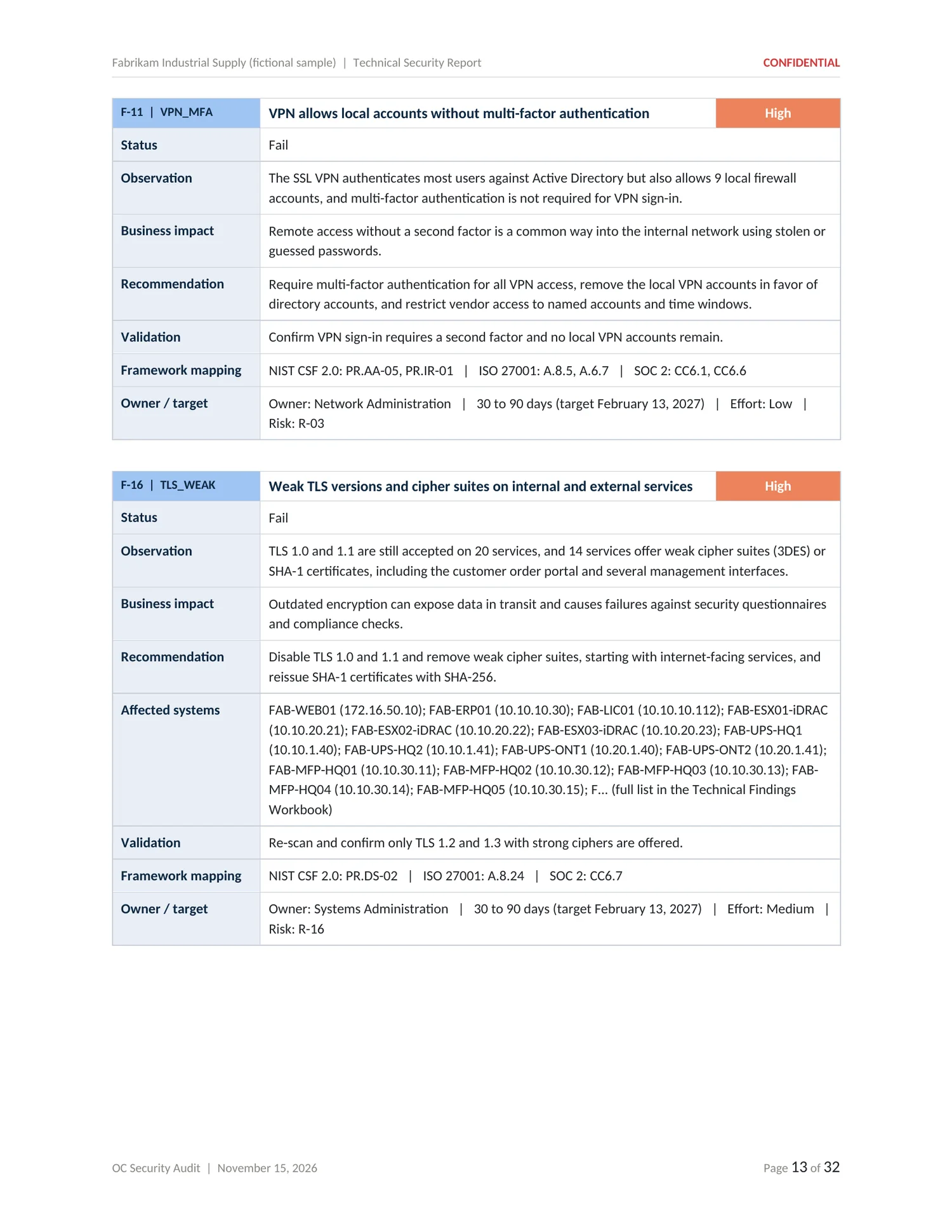
Each finding shows what we saw, why it matters, how serious it is and exactly how to fix it, so your team or your provider can act on it right away. Our MSP security audit sample shows how we review an IT provider’s own procedures.
MSP security auditAll sample reportsFrequently asked questions
What happened in the November 2026 ScreenConnect attacks?
ConnectWise confirmed unauthorized access to ScreenConnect partner accounts and the installation of unauthorized remote-access software in customer environments. Security firms traced the activity to a third-party extension called RMM+, and Huntress reported 288 affected endpoints across 48 organizations.
Should I be worried if my IT provider uses ScreenConnect?
Using ScreenConnect does not mean you were affected. ConnectWise said partners who never installed the flagged extensions have no reason to believe they are affected. Ask your provider to confirm the extension status, patch level and MFA settings in writing.
What data was exposed in the Uber breach?
According to TechCrunch, Uber’s notices say drivers’ personal information and driver’s license information were stolen through a breach at a technology provider. Uber had not disclosed a total number of people affected as of November 17, 2026.
What is an MSP security audit?
It is an independent review of how your managed IT provider secures its own tools, accounts and procedures, because those tools reach into every client network the provider manages.
Can you audit our vendors remotely?
Yes. We work on-site across Southern California and remotely with organizations nationwide, and most vendor and MSP reviews can be done remotely.
How OC Security Audit can help
We check who and what can reach your systems from outside, starting with your IT provider and the vendors that hold your data.
- MSP security audit: your provider’s tools, access and procedures
- Internal security audit: remote tools and admin accounts inside your network
- Enterprise risk assessment: vendors, data and business impact
- M365 & Azure compromise investigation: when you suspect misuse already happened
Ali Hassani, CISSP, C|CISO, is based in Irvine and works with organizations on-site across Southern California and remotely nationwide.
Schedule a consultationCall 949-777-5567An audit shows where your controls are weak and what to fix first. No audit or service can guarantee that an organization or its vendors will not be attacked; the goal is to lower the likelihood and the impact.
More in this series
See all incident briefings in the recent cyberattacks and data breaches tracker.
Sources
- BleepingComputer, Active ScreenConnect attacks breach MSPs, impact dozens of organizations, November 11, 2026. https://bleepingcomputer.com/news/security/active-screenconnect-attacks-breach-msps-impact-dozens-of-organizations
- The Record, ConnectWise investigating ScreenConnect breaches tied to third-party tool, November 12, 2026. https://therecord.media/connectwise-screenconnect-breaches-third-party-tool
- Field Effect, SCKit campaign targets MSP ScreenConnect environments, November 12, 2026. https://fieldeffect.com/blog/sckit-campaign-targets-msp-screenconnect-environments
- CyberScoop, Rogue remote-access campaign spread through ScreenConnect add-on, November 2026. https://cyberscoop.com/?p=91552
- SecurityOnline, ScreenConnect extensions disabled, November 2026. https://securityonline.info/screenconnect-extensions-disabled/
- TechCrunch, Uber confirms hackers stole thousands of drivers’ license information in data breach, November 13, 2026. https://techcrunch.com/2026/11/13/uber-confirms-hackers-stole-thousands-of-drivers-license-information-in-data-breach/
- CISA, AA23-025A, Protecting Against Malicious Use of Remote Monitoring and Management Software. https://www.cisa.gov/news-events/cybersecurity-advisories/aa23-025a
- CISA, Known Exploited Vulnerabilities Catalog. https://www.cisa.gov/known-exploited-vulnerabilities-catalog
About this briefing. This page summarizes publicly available information from the sources linked above, as of the verification date shown. OC Security Audit was not involved in responding to any incident described here and has no inside knowledge of them. Organization names are used only to identify the subjects of the cited public reports. Statements by researchers are attributed to them; details that the sources do not confirm are marked as unknown. Facts may change as investigations continue.
This content is for general educational purposes. It is not legal advice, a forensic conclusion or a finding about any organization’s security practices. See our editorial standards. To report an error, contact support@ocsecurityaudit.com and we will review it and publish a dated correction where needed.