

FAA Nationwide Ground Stop, November 13, 2026: Network Resilience Lessons for Every Business
Part 1 of 3 in U.S. Outages and Hacks: November 2026 Briefings
Official FAA explanation · investigation ongoing · Last verified: November 17, 2026 · Reviewed by Ali Hassani, CISSP, C|CISO

See what a finished audit looks like
Sample reports built for fictional companies show the executive summary, findings, risk register and roadmap you receive.

Want this checked in your own environment?
Ali Hassani, a Certified CISO (C|CISO) and CISSP with 25+ years in IT and cybersecurity, turns guidance like this into a ranked, practical plan. Based in Irvine, on-site across Southern California and remote nationwide.
The FAA’s own question-and-answer page, published two days after the event, says the trouble started when data flooded its telecommunications network at roughly 1,000 connection attempts every four to five seconds, and that investigators traced the flood to two field sites where its network provider had been working, including the deployment of a new router (FAA, Nationwide Ground Stop Q&A). That is a story most IT teams will recognize. This briefing summarizes what the public record says, what is still unknown, and the practical checks any business can run on its own network.
| Organization | Federal Aviation Administration (FAA), U.S. Department of Transportation |
|---|---|
| When | November 13, 2026, about 3:30 p.m. ET; air traffic resumed about 8:15 p.m. ET the same day (FAA Q&A) |
| Impact | Nationwide ground stop of departing flights; instability began at 17 of 22 Air Route Traffic Control Centers and spread to several approach-control facilities (FAA Q&A) |
| Stated cause | Legacy equipment became unstable when data flooded the FAA’s telecommunications network; initial investigation points to a radar site in Amarillo, Texas, and a radio site in El Dorado, Arkansas (FAA Q&A) |
| Cyberattack? | The FAA says available evidence does not indicate a cyberattack; federal officials said the same on the day of the event (GovInfoSecurity) |
| Status | The FAA and its provider are still investigating the root cause (FAA Q&A) |
Each item is linked to its source. The status label reflects the strongest source available on the verification date.
What happened
- July 28, 2026. A connectivity outage at American Airlines leads the FAA to briefly ground that airline’s flights nationwide (FOX 5 Atlanta).
- September 21, 2026. The FAA loses its primary circuit at the Philadelphia approach-control facility, and the backup fiber line is also broken. Ground stops hit major Northeast airports; the Transportation Secretary said a construction crew had accidentally cut a fiber line in New Jersey (Al Jazeera).
- November 13, about 3:30 p.m. ET. A technical problem leads the FAA to issue a nationwide ground stop (FAA Q&A). Trade press reports the stop was ordered shortly before 4 p.m. ET (AeroTime).
- November 13, evening. Officials tell reporters the outage is unlikely to be a cyberattack, and the Transportation Secretary says it was not caused by the new SMART controller-assistance system (GovInfoSecurity).
- November 13, about 8:15 p.m. ET. The FAA confirms the system is stable and air traffic resumes (FAA Q&A).
- November 15. The FAA publishes its Q&A: its provider blocked the two sites and the network stabilized; the FAA disabled the broadcasting function on all new routers and on about 60 similar routers as a precaution, and said it will reevaluate when maintenance is performed, because this routine router replacement happened midday rather than at night (FAA Q&A).
What is still unknown
- The final root cause. The FAA says it and its network provider are still investigating (FAA Q&A).
- Exactly why a flood of traffic from two sites could destabilize equipment across most en-route centers. No detailed technical report had been published in the sources reviewed.
- Whether other parts of the network carry the same exposure, beyond the roughly 60 routers the FAA has already changed.
Why a business network should care
Most companies do not run air traffic control, but almost every company runs a network that was built in layers over many years. The FAA itself says the incident underscores the need to modernize aging infrastructure (FAA Q&A), and the Homeland Security Secretary told reporters that introducing new technology into an old system overwhelmed it (Christian Science Monitor / AP).
Two patterns from this fall apply to almost any office, clinic, warehouse or multi-site company. First, a routine change made during business hours can spread far beyond the device that was changed. Second, a backup path only helps if it does not fail at the same time; in the September Northeast outage, the backup fiber line was also broken (Al Jazeera). Neither pattern needs an attacker. Both can stop a business just as completely as ransomware.
Seven network resilience lessons
- Schedule changes, and protect business hours. The FAA says it will reevaluate maintenance timing because this replacement happened midday. Set approved change windows and an emergency-change process for your own firewalls, switches and routers.
- Roll out in stages. Change one site or one device first, watch it, then continue. A staged rollout limits how far a bad setting can travel.
- Review default features on new equipment. The FAA disabled a broadcasting function on new routers after the event. New devices often ship with discovery and broadcast features turned on; your configuration standard should say which ones stay off.
- Contain traffic floods. Storm control, rate limits and proper network segmentation keep one noisy device or site from overwhelming the rest of the network.
- Make backup paths truly separate. A second internet circuit that shares the same conduit, building entry or provider can fail together with the first. Document where each path actually runs.
- Know your legacy equipment. Keep an inventory with end-of-support dates and a replacement plan, so that old and new gear are not mixed without testing.
- Practice the outage. Write down who decides, how staff communicate if email and phones are affected, and how the business keeps working. Then rehearse it. NIST’s contingency planning guide is a good free starting point (NIST SP 800-34 Rev. 1).
Questions to ask about your own network this week
- When was the last change to a firewall, router or core switch, and who approved it?
- Is there a written rollback plan for every planned network change?
- Do our switches have storm control or rate limiting turned on?
- If our main internet line fails, does the backup really take over, and when did we last test it?
- Do our two connections leave the building by different routes and different providers?
- Which network devices are past end of support?
- Do we have a current network diagram that someone outside IT could follow?
- Who would we call first, and how, if our network went down at 3:30 p.m. on a Friday?
How a network security audit checks these areas
A security audit looks at the same controls that keep a business running during a bad change or a failed circuit, not only at attackers. Here is how our audits map to the lessons above.
| Area | What we review | Related service |
|---|---|---|
| Change control | Change records, approval steps, maintenance windows, rollback plans | Cisco network security audit |
| Device configuration | Unneeded services and broadcast features, firmware age, management access | Firewall security audit |
| Segmentation | VLANs, storm control, how far one failure can spread | Internal security audit |
| Redundancy and recovery | Backup circuits, failover tests, recovery objectives | Backup & disaster recovery audit |
| Outage readiness | Outage runbooks, communication plans, tabletop exercises | Incident response & outage resilience |
| Documentation | Network diagrams, asset inventory, end-of-support tracking | IT documentation |
See how we report what we find
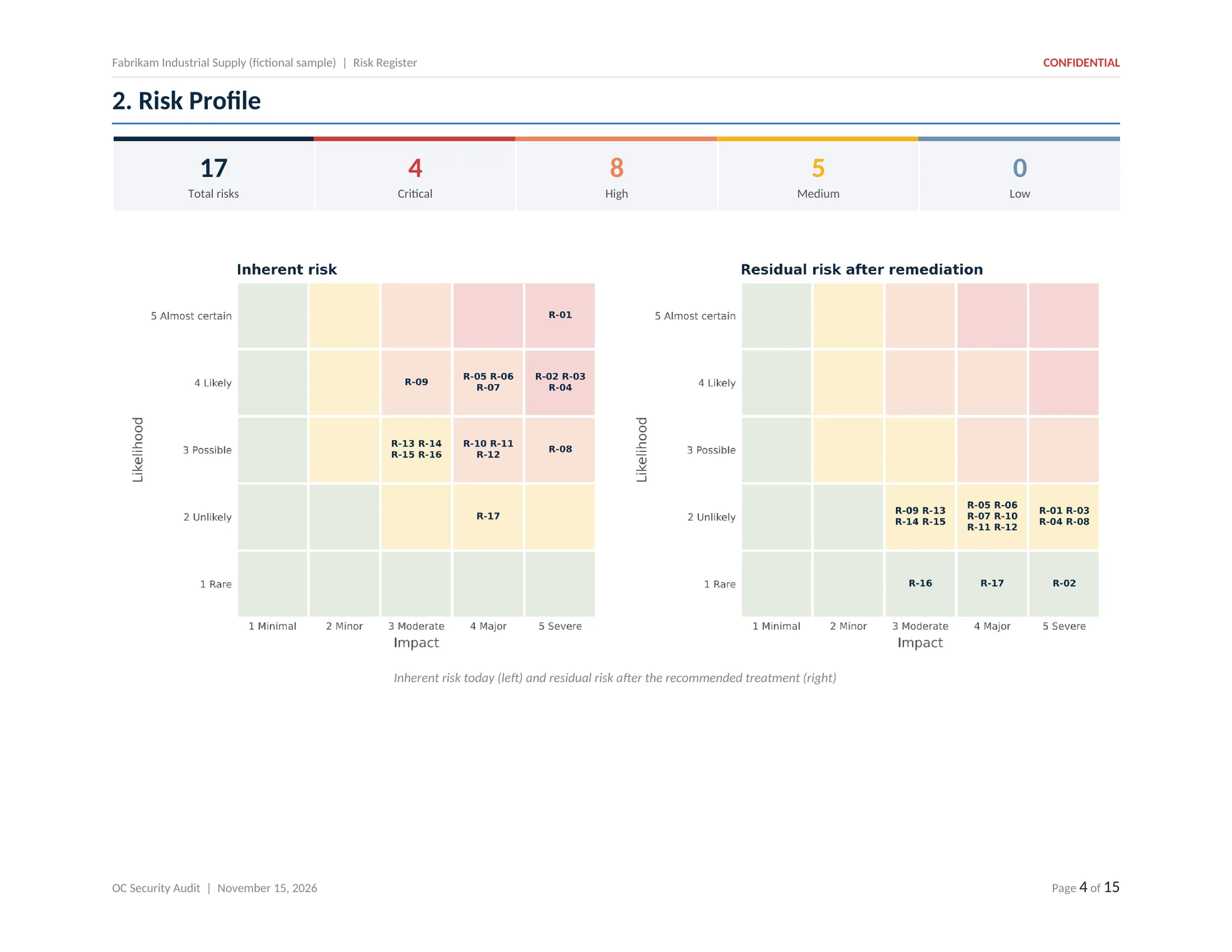
Every audit ends with plain-language deliverables: an executive report for leadership, a technical report for your IT team or provider, a risk register that ranks each finding by business impact, and a step-by-step roadmap. You can look through real sample pages before you talk to us.
Browse all sample reportsNetwork sample reportFrequently asked questions
Was the November 13, 2026 FAA outage a cyberattack?
According to the FAA, the available evidence does not indicate a cyberattack. The FAA and its network provider were still investigating the root cause as of November 17, 2026.
What did the FAA say caused the ground stop?
The FAA says legacy equipment became unstable when data flooded its telecommunications network, and that the initial investigation points to a radar site in Amarillo, Texas, and a radio site in El Dorado, Arkansas, where a new router was being deployed.
How long did the nationwide ground stop last?
The FAA says the problem began at about 3:30 p.m. ET and that the system was stable and traffic resumed at about 8:15 p.m. ET the same day. Airlines needed longer to recover schedules.
Can a network change really take down a whole business?
Yes. A wrong setting, a feature left on by default, or a change made without a rollback plan can spread across a flat or poorly segmented network. That is why change control and segmentation are core parts of a network security audit.
Do you only audit companies in Orange County?
No. We work on-site across Southern California, including Orange County and Los Angeles County, and remotely with organizations nationwide.
How OC Security Audit can help
We review the network, change control and recovery plans that decide whether a bad day becomes a lost week. Start with the audit that fits your environment:
- Security audit services: the full list of audits
- Cisco network security audit: routers, switches and configuration standards
- Backup & disaster recovery audit: recovery objectives and restore testing
- Incident response & outage resilience: runbooks and tabletop exercises
Ali Hassani, CISSP, C|CISO, is based in Irvine and works with organizations on-site across Southern California and remotely nationwide.
Schedule a consultationCall 949-777-5567An audit shows where your controls are weak and what to fix first. No audit or service can guarantee that a network will never fail or be attacked; the goal is to lower the likelihood and the impact.
More in this series
See all incident briefings in the recent cyberattacks and data breaches tracker.
Sources
- Federal Aviation Administration, Nationwide Ground Stop: Questions and Answers, November 15, 2026. https://www.faa.gov/newsroom/nationwide-ground-stop-questions-and-answers
- GovInfoSecurity, US Flights Halted as FAA Communications Systems Fail, November 2026. https://www.govinfosecurity.com/us-flights-halted-as-faa-communications-systems-fail-a-33394
- AeroTime, FAA halts all US departures, November 13, 2026. https://www.aerotime.aero/articles/faa-nationwide-ground-stop-atc-communications-november-2026
- Christian Science Monitor (AP), FAA says flights can resume following nationwide ground stop, November 13, 2026. https://www.csmonitor.com/Business/2026/1113/faa-duffy-ground-stop-lifted
- Al Jazeera, FAA halts flights to major US East Coast airports amid outage, September 21, 2026. https://www.aljazeera.com/news/2026/9/21/faa-halts-flights-to-major-us-east-coast-airports-amid-outage
- FOX 5 Atlanta, What happened the last time the FAA grounded all departing flights, November 13, 2026. https://www.fox5atlanta.com/news/what-happened-last-time-faa-grounded-all-departing-flights
- NIST, SP 800-34 Rev. 1, Contingency Planning Guide for Federal Information Systems. https://csrc.nist.gov/pubs/sp/800/34/r1/upd1/final
About this briefing. This page summarizes publicly available information from the sources linked above, as of the verification date shown. OC Security Audit was not involved in responding to any event described here and has no inside knowledge of it. Organization names are used only to identify the subjects of the cited public reports. Details that the sources do not confirm are marked as unknown, and facts may change as investigations continue.
This content is for general educational purposes. It is not legal advice, an engineering conclusion or a finding about any organization’s practices. See our editorial standards. To report an error, contact support@ocsecurityaudit.com and we will review it and publish a dated correction where needed.