

Snowflake Customer Breaches: Old Passwords, No MFA and 165 Organizations Notified
Part 5 of 10 in the series Lessons from Major Cyber Incidents · United States and worldwide · 2024

What happened, in brief
- How it started: Stolen passwords used on customer accounts without MFA, per Mandiant
- Age of passwords: Some were still valid years after they were stolen
- Scale: About 165 organizations notified, per Mandiant
- Legal cost: AT&T: settlement reported as $177 million, covering two incidents, with no admission of liability
Summary of public reporting; sources are listed in the briefing.

Want this checked in your own environment?
Ali Hassani, a Certified CISO (C|CISO) and CISSP with 25+ years in IT and cybersecurity, turns guidance like this into a ranked, practical plan. Based in Irvine, on-site across Southern California and remote nationwide.

Key facts
| How it started | Stolen passwords used on customer accounts without MFA, per Mandiant |
|---|---|
| Age of passwords | Some were still valid years after they were stolen |
| Scale | About 165 organizations notified, per Mandiant |
| Legal cost | AT&T: settlement reported as $177 million, covering two incidents, with no admission of liability |
Each figure is sourced in the article below.
In 2024, data belonging to customers of AT&T, Ticketmaster and other large companies was stolen from cloud accounts on the Snowflake data platform. Investigators found no evidence that Snowflake’s own systems were breached. According to the investigation by Google’s Mandiant unit, the attackers logged in with stolen passwords, some of them taken years earlier and never changed, on accounts that had no multi-factor authentication (MFA). It is one of the most instructive cloud incidents on record, because the gaps Mandiant described across the campaign were basic ones.
What happened
Snowflake is a cloud platform that companies use to store and analyze large volumes of data. In spring 2024, a financially motivated group that Google’s Mandiant unit tracks as UNC5537 logged in to the Snowflake accounts of many Snowflake customers, copied data, and then tried to extort the victims and sell the data.
Mandiant, which investigated with Snowflake, reported that the two companies had notified approximately 165 potentially exposed organizations (Mandiant, June 10, 2024). Publicly identified victims include:
- AT&T. The company told the SEC that records of calls and texts of nearly all of its wireless customers were copied from a third-party cloud platform. The records covered mainly May to October 2022 and did not include the content of calls or texts (AT&T Form 8-K, filed July 12, 2024).
- Live Nation and Ticketmaster. Live Nation disclosed unauthorized activity in a third-party cloud database containing mainly Ticketmaster data (Live Nation Form 8-K, filed May 31, 2024).
- Advance Auto Parts. The company reported that about 2.3 million people were affected (BleepingComputer, July 11, 2024).
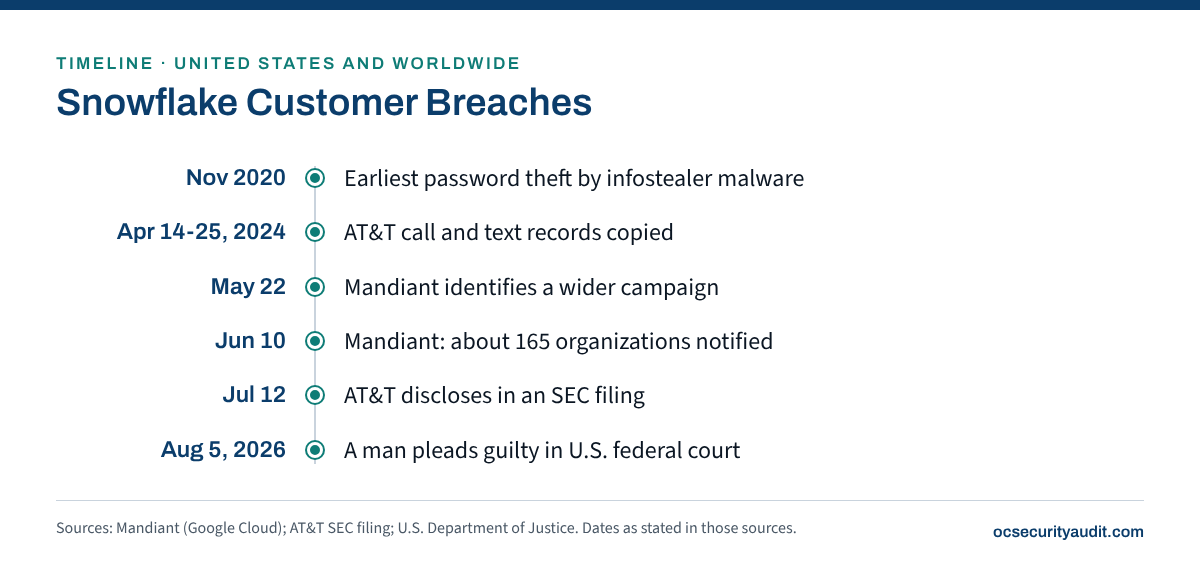
How it started
Mandiant’s finding was direct: every incident it responded to in this campaign was traced back to compromised customer credentials (Mandiant).
Those credentials had been collected by infostealer malware, programs that quietly copy saved passwords from an infected computer. Mandiant found that the earliest infection dated to November 2020. In several cases, the malware was on contractor laptops that were also used for personal activities, including gaming and downloading pirated software.
In a joint statement with CrowdStrike and Mandiant, posted by Snowflake’s chief information security officer, the company said this appeared to be a targeted campaign directed at users with single-factor authentication, and that it had not identified evidence the activity was caused by a vulnerability, misconfiguration or breach of Snowflake’s platform (Snowflake statement).
How long it took to detect
There is no single figure for the campaign. For AT&T, the company’s SEC filing gives two dates: data was copied between April 14 and April 25, 2024, and AT&T learned of the claim on April 19. The more striking number is the age of the passwords. Mandiant reported that some stolen credentials were still valid years after they were taken (Mandiant).
What it cost
- Criminal proceeds and losses: When a Canadian man pleaded guilty in August 2026, the U.S. Department of Justice stated that the conspiracy received more than $2.5 million in ransom payments and that victim companies suffered more than $9.5 million in actual losses, a figure that does not include losses to those companies’ customers, who numbered at least 100 million individuals (Department of Justice, August 5, 2026). The department’s release does not name the cloud provider. KrebsOnSecurity identifies it as Snowflake (KrebsOnSecurity, August 2026).
- AT&T settlement: AT&T agreed to a class action settlement, reported by Law360 as $177 million, that covers two separate data incidents, one of which is the Snowflake incident (Law360, October 2, 2026). The settlement was made without any admission of liability or wrongdoing, and the court granted final approval on October 2, 2026 (official settlement website).
- Reported ransom: Wired reported in July 2024 that AT&T paid about $370,000 to have the stolen records deleted, as noted by KrebsOnSecurity. We did not find a public confirmation from AT&T.
At the time of their filings, AT&T and Live Nation each told the SEC the incident had not had a material impact on their operations. The larger cost in cases like this tends to arrive later, through litigation.
What Mandiant found across the affected accounts
Mandiant identified three factors (Mandiant):
- No MFA. The impacted accounts were not configured with multi-factor authentication, so a valid username and password were enough.
- Passwords never rotated. Credentials stolen by infostealer malware were still valid, in some cases years later.
- No network allow lists. The accounts accepted sign-ins from anywhere, with no restriction to trusted locations.
Mandiant also pointed to contractors using personal or unmonitored laptops for work.
These are findings about the campaign as a whole. No official source we reviewed attributes specific failures to AT&T, Live Nation or any other named company. Snowflake has since begun requiring MFA for people who sign in with passwords and is phasing out password-only sign-ins (Snowflake documentation).
How the risk could be reduced
CISA issued an alert pointing organizations to Snowflake’s guidance (CISA alert, June 3, 2024). Snowflake’s recommendations were to enforce MFA on all accounts, set network policy rules that allow only authorized users and locations, and, for affected organizations, reset and rotate credentials (Snowflake statement).
The same checklist applies to every cloud service a business uses:
- Enforce MFA everywhere, including service and shared accounts. If a platform lets you make MFA mandatory, turn it on. Do not rely on each user to enroll.
- Restrict where sign-ins can come from. In Microsoft 365 this is Conditional Access: trusted locations, compliant devices and blocked legacy protocols.
- Rotate credentials on a schedule and after any malware finding. An infected laptop means every password saved on it is compromised.
- Keep work off personal devices. Infostealers arrive through personal downloads. Managed, monitored devices are the fix, and that is what an Intune security audit verifies.
- Hold contractors to your standards. Their laptops are a way into your data.
- Inventory your cloud accounts. You cannot enforce MFA on a platform your IT team does not know about.
Where things stand now
A Canadian man pleaded guilty in U.S. federal court on August 5, 2026 to conspiracy, computer fraud, wire fraud and aggravated identity theft, and his sentencing is scheduled for October 27, 2026, according to the Department of Justice. A second man indicted with him has not been convicted and is presumed innocent (KrebsOnSecurity).
What this means for your organization
The Snowflake cases were not about Snowflake. They were about accounts where a password was the only lock. Most small and mid-size businesses have the same exposure in Microsoft 365, in their accounting platform, in their file sharing and in the tools their vendors use.
Our Microsoft 365 security audit checks MFA coverage for every account, Conditional Access policies, legacy authentication and sign-in risk, using read-only access, for a fixed price of $3,500. Our guide to MFA and Conditional Access explains the settings.
Try the free Microsoft 365 Security Risk Check, or schedule a consultation with Ali Hassani, CISSP, C|CISO.
More in this series
- First article in the series: Change Healthcare Ransomware Attack: A Portal Without MFA and $3.09 Billion in Costs
- Previous: Article 4, CDK Global Ransomware Attack: How One Vendor Outage Disrupted Dealerships Across North America
- Next: Article 6, PowerSchool Data Breach: One Support Login and Millions of Student Records (publishes October 10, 2026)
Sources
- Mandiant, June 10, 2024 (cloud.google.com): https://cloud.google.com/blog/topics/threat-intelligence/unc5537-snowflake-data-theft-e…
- AT&T Form 8-K, filed July 12, 2024 (sec.gov): https://www.sec.gov/Archives/edgar/data/732717/000073271724000046/t-20240506.htm
- Live Nation Form 8-K, filed May 31, 2024 (sec.gov): https://www.sec.gov/Archives/edgar/data/1335258/000133525824000081/lyv-20240520.htm
- BleepingComputer, July 11, 2024 (bleepingcomputer.com): https://www.bleepingcomputer.com/news/security/advance-auto-parts-data-breach-impacts-2…
- Snowflake statement (medium.com): https://medium.com/snowflake/detecting-and-preventing-unauthorized-user-access-d67be8bd…
- Department of Justice, August 5, 2026 (justice.gov): https://www.justice.gov/opa/pr/canadian-man-pleads-guilty-hacking-us-cloud-storage-prov…
- KrebsOnSecurity, August 2026 (krebsonsecurity.com): https://krebsonsecurity.com/2026/08/canadian-man-pleads-guilty-in-snowflake-extortions/
- Law360, October 2, 2026 (law360.com): https://www.law360.com/cybersecurity-privacy/articles/2533531
- official settlement website (telecomdatasettlement.com): https://www.telecomdatasettlement.com/
- KrebsOnSecurity (krebsonsecurity.com): https://krebsonsecurity.com/2024/11/canadian-man-arrested-in-snowflake-data-extortions/
- Snowflake documentation (docs.snowflake.com): https://docs.snowflake.com/en/user-guide/security-mfa-rollout
- CISA alert, June 3, 2024 (cisa.gov): https://www.cisa.gov/news-events/alerts/2024/06/03/snowflake-recommends-customers-take-…
Last verified: October 4, 2026. This article is general information based on the public sources cited, as of the date shown. It is not legal advice. OC Security Audit had no involvement in the incidents described and has no inside knowledge of them. Company names appear only to identify the organizations named in those public sources. Statements made in lawsuits are allegations and have not been proven. Where a source could not be confirmed, the article says so. If you believe anything here is inaccurate, contact us and we will review it.