

SharePoint ToolShell Attacks: Why Patching Alone Did Not Stop the Intruders
Part 7 of 10 in the series Lessons from Major Cyber Incidents · Worldwide · 2025

What happened, in brief
- How it started: Flaws in internet-facing on-premises SharePoint servers
- Scale: More than 400 compromised systems, Eye Security count
- Cloud: SharePoint Online in Microsoft 365 was not affected
- Key lesson: Stolen machine keys keep working after a patch
Summary of public reporting; sources are listed in the briefing.

Want this checked in your own environment?
Ali Hassani, a Certified CISO (C|CISO) and CISSP with 25+ years in IT and cybersecurity, turns guidance like this into a ranked, practical plan. Based in Irvine, on-site across Southern California and remote nationwide.

Key facts
| How it started | Flaws in internet-facing on-premises SharePoint servers |
|---|---|
| Scale | More than 400 compromised systems, Eye Security count |
| Cloud | SharePoint Online in Microsoft 365 was not affected |
| Key lesson | Stolen machine keys keep working after a patch |
Each figure is sourced in the article below.
In July 2025, attackers began breaking into Microsoft SharePoint servers that organizations run in their own offices and data centers. The attack chain became known as “ToolShell”. Its most important lesson is uncomfortable: organizations that installed the patch could still be compromised, because the attackers had already taken the server’s keys.
What happened
The flaws affected on-premises SharePoint Server 2016, 2019 and Subscription Edition. Microsoft stated clearly that SharePoint Online in Microsoft 365 was not impacted (Microsoft Security Response Center guidance).
The attack chained two vulnerabilities, CVE-2025-49706 and CVE-2025-49704, which together let someone with no account run their own code on the server. Microsoft released fixes for those on July 8, 2025. Microsoft then said the attacks were exploiting vulnerabilities only partially addressed by that update, and two further identifiers were assigned. CISA describes that later pair, CVE-2025-53771 and CVE-2025-53770, as patch bypasses (CISA alert, July 20, 2025). Microsoft published further updates on July 20 and 21.
How it started
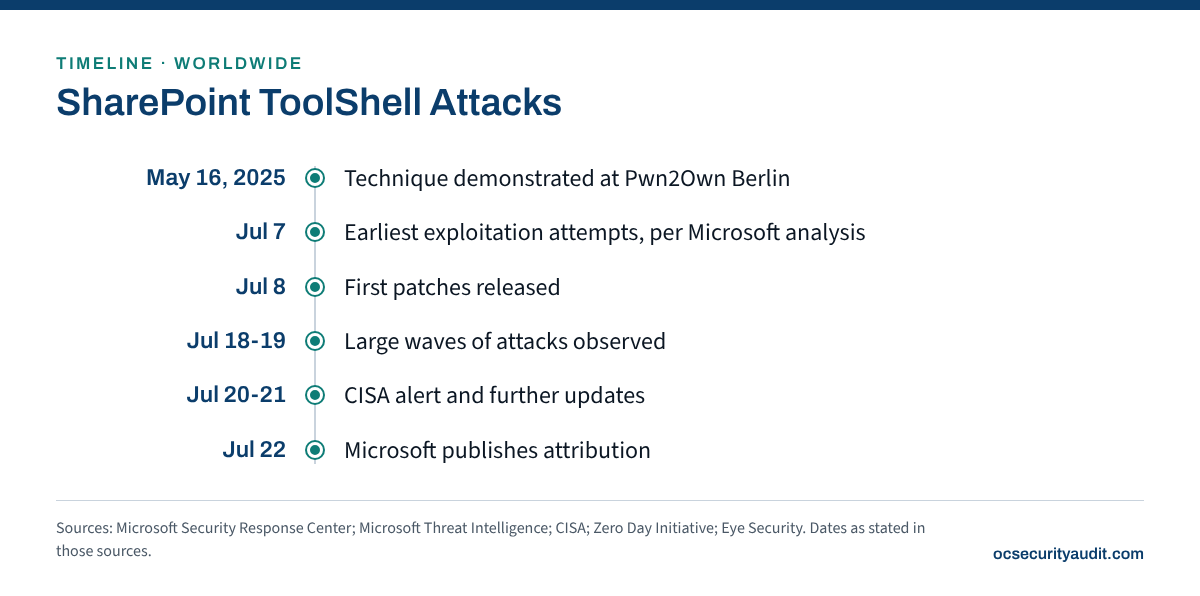
The underlying technique was first shown publicly at the Pwn2Own security contest in Berlin on May 16, 2025, where a researcher combined an authentication bypass with a second bug to compromise SharePoint (Zero Day Initiative).
Microsoft reported that its analysis suggests attackers were attempting to exploit the flaws as early as July 7, 2025. The attackers sent a crafted request to an internet-facing SharePoint server, installed a small malicious file called a web shell, and used it to retrieve the server’s cryptographic machine keys (Microsoft Threat Intelligence, July 22, 2025).
Microsoft attributed the activity to two Chinese state-linked groups it calls Linen Typhoon and Violet Typhoon, and to a third actor, Storm-2603, which it assessed with moderate confidence to be based in China. Microsoft observed Storm-2603 deploying Warlock ransomware from July 18, 2025. This is Microsoft’s attribution. We found no criminal charges as of October 2026.
How long it took to detect
There is no single figure, because this was a campaign against many organizations. The public timeline shows how little time defenders had:
- July 7: earliest exploitation attempts seen by Microsoft.
- July 8: first patches released.
- July 18 and 19: large waves of attacks observed by Eye Security, a European security company (Eye Security research).
- July 20: CISA added CVE-2025-53770 to its Known Exploited Vulnerabilities catalog.
- July 20 and 21: further updates published.
Even an organization that installed the July 8 update promptly was not fully protected until the later updates were applied and the keys were rotated.
Who was affected and what it cost
Eye Security scanned more than 23,000 SharePoint servers and reported more than 400 systems actively compromised (Eye Security). That is one vendor’s count, not an official total.
The U.S. Department of Energy confirmed that it was affected, including the National Nuclear Security Administration. A department spokesperson said it was “minimally impacted” because of its widespread use of the Microsoft 365 cloud and its cybersecurity systems, and that a very small number of systems were affected (Cybersecurity Dive, July 23, 2025). That statement confirms affected systems. It does not confirm any loss of data.
No reliable total cost has been published. We found no company-reported or official figure.
What made servers vulnerable, according to Microsoft and CISA
These points come from Microsoft and CISA guidance (Microsoft; CISA). They describe the conditions that made servers vulnerable in general. No official source attributes a specific failure to a specific victim.
- The first patch did not fully close the hole. Microsoft said the attacks exploited vulnerabilities partially addressed by the July security update.
- Stolen machine keys survive patching. Machine keys are what a SharePoint server uses to sign and trust its own data. An attacker who has copied them can keep forging valid requests after the software is updated. Microsoft called it critical that customers rotate the keys and restart the web server. CISA’s instruction was to rotate the keys, apply the update, then rotate the keys again.
- Malware scanning inside SharePoint. Microsoft advised turning on the Antimalware Scan Interface (AMSI) in Full Mode and running endpoint protection on SharePoint servers.
- Internet-facing and out-of-support servers. CISA advised disconnecting public-facing SharePoint servers that had reached end of life.
- Logging and privileges. CISA recommended comprehensive logging and reducing administrative privileges.
How the risk could be reduced
A checklist for any business that runs servers reachable from the internet:
- Know what you expose. Many organizations have a forgotten SharePoint, file transfer or remote access server. An external security audit finds them from the outside, the way an attacker would.
- Patch internet-facing systems within days. Subscribe to CISA’s Known Exploited Vulnerabilities catalog and treat each new entry that matches your software as urgent.
- After an exploited flaw, assume compromise and check. Patching closes the door. It does not remove someone who is already inside. Rotate keys and passwords, and look for unfamiliar files and accounts.
- Put endpoint protection on servers, not only on laptops.
- Retire end-of-life software. If it no longer receives security updates, it should not face the internet.
- Reduce what faces the internet at all. Put collaboration servers behind a VPN or an identity-aware gateway.
- Scan regularly. A network vulnerability assessment shows which systems are missing which patches.
What happened next
A similar pattern appeared in 2026. Cybersecurity Dive reported in July 2026 that, according to security researchers, a new SharePoint flaw, CVE-2026-50522, was being exploited, and that researchers warned attackers were stealing machine keys (Cybersecurity Dive, July 21, 2026). This is a different flaw with its own identifier, patched on July 14, 2026. The lesson about keys carried over.
What this means for your organization
Two practical points follow. First, if you still run SharePoint, Exchange or another collaboration server in your own office, it carries a patching burden that the cloud version does not. The Department of Energy’s statement credits its cloud use, among other things, for limiting the impact. Second, moving to Microsoft 365 shifts the work to configuration: sharing settings, external access, identity and audit logging. That is what our Microsoft 365 security audit reviews, with read-only access.
If you are not sure what your network exposes, take the free Vulnerability Management Readiness Assessment, or schedule a consultation with Ali Hassani, CISSP, C|CISO.
More in this series
- First article in the series: Change Healthcare Ransomware Attack: A Portal Without MFA and $3.09 Billion in Costs
- Previous: Article 6, PowerSchool Data Breach: One Support Login and Millions of Student Records
- Next: Article 8, Collins Aerospace Ransomware Attack: How One Supplier Disrupted Europe's Airports (publishes October 12, 2026)
Sources
- Microsoft Security Response Center guidance (microsoft.com): https://www.microsoft.com/en-us/msrc/blog/2025/07/customer-guidance-for-sharepoint-vuln…
- CISA alert, July 20, 2025 (cisa.gov): https://www.cisa.gov/news-events/alerts/2025/07/20/update-microsoft-releases-guidance-e…
- Zero Day Initiative (thezdi.com): https://www.thezdi.com/blog/2025/5/16/pwn2own-berlin-2025-day-two-results
- Microsoft Threat Intelligence, July 22, 2025 (microsoft.com): https://www.microsoft.com/en-us/security/blog/2025/07/22/disrupting-active-exploitation…
- Eye Security research (research.eye.security): https://research.eye.security/sharepoint-under-siege/
- Cybersecurity Dive, July 23, 2025 (cybersecuritydive.com): https://www.cybersecuritydive.com/news/sharepoint-hacking-campaign-affects-hundreds-of-…
- Cybersecurity Dive, July 21, 2026 (cybersecuritydive.com): https://www.cybersecuritydive.com/news/microsoft-sharepoint-attack-new-exploit/825797/
Last verified: October 4, 2026. This article is general information based on the public sources cited, as of the date shown. It is not legal advice. OC Security Audit had no involvement in the incidents described and has no inside knowledge of them. Company names appear only to identify the organizations named in those public sources. Statements made in lawsuits are allegations and have not been proven. Where a source could not be confirmed, the article says so. If you believe anything here is inaccurate, contact us and we will review it.