

PowerSchool Data Breach: One Support Login and Millions of Student Records
Part 6 of 10 in the series Lessons from Major Cyber Incidents · United States and Canada · 2024-2025

What happened, in brief
- How it started: A compromised subcontractor account on a support portal without MFA
- Scale: Data of more than 60 million students and 10 million teachers cited in a U.S. Department of Justice release
- Ransom demanded: About $2.85 million in Bitcoin
- Court outcome: 4 years in prison and about $14.08 million restitution
Summary of public reporting; sources are listed in the briefing.

Want this checked in your own environment?
Ali Hassani, a Certified CISO (C|CISO) and CISSP with 25+ years in IT and cybersecurity, turns guidance like this into a ranked, practical plan. Based in Irvine, on-site across Southern California and remote nationwide.

Key facts
| How it started | A compromised subcontractor account on a support portal without MFA |
|---|---|
| Scale | Data of more than 60 million students and 10 million teachers cited in a U.S. Department of Justice release |
| Ransom demanded | About $2.85 million in Bitcoin |
| Court outcome | 4 years in prison and about $14.08 million restitution |
Each figure is sourced in the article below.
In December 2024, someone used a single stolen support login to copy student and teacher records from school systems across the United States and Canada. A related U.S. criminal case described threats to leak the data of more than 60 million students and 10 million teachers. Two Canadian privacy regulators then published detailed findings about what went wrong, which makes the PowerSchool breach one of the best-documented vendor incidents of recent years.
What happened
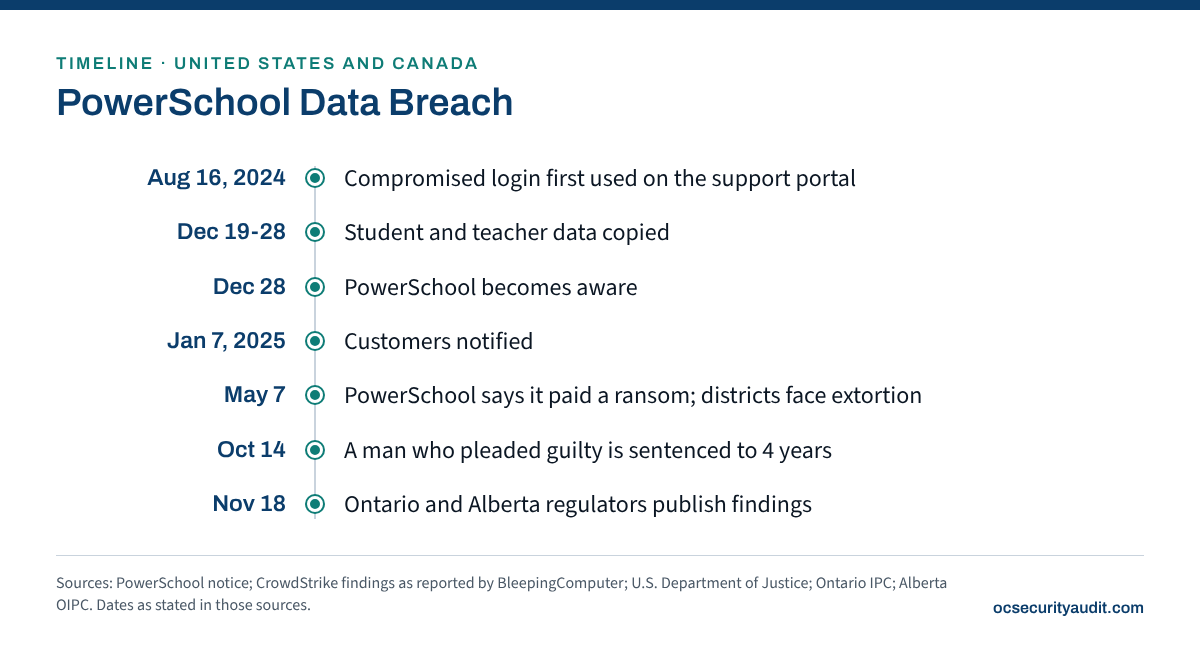
PowerSchool sells a Student Information System (SIS) that school districts use to hold student and staff records. On December 28, 2024, the company became aware that personal information had been taken from customers’ SIS environments through PowerSource, one of its customer support portals (PowerSchool notice of data breach, January 28, 2025).
According to the Ontario and Alberta regulators’ reports, PowerSchool notified the affected school bodies on January 7, 2025 (Ontario IPC report). According to PowerSchool’s notice, the data involved could include names, contact information, dates of birth, limited medical alert information and Social Security numbers, depending on the person.
PowerSchool paid a ransom. In May 2025 it said publicly that it had made the difficult decision to pay, and disclosed that someone was contacting individual school districts and trying to extort them with data from the same incident (The Record, May 7, 2025).
How it started
The Information and Privacy Commissioner of Ontario found that the attacker used the compromised account of a subcontractor who did technical support work for PowerSchool. According to the report, PowerSchool’s own experts were unable to determine how those credentials were first obtained (Ontario IPC report, November 2025).
Alberta’s Information and Privacy Commissioner described the next step. The support portal had a remote maintenance function that let support staff connect to individual customers’ systems. With the stolen login, the attacker used that function to reach school districts’ SIS databases and copy out the student and teacher tables (Alberta OIPC report F2025-IR-02).
How long it took to detect
The forensic investigation by CrowdStrike, as reported by BleepingComputer and SecurityWeek, found two relevant windows:
- Data theft: December 19 to December 28, 2024. The theft began nine days before PowerSchool became aware of it.
- Earlier use of the same login: The same compromised credential was used to access the support portal between August 16 and September 17, 2024 (SecurityWeek, March 12, 2025). CrowdStrike did not find enough evidence to attribute that earlier access to the same attacker (BleepingComputer, March 11, 2025).
CrowdStrike also noted that the available logs did not go back far enough to show whether data had been accessed during the earlier period (SecurityWeek, March 12, 2025). A stolen credential was therefore usable for at least four months.
What it cost
- Ransom demand: In a related criminal case, the Department of Justice stated that a software company serving school systems, which it did not name, received a demand for about $2.85 million in Bitcoin (U.S. Attorney’s Office, District of Massachusetts, May 20, 2025). News reports identify the company as PowerSchool (BleepingComputer, October 15, 2025). PowerSchool has confirmed it paid a ransom but has not, in the sources we reviewed, confirmed the amount.
- Restitution: A Massachusetts college student who pleaded guilty in that case was sentenced on October 14, 2025 to four years in prison and ordered to pay about $14.08 million in restitution. The release describes two victim companies and gives a single restitution figure without saying how it is divided (U.S. Attorney’s Office, District of Massachusetts).
- Company total: We found no published total cost for PowerSchool in the sources we reviewed.
- Ongoing exposure: Texas sued PowerSchool in September 2025, stating that more than 880,000 Texas students and teachers were affected (Texas Attorney General petition). A consolidated class action in federal court in California was allowed to proceed in March 2026, according to a notice from the plaintiffs’ lawyers (Hausfeld, April 1, 2026). The claims in both are allegations that have not been proven.
Paying the ransom did not end the matter. School districts were approached by an extortionist months later.
What the regulators found
These points come from the published reports of the Ontario and Alberta privacy commissioners (Ontario IPC; Alberta OIPC).
- No MFA on the support portal. The Ontario report states that multi-factor authentication did not apply to PowerSchool users logging in to PowerSource at the time of the attack.
- Remote maintenance access that stayed enabled. The Alberta Commissioner found that PowerSchool had not implemented appropriate controls to securely manage remote access to customer systems. PowerSchool told the Commissioner the setting was on by default only for the first 30 days after installation. After the incident, PowerSchool removed the “always on” maintenance access option and limited maintenance access to no more than 30 days.
- Weak control of privileged accounts. The Alberta Commissioner found the company’s access control policy deficient for managing remote access by privileged account holders. PowerSchool disputed the description of the compromised account as administrative, saying it had limited, task-specific access.
- Short log retention. Investigators could not establish whether data was accessed in August and September because the relevant SIS logs were outside the retention period.
The regulators also made findings about the customers. In a joint release, the Ontario and Alberta commissioners said school boards had failed to include certain privacy and security provisions in their contracts, lacked procedures to oversee the vendor’s safeguards, failed to limit remote access by the vendor’s support staff to only as long as necessary, and lacked adequate breach response plans (Ontario IPC news release, November 18, 2025).
How the risk could be reduced
CISA’s guidance for school technology purchasing states that multi-factor authentication, particularly phishing-resistant methods, is the single most effective measure to prevent cyber intrusions, and that products should enable it by default (CISA K-12 acquisition guidance).
For any organization that lets a vendor connect to its systems:
- Turn vendor remote access off by default. Enable it for a specific task and a set period, then turn it off again.
- Require MFA on every vendor and support account. Ask the vendor in writing whether their own support portal enforces MFA.
- Put security terms in the contract. MFA, breach notification deadlines, log retention and the right to see independent audit reports.
- Keep logs long enough to investigate. Ninety days is often too short. Twelve months is a reasonable target for sign-in and access logs.
- Store less data. Old records that are no longer needed cannot be stolen if they have been removed.
- Have a breach response plan that covers a vendor incident. Know who notifies families, customers and regulators, and how quickly.
Our third-party vendor risk management service covers these points, and an internal security audit identifies every standing remote access path into your network.
What this means for your organization
Schools were the victims here, but the pattern fits any business. Your IT provider, your software vendors and your equipment suppliers often hold remote access that was set up years ago and never reviewed. In Microsoft 365, the same issue appears as guest accounts, partner relationships with administrative rights and app permissions that nobody remembers approving. Our Microsoft 365 security audit reports on each of those with read-only access.
Start with the free Vendor Risk Assessment tool, or schedule a consultation with Ali Hassani, CISSP, C|CISO.
More in this series
- First article in the series: Change Healthcare Ransomware Attack: A Portal Without MFA and $3.09 Billion in Costs
- Previous: Article 5, Snowflake Customer Breaches: Old Passwords, No MFA and 165 Organizations Notified
- Next: Article 7, SharePoint ToolShell Attacks: Why Patching Alone Did Not Stop the Intruders (publishes October 11, 2026)
Sources
- PowerSchool notice of data breach, January 28, 2025 (businesswire.com): https://www.businesswire.com/news/home/20250128218088/en/PowerSchool-Notice-of-Data-Bre…
- Ontario IPC report (ipc.on.ca): https://www.ipc.on.ca/en/media/5990/download?attachment
- The Record, May 7, 2025 (therecord.media): https://therecord.media/despite-ransom-payment-powerschool-extorting
- Alberta OIPC report F2025-IR-02 (oipc.ab.ca): https://oipc.ab.ca/wp-content/uploads/2025/11/FINAL-Investigation-Report-Regarding-Powe…
- SecurityWeek, March 12, 2025 (securityweek.com): https://www.securityweek.com/powerschool-portal-compromised-months-before-massive-data-…
- BleepingComputer, March 11, 2025 (bleepingcomputer.com): https://www.bleepingcomputer.com/news/security/powerschool-previously-hacked-in-august-…
- U.S. Attorney's Office, District of Massachusetts, May 20, 2025 (justice.gov): https://www.justice.gov/usao-ma/pr/worcester-college-student-plead-guilty-cyber-extorti…
- BleepingComputer, October 15, 2025 (bleepingcomputer.com): https://www.bleepingcomputer.com/news/security/powerschool-hacker-gets-sentenced-to-fou…
- U.S. Attorney's Office, District of Massachusetts (justice.gov): https://www.justice.gov/usao-ma/pr/worcester-college-student-sentenced-four-years-priso…
- Texas Attorney General petition (texasattorneygeneral.gov): https://texasattorneygeneral.gov/sites/default/files/images/press/PowerSchool%20Petitio…
- Hausfeld, April 1, 2026 (hausfeld.com): https://www.hausfeld.com/news/court-denies-motions-to-dismiss-in-powerschool-data-breac…
- Ontario IPC news release, November 18, 2025 (ipc.on.ca): https://www.ipc.on.ca/en/media-centre/news-releases/ontario-alberta-powerschool-breach
- CISA K-12 acquisition guidance (cisa.gov): https://www.cisa.gov/sites/default/files/2023-08/K-12_Acquisition_Guidance.pdf
Last verified: October 4, 2026. This article is general information based on the public sources cited, as of the date shown. It is not legal advice. OC Security Audit had no involvement in the incidents described and has no inside knowledge of them. Company names appear only to identify the organizations named in those public sources. Statements made in lawsuits are allegations and have not been proven. Where a source could not be confirmed, the article says so. If you believe anything here is inaccurate, contact us and we will review it.