

Jaguar Land Rover Cyberattack: Five Weeks Without Production and a £1.9 Billion Estimate
Part 2 of 10 in the series Lessons from Major Cyber Incidents · United Kingdom · 2025

What happened, in brief
- How it started: Not officially disclosed
- Production stopped: About 5 weeks; normal output by mid-November 2025
- JLR's cyber costs: £260 million disclosed across two quarters
- UK-wide impact: £1.9 billion, Cyber Monitoring Centre estimate
Summary of public reporting; sources are listed in the briefing.

Want this checked in your own environment?
Ali Hassani, a Certified CISO (C|CISO) and CISSP with 25+ years in IT and cybersecurity, turns guidance like this into a ranked, practical plan. Based in Irvine, on-site across Southern California and remote nationwide.

Key facts
| How it started | Not officially disclosed |
|---|---|
| Production stopped | About 5 weeks; normal output by mid-November 2025 |
| JLR's cyber costs | £260 million disclosed across two quarters |
| UK-wide impact | £1.9 billion, Cyber Monitoring Centre estimate |
Each figure is sourced in the article below.
In late summer 2025, a cyber incident stopped vehicle production at Jaguar Land Rover (JLR) for about five weeks. An independent UK body later estimated the damage to the wider British economy at £1.9 billion. The case is unusual because so little about the attack itself has been confirmed, and that is part of the lesson: the cost came from the shutdown, and it spread far beyond one company.
What happened
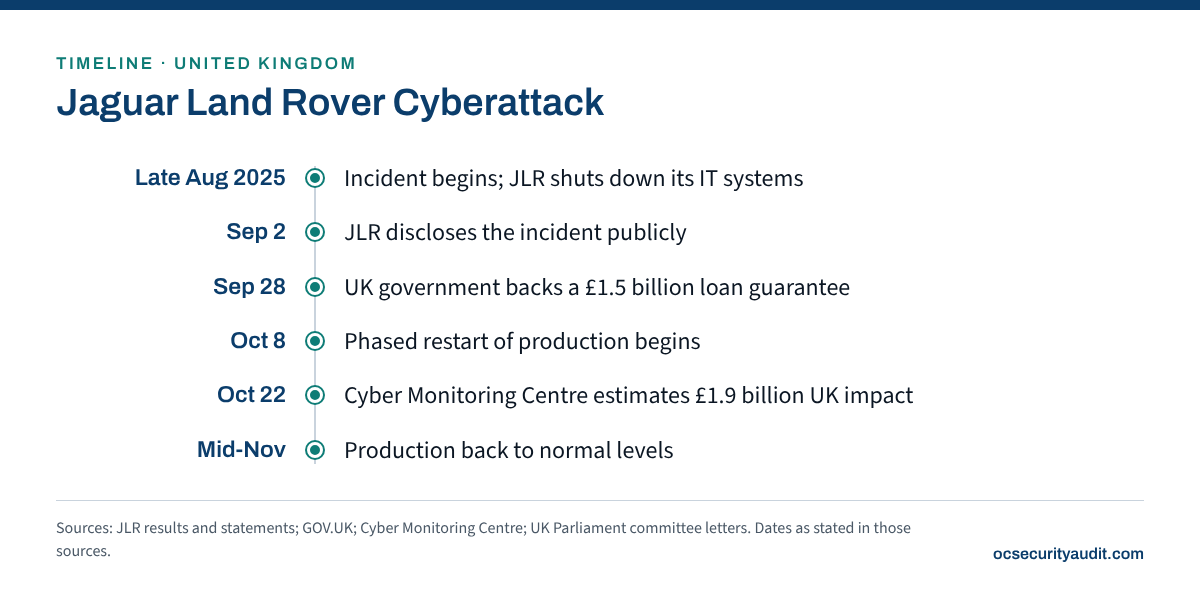
JLR is a British carmaker and a wholly owned subsidiary of India’s Tata Motors Passenger Vehicles Limited. The UK government describes it as one of the country’s largest exporters (GOV.UK). The incident began in late August 2025, according to the Cyber Monitoring Centre. JLR announced on September 2 that it had been affected and that its first action was to shut down all global systems (JLR second-quarter results, November 14, 2025). Production at its plants stopped. JLR later described this as “the production shutdown we initiated in response to the cyber incident” (JLR third-quarter results, February 5, 2026).
The UK National Cyber Security Centre (NCSC) confirmed on September 5, 2025 that it was supporting JLR (NCSC statement). A phased restart began on October 8, 2025 (JLR, October 7, 2025). JLR states that vehicle production returned to normal levels by mid-November (JLR third-quarter results).
In December 2025, JLR confirmed that data belonging to current and former employees and contractors had been affected (The Record, December 15, 2025). The Record noted a Telegraph report that the data included payroll information.
How it started
This has not been officially disclosed. As of October 2026, we found no statement from JLR, the NCSC, the National Crime Agency or the UK government that explains how the attackers got in. The Cyber Monitoring Centre, an independent UK non-profit that classifies major cyber events, noted that fewer technical details about this incident had emerged publicly than usual (Cyber Monitoring Centre statement, copy hosted by the Northern Automotive Alliance).
Press reports about the entry point have not been confirmed, and we do not repeat them here as fact.
Attribution is equally unsettled. A group calling itself Scattered Lapsus$ Hunters claimed responsibility (BleepingComputer, September 10, 2025). In June 2026, the New York Times reported, citing unnamed sources, that Russian hackers were responsible (TechCrunch summary, June 26, 2026). According to that summary, it remained unclear whether they worked for the Russian state, were criminals, or something in between. As of October 2026, we found no public confirmation from JLR or UK authorities of who was behind the attack.
How long it took to detect
No official source gives the date the attackers first gained access, so the time between intrusion and detection cannot be stated. What is documented is the recovery time: roughly five weeks with no production, and about eleven weeks before output was back to normal.
What it cost
- JLR’s own cyber costs: JLR reported £196 million of cyber-related exceptional costs in the quarter ending September 30, 2025 (JLR second-quarter results), and a further £64 million in the following quarter (JLR third-quarter results). Those two disclosed items add up to £260 million.
- The wider economy: The Cyber Monitoring Centre estimated the UK financial impact at £1.9 billion, within a modeled range of £1.6 billion to £2.1 billion, and rated the event Category 3 on its five-point scale. It said the incident affected more than 5,000 UK organizations (Cyber Monitoring Centre statement). This is a model-based estimate of economy-wide losses, made in October 2025 on the assumption that full production would return in early January 2026. It is not a JLR accounting figure.
- National output: The UK Office for National Statistics recorded a 28.6 percent fall in motor vehicle manufacturing in September 2025 and cited an industry body’s reference to a cyber incident pausing production at a major manufacturer (ONS GDP first quarterly estimate).
- Government support: The UK government backed a loan guarantee of up to £1.5 billion to support JLR’s supply chain. It is a guarantee on a commercial loan, not a grant (GOV.UK, September 28, 2025).
JLR’s quarterly losses in this period also reflect other pressures, including U.S. tariffs. In those two results statements, only the £196 million and £64 million figures are labeled as cyber costs.
Which controls failed: not publicly known
No official source, and no statement from JLR that we found, identifies which security controls failed. It would be wrong to guess.
What the public record does show is a business continuity problem. The UK government said JLR employs 34,000 people directly in the UK and that its supply chain employs around 120,000 people, much of it in small and medium-sized firms (GOV.UK). When one company’s IT systems went down, the Cyber Monitoring Centre estimates, more than 5,000 UK organizations were affected.
How the risk could be reduced
Because the entry point is unknown, the guidance below applies to attacks of this kind in general. It is not a statement of what would have stopped this one. The NCSC’s guidance on mitigating malware and ransomware attacks sets out four areas: keep regular backups with offline copies, prevent malware from being delivered and spreading, prevent it from running, and prepare for an incident.
For a manufacturer or any business that depends on continuous operations:
- Know which systems stop the business. List the applications that production, shipping and invoicing cannot run without, and how long you can operate without each one.
- Separate office IT from production systems. An internal security audit tests whether a problem in email or file servers can reach the plant floor.
- Rehearse a full restore. Backups that have never been restored under time pressure are an assumption. Our BCDR services page covers recovery objectives and testing.
- Plan for a customer or supplier outage. If you sell to one large customer, ask what happens to your cash flow if their systems are down for five weeks.
- Check your cyber insurance before you need it. Our cyber insurance readiness assessment reviews the controls that insurers ask about.
What this means for your organization
Small and mid-size manufacturers in Southern California sit in the same kind of supply chains. You may be the supplier who is cut off, or the company whose shutdown cuts others off. Our page on cybersecurity for manufacturing companies explains how an audit covers both office and production networks.
A good first step is the free Ransomware Resilience Assessment. For a review led by Ali Hassani, CISSP, C|CISO, schedule a consultation.
More in this series
- Previous (and first) article: Change Healthcare Ransomware Attack: A Portal Without MFA and $3.09 Billion in Costs
- Next: Article 3, M&S Cyberattack and Co-op Breach: When the Help Desk Resets the Wrong Password (publishes October 7, 2026)
Sources
- GOV.UK (gov.uk): https://www.gov.uk/government/news/government-backs-jaguar-land-rover-with-15-billion-l…
- JLR second-quarter results, November 14, 2025 (media.jlr.com): https://media.jlr.com/corporate/news/2025/11/jlr-performance-impacted-challenging-quarter
- JLR third-quarter results, February 5, 2026 (jlr.com): https://www.jlr.com/news/2026/02/jlr-q3-performance-impacted-previously-indicated-chall…
- NCSC statement (ncsc.gov.uk): https://www.ncsc.gov.uk/news/jlr-incident
- JLR, October 7, 2025 (jlr.com): https://www.jlr.com/news/2025/10/jlr-restarts-manufacturing-and-introduces-new-financin…
- The Record, December 15, 2025 (therecord.media): https://therecord.media/jaguar-land-rover-confirms-staff-data-stolen-cyberattack
- Cyber Monitoring Centre statement, copy hosted by the Northern Automotive Alliance (northernautoalliance.com): https://northernautoalliance.com/wp-content/uploads/2025/11/JLR-Categorisation-Statemen…
- BleepingComputer, September 10, 2025 (bleepingcomputer.com): https://www.bleepingcomputer.com/news/security/jaguar-land-rover-jlr-confirms-data-thef…
- TechCrunch summary, June 26, 2026 (techcrunch.com): https://techcrunch.com/2026/06/26/russian-hackers-were-behind-2-5-billion-hack-of-jagua…
- ONS GDP first quarterly estimate (ons.gov.uk): https://www.ons.gov.uk/economy/grossdomesticproductgdp/bulletins/gdpfirstquarterlyestim…
- mitigating malware and ransomware attacks (ncsc.gov.uk): https://www.ncsc.gov.uk/guidance/mitigating-malware-and-ransomware-attacks
Last verified: October 4, 2026. This article is general information based on the public sources cited, as of the date shown. It is not legal advice. OC Security Audit had no involvement in the incidents described and has no inside knowledge of them. Company names appear only to identify the organizations named in those public sources. Statements made in lawsuits are allegations and have not been proven. Where a source could not be confirmed, the article says so. If you believe anything here is inaccurate, contact us and we will review it.